


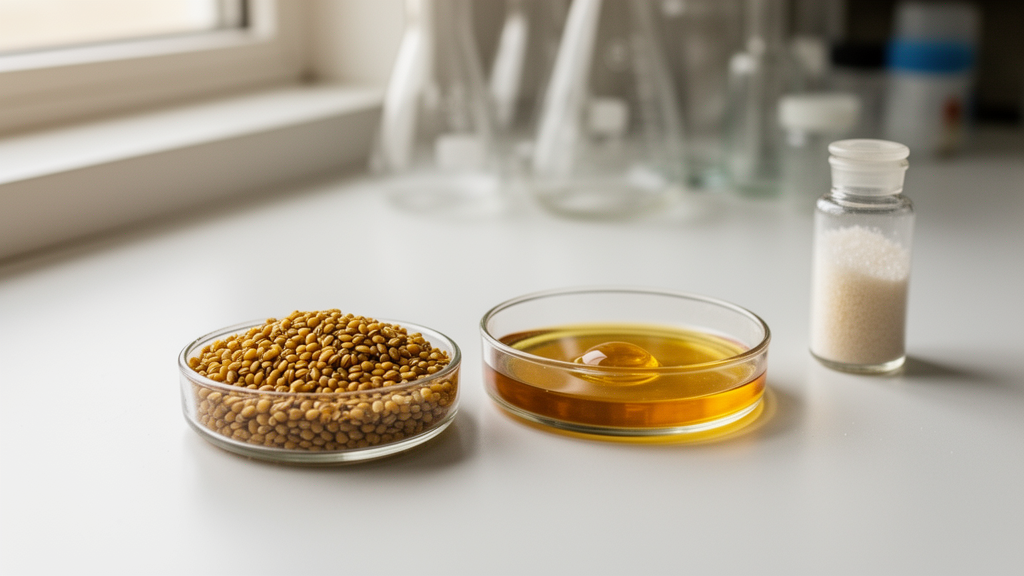
A flowering plant better known for its oil may carry a far more interesting cargo than fatty acids. In a pair of controlled animal experiments, Polish researchers report that whole camelina seeds and one of their signature compounds, the glucosinolate glucocamelinin, markedly counteracted severe fatty liver in two classic rodent models of monogenic obesity. The findings, published open access in Genes & Nutrition, point to the non-oil fraction of the seeds as the active part and to a hepatic signaling pathway involving thyroid hormone receptor beta and fibroblast growth factor 21 as a possible mechanism.
The team, led by Adam Jurgoński at the InLife Institute in Olsztyn, used obese (fa/fa) Zucker rats and obese (db/db) mice, both of which carry leptin-signaling defects that produce drastic weight gain, dyslipidemia, insulin resistance and advanced fatty liver. These animals are experimental models of monogenic obesity, and the authors deliberately avoided describing their results in clinical terms. Nevertheless, the rodent condition closely mimics metabolic dysfunction-associated steatotic liver disease, or MASLD, the condition formerly called non-alcoholic fatty liver disease, which affects an estimated 51 percent of overweight and obese adults worldwide and currently has no approved drug treatment.
The first experiment ran for five weeks on 32 female Zucker rats, divided into one lean and three obese groups of eight animals each. The lean and obese control groups received a semipurified casein diet containing rapeseed oil and palm oil as fat sources. One obese group had camelina seed oil replace palm oil, while another received ground whole camelina seeds, with the seed-derived oil content matched at four percent of the diet and all diets balanced for protein, fat and fiber. This design let the researchers directly test the oil fraction and, by comparison, indirectly assess the non-oil fraction, which contains fiber, protein and glucosinolates.
The results were striking. Rats fed whole camelina seeds showed counteracted liver hypertrophy and steatosis, confirmed both by macroscopic and histological images and by a several-fold lower hepatic content of total fat, triglycerides and cholesterol, each significant at p < 0.01. Histology revealed numerous lipid droplets in the hepatocytes of obese control rats and of rats given camelina oil, while seeds largely prevented their appearance. Blood biochemistry backed this up: alanine transaminase and alkaline phosphatase activities, along with total bilirubin and bile acid concentrations, were lower in the seed-fed group. Crucially, camelina seed oil alone did not significantly affect fatty liver or liver function, indicating that the non-oil fraction drove all the observed benefits.
Neither the seeds nor the oil changed food intake or body weight, so the effects were not a product of reduced obesity itself. The seeds did reduce putrefaction in the cecum, lowering ammonia and the branched short-chain fatty acids isobutyrate and isovalerate, which derive from amino acid catabolism by gut bacteria. But the major fiber-derived short-chain fatty acids, acetate, propionate and butyrate, were unchanged, ruling out a simple fiber-fermentation explanation and sharpening the focus on glucosinolates, sulfur- and nitrogen-containing plant metabolites characteristic of the Brassicaceae family, of which camelina seeds contain a high amount, roughly 65 percent of them glucocamelinin.
To test that hypothesis, the researchers ran a second five-week experiment on 15 female mice, five lean db/+ controls and ten obese db/db animals, the latter split into an obese control group and a group receiving daily oral glucocamelinin by gavage at a dose matched to the glucosinolate intake of the seed-fed rats. Oral glucocamelinin attenuated liver hypertrophy and steatosis, again confirmed by imaging and by considerably lower hepatic total fat (p < 0.05) and cholesterol (p < 0.01) contents, though the effect was slightly less pronounced than with whole seeds, possibly because of the once-daily dosing route or the absence of other bioactive seed components.
The mechanistic thread running through both experiments was gene expression. In rats fed camelina seeds, hepatic mRNA of Thrb, encoding thyroid hormone receptor beta, was upregulated more than twofold, and Thrb levels negatively correlated with liver fat percentage (r = −0.782, p < 0.05). In mice, oral glucocamelinin likewise upregulated Thrb, with an even stronger negative correlation (r = −0.900, p < 0.05). THR-β is a nuclear receptor considered an important therapeutic target for lipid disorders, and its activation stimulates fatty acid beta-oxidation and biliary cholesterol excretion. In both species, expression of Fgf21, encoding fibroblast growth factor 21, a key metabolic regulator that reduces hepatic lipid accumulation and enhances insulin sensitivity, was also upregulated (p < 0.01 in rats and p < 0.05 in mice), supporting a proposed mechanism in which glucocamelinin activates FGF21 signaling through THR-β.
The metabolic benefits extended beyond the liver. In obese rats, camelina seeds lowered non-HDL cholesterol and counteracted elevated blood triglycerides, while in mice the cholesterol-lowering effect of glucocamelinin was even more significant. The seeds also attenuated hyperinsulinemia without altering blood glucose, a notable point because THR-β agonists under development for MASLD often disturb glucose metabolism; the authors report that glucocamelinin did not do so in their model. In the intestine, seed-fed rats showed nearly doubled mucosal sucrase activity and higher Slc5a1 expression, though glucocamelinin alone did not reproduce these changes, suggesting other seed components were responsible.
The authors are careful about limitations. Thyroid function was not assessed, a significant gap given that glucosinolate consumption can range from goitrogenic effects to protective roles in chronic disease. The mouse experiment used small groups because of limited glucocamelinin availability, no positive control drug was included, and detailed histopathological analysis of inflammation and fibrosis was not performed. The protocols, while approved by the local animal care committee in Olsztyn and conducted under EU directives and ARRIVE guidelines, were not registered in a public database, and the camelina oil used contained about three percent erucic acid, an fatty acid of potential concern at chronic high exposure.
What this study does not yet establish is any benefit for people. The interventions were tested only in female rodents with severe genetic obesity over five weeks, and the authors explicitly call for further animal studies on diet-induced obesity as well as clinical trials to verify the effects and exclude potential side effects of camelina seed components. Still, the work sharpens a plausible target: camelina seeds, occasionally cultivated in Europe and North America and rich in omega-3 alpha-linolenic acid, protein and fiber, may be worth attention both as a dietary component and as a source of bioactive glucosinolates relevant to MASLD, with glucocamelinin as the leading candidate compound.
Subject of Research: Effects of camelina seeds and the glucosinolate glucocamelinin on fatty liver in obese rodents
Article Title: Camelina seeds and their glucosinolate, glucocamelinin, counteract severe fatty liver in rodents with monogenic obesity
Article References: Jurgoński, A., Opyd, P. M., Napiórkowska, D., Fotschki, B., & Brzuzan, Ł. (2026). Camelina seeds and their glucosinolate, glucocamelinin, counteract severe fatty liver in rodents with monogenic obesity. Genes & Nutrition, 21(1), Article 19. https://doi.org/10.1186/s12263-026-00807-x
Image Credits: AI Generated
DOI: 10.1186/s12263-026-00807-x
Keywords: camelina seeds, glucocamelinin, glucosinolates, fatty liver, MASLD, monogenic obesity, Zucker rats, db/db mice, THR-β, FGF21, liver steatosis, lipid metabolism
News Source: Drew Townsend. (October 30, 2026). Camelina Seeds and Glucocamelinin Fight Severe Fatty Liver in Obese Rodents. Scienmag.



