Researchers at the California Institute of Technology have developed a method to deliver functional proteins directly into plant cells using engineered bacterial nanosyringes. The team, led by Gozde Demirer, a Clare Boothe Luce Assistant Professor of Chemical Engineering, adapted a natural injection system found in bacteria to recognize and penetrate plant cell walls and membranes. This approach allows for the direct delivery of molecular tools, such as enzymes that rearrange DNA, bypassing the need for cells to produce the proteins themselves from DNA instructions. The work, published in the journal Nature Nanotechnology, establishes a new route for bringing active molecular tools into plants, potentially supporting research across plant biology and biotechnology.
Understanding and improving plants often requires changing processes inside their cells, where proteins control growth, stress responses, and other vital tasks. However, the cell wall and membrane that protect each plant cell have remained a major obstacle to delivering these molecular tools. Existing approaches to genetic modification typically introduce DNA instructions that tell cells to make a desired protein. By delivering the protein itself, the new method reduces the chance of unwanted DNA ending up in the plant’s genome. This direct delivery could offer more control over when and where a molecular tool acts, whether the goal is a temporary change in cell behavior or a lasting change to the genome.
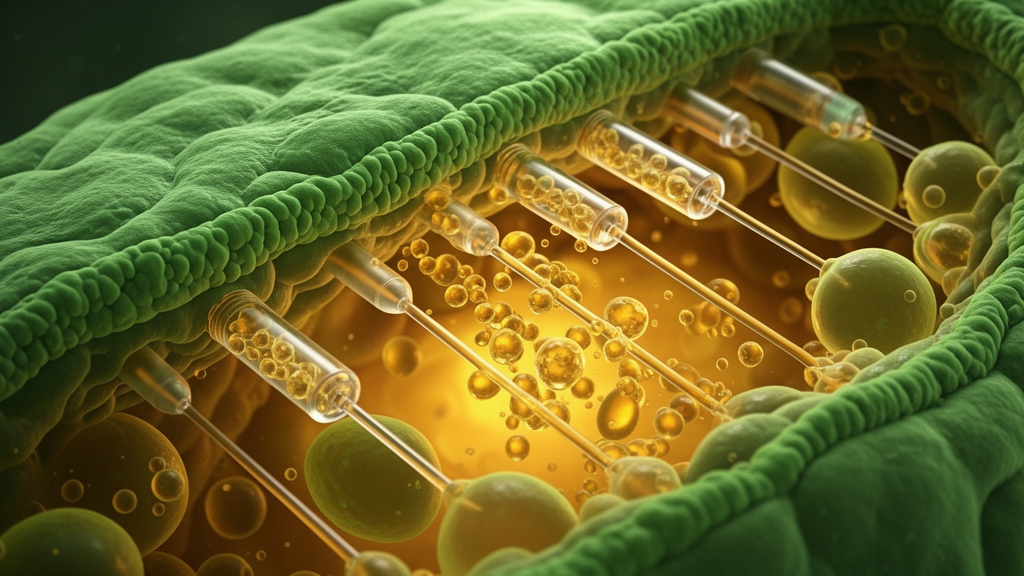
The Caltech team adapted an injection system originally found in bacteria from the genus Photorhabdus. In nature, these bacteria release tiny syringes that deliver toxins into insect cells. The bacterial tail fibers recognize and attach to a target cell, and a surrounding sheath contracts, driving an inner tube through the cell membrane. The researchers engineered this system, produced it in laboratory bacteria, and applied the purified particles to plant cells. To make the tail fibers attach to plant cells instead of insect cells, the scientists replaced their natural binding region with a short chain of amino acids called flg22.
Many plants have an immune receptor called FLS2, or FLAGELLIN SENSITIVE 2, on the surface of their cells that recognizes flg22 as a sign of bacterial infection. Displaying flg22 on the nanosyringes gave the tail fibers a molecular attachment point on plant cells. This modification allowed the engineered nanosyringes to bind to receptors on the surface of plant cells. A protective sheath then contracts, releasing active protein cargoes into the cell. The system was tested in two common laboratory plants: Arabidopsis thaliana, a small flowering plant in the mustard family, and Nicotiana benthamiana, a relative of tobacco.
Initial experiments in Arabidopsis cells with their walls removed confirmed the delivery of fluorescent proteins along with native toxin cargoes. The team then tested whether the nanosyringes could deliver active enzymes into cells within intact leaf tissue, where the cell wall remained a barrier. For these leaf experiments, the team loaded nanosyringes with Cre recombinase, an enzyme that rearranges DNA. The researchers supplied a specially designed genetic reporter that switches on a fluorescent signal when Cre acts on it. Fluorescence therefore showed that the injected enzyme was active inside the cells rather than simply attached to their surfaces.
Delivery depended on the availability of the intended receptor on the plant cell surface. When Arabidopsis plants lacked the FLS2 receptor, Cre delivery did not happen. In plants with normal, or native, receptor levels, delivery reached up to 16 percent under the tested conditions. However, when the scientists engineered plants to produce extra FLS2, about 75 percent of leaf cells lit up. This suggests that the abundance of receptors on cell surfaces can help determine how efficiently a protein reaches the cell interior. The results highlight the importance of receptor density in the efficiency of the nanosyringe delivery system.
The nanosyringes were also able to deliver a more complex genome-engineering protein called R2, which inserts genetic material at a defined location in a plant’s genome. The team supplied DNA for a fluorescent reporter gene separately. Inside the cell, R2 used an RNA copy of those instructions as a template, cutting the plant’s DNA at the target spot and writing the gene into it. After delivering R2 into Nicotiana benthamiana leaf cells, the researchers detected expression of the reporter. They confirmed that the genetic material was inserted at the desired location using molecular measurements and DNA sequencing, demonstrating the system’s capability for targeted gene insertion.
Mark G. Legendre, the lead author of the new paper and a chemical engineering graduate student in Demirer’s lab, noted that the platform still requires more development before it might be deployed in the field. He expressed confidence that the team can eventually produce the first plant transformation system with cell-targeting and multifunctional capabilities. The advance could support research across plant biology and biotechnology, with longer-term applications in crop improvement. The ability to deliver proteins directly offers a significant step in bridging the gap between breakthroughs in human medicine and the agricultural sector.
In future work, the scientists hope to adapt the delivery system to recognize other receptors and deliver proteins to specific plant cell types. That could let researchers test how a particular protein affects growth, immunity, or stress responses in one part of a plant without changing every cell. By engineering what these particles recognize and what they carry, the team is building toward delivering particular cargoes to particular cells when they are needed. This approach could allow scientists to investigate how individual cells influence plant growth and stress responses without first creating a new genetically modified plant for every experiment.
The paper is titled “An extracellular contractile injection system for receptor-mediated protein delivery into plant cells.” Additional authors are graduate students Kimberley T. Muchenje, Andrés Heredia, Clair Colee, Yunqing Wang, and alumna Virginia H. Pistilli. Support for the work came from Caltech start-up funds, the Caltech Space-Health Innovation Fund, the Henry Luce Foundation, the Shurl and Kay Curci Foundation, the National Science Foundation, Margaret McNamara Education Grants, and the Foundation for Food & Agriculture Research. The study provides a foundational step in developing precise tools for plant cell engineering.
The mechanical architecture of the delivery apparatus reflects an adaptation of an extracellular contractile injection system naturally produced by bacteria from the genus Photorhabdus. In nature, these microorganisms deploy specialized syringe-like complexes to deliver lethal toxin payloads into insect cells. To redirect this nanomachine toward plant biology, the investigators engineered the bacterial tail fiber architecture by replacing the natural binding region with a short amino acid sequence designated flg22. Many plant species express the surface receptor FLS2, or FLAGELLIN SENSITIVE 2, which typically recognizes flg22 as a molecular signature of bacterial infection. By decorating the nanosyringes with this specific peptide, the team repurposed an endogenous immune detection pathway into a synthetic docking mechanism, allowing purified particles cultured in laboratory bacteria to attach selectively to plant cellular surfaces.
Following surface docking, cargo delivery is powered by structural contraction. When tail fibers bind the target receptor, the outer sheath contracts, driving a rigid inner tube across the protective cellular barrier. In preliminary verification stages, the researchers evaluated the system in wall-less Arabidopsis thaliana cells, confirming intracellular translocation of fluorescent proteins together with native bacterial toxin cargoes. Progressing from wall-less cells to intact vegetative tissue represented a critical technical milestone because intact plant cell walls form a formidable barrier against exogenous proteins. To assess transport through intact leaf tissue, the team packaged the nanosyringes with Cre recombinase, a specialized enzyme responsible for rearranging targeted DNA segments within host genomes.
To confirm that the translocated enzymes remained biologically active inside intact leaf cells, the team coupled the delivery process with a genetic reporter based on yellow fluorescent protein, or YFP. Under this experimental arrangement, the reporter gene emits a fluorescent signal only after Cre recombinase successfully acts on it, verifying that the delivered enzyme reached the interior in a functional state rather than adhering nonspecifically to outer surfaces. The efficiency of this molecular transfer depended strictly on the abundance of target receptors. In mutant Arabidopsis plants deficient in FLS2, Cre delivery failed entirely. In plants exhibiting native receptor levels, delivery was observed in up to 16 percent of leaf cells under the tested experimental parameters. Furthermore, in plants genetically modified to express elevated quantities of FLS2, approximately 75 percent of cells displayed reporter activation, demonstrating that receptor density on cell membranes governs the overall efficiency of payload delivery.
The platform also accommodated more sophisticated genomic manipulation through the delivery of R2, a specialized protein designed for targeted gene insertion. In these trials involving Nicotiana benthamiana leaves, the team administered DNA encoding a fluorescent reporter gene separately from the nanosyringes. Inside recipient leaf cells, R2 utilized an RNA copy of these provided instructions as a template, cleaving the host DNA at the designated site and inserting the reporter gene directly into the locus. The researchers subsequently detected reporter expression and validated accurate targeted insertion through molecular measurements and DNA sequencing. By delivering catalytic proteins directly rather than introducing DNA instructions that force cells to synthesize them, this extracellular injection method avoids the unintended insertion of unwanted foreign DNA into the host genome. This modular strategy lays the groundwork for transient cellular modifications or targeted genome editing across distinct plant tissues without requiring permanent whole-plant genetic transformation.
Subject of Research: Engineered bacterial nanosyringes for protein delivery into plant cells
Article Title: Engineered nanosyringes open a new route into plant cells
Article References: Engineered nanosyringes open a new route into plant cells. Original publication (Bibliographic details unavailable.)
Image Credits: AI Generated
DOI: Not provided
Keywords: Caltech, nanosyringes, plant cells, protein delivery, Nature Nanotechnology, Gozde Demirer, Mark G. Legendre, Cre recombinase, FLS2 receptor, Arabidopsis thaliana, Nicotiana benthamiana, genome engineering, R2 protein, bacterial injection, crop improvement, cell wall, molecular tools, fluorescent reporter, DNA rearrangement, targeted gene insertion
News Source: Denise Maddox. (November 20, 2026). Caltech nanosyringes inject enzymes into plant cells. Scienmag.