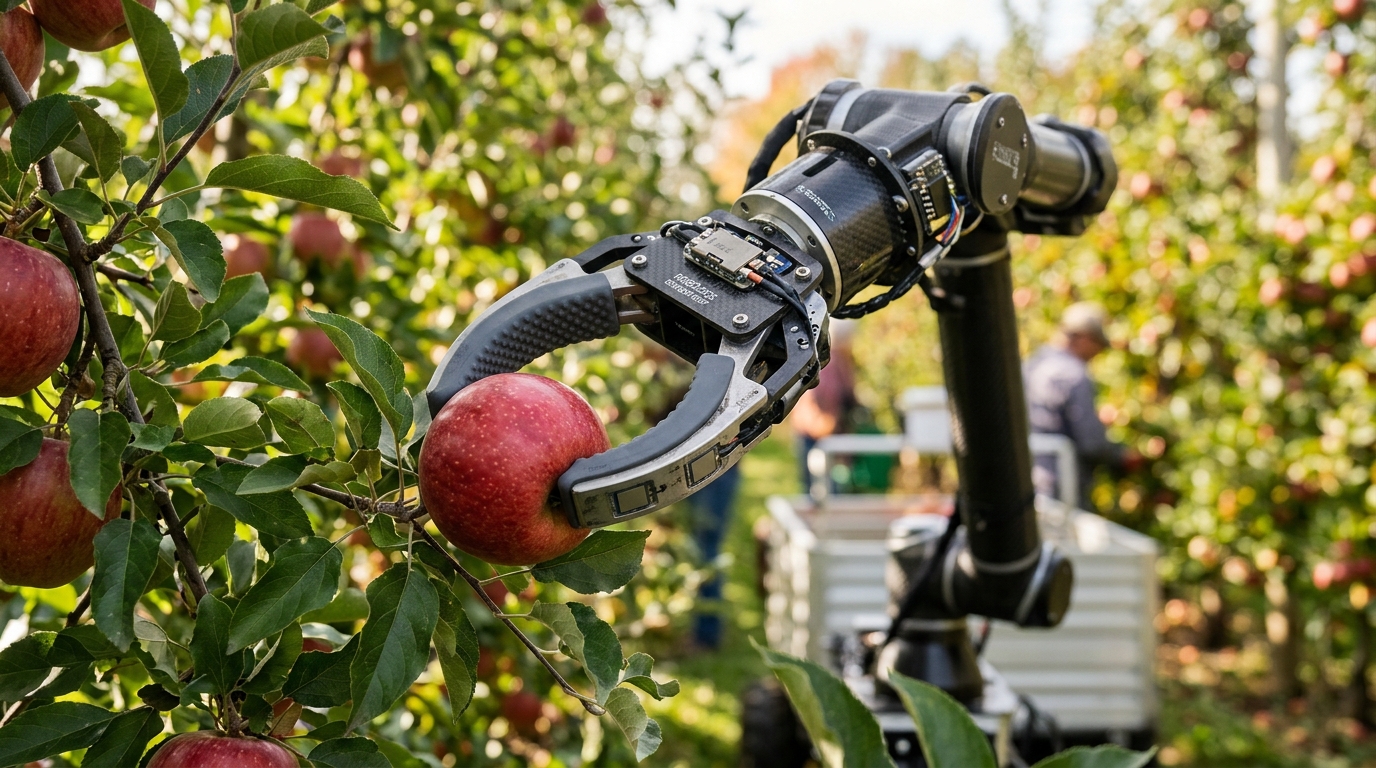
Agricultural engineers have established a high-precision biomechanical framework that combines three-dimensional morphological scanning, the Drucker-Prager constitutive model, and response surface methodology to predict compressive damage and robotic grasping forces across multiple apple cultivars. Modern dwarf-rootstock dense-planting orchard systems have substantially improved machinery mobility, yet automated robotic pickers continue to face severe operational bottlenecks due to fruit bruising. Field observations indicate that damage rates from mechanical end-effectors are frequently more than thirty percent higher than those associated with traditional manual picking. Because previous engineering efforts relied heavily on empirical trial-and-error parameter selection and overly simplified linear-elastic assumptions that neglected the pressure-sensitive porous behavior of apple flesh, developing accurate constitutive models has become essential for establishing non-destructive harvesting thresholds.
To capture realistic geometric morphology and account for cultivar-dependent variability, the research team examined three commercially significant cultivars from the apple experimental base of Northwest A&F University: Ruixue, Qincui, and Fuji. Ten undamaged specimens of each variety were measured for physical properties, showing average fruit masses of 200 grams for Qincui, 214 grams for Ruixue, and 220 grams for Fuji, with corresponding average equatorial diameters of 75, 77, and 79 millimeters, and heights of 67, 69, and 68 millimeters. The researchers scanned fruit surfaces using a HandySCAN 3D scanner operating at a spatial resolution of 0.025 millimeters. The resulting point cloud geometries were processed in Geomagic Studio to resolve stem-depression topological defects and smooth surface noise, yielding reconstructed surface models comprising 11,310 triangular facets for Qincui, 11,498 for Ruixue, and 11,754 for Fuji before conversion into solid volumetric representations in SpaceClaim.
The structural geometry was transferred into finite element simulation software, where solid bodies were discretized using approximately 252,811 four-node linear tetrahedral elements alongside four-node linear quadrilateral shell elements for compression plates, applying automatic curvature-based mesh refinement around high-stress contact zones. The flesh of the fruit was characterized as a biological porous material governed by the Drucker-Prager elastoplastic constitutive model under a perfect-plasticity assumption. In this formulation, internal friction angle macroscopically quantifies the hydrostatic-pressure sensitivity of the shear yield surface, reflecting intercellular sliding, mechanical interlocking, and lateral cellular constraints within porous fibrous parenchyma tissue. To represent macroscopic post-peak softening and crack progression without violating plastic rules, the team implemented a decoupled Abaqus damage initiation and evolution module that progressively degrades element stiffness and removes fully damaged elements.
Accurate boundary definitions also required determining precise interface interaction parameters between fruit skin and mechanical gripper materials. Using an MXD-01 friction tester, the authors performed three repeated measurements at a displacement speed of 100 millimeters per minute to evaluate static and kinetic friction coefficients against polyethylene terephthalate glycol, industrial rubber, and structural steel. For Qincui, static and kinetic friction coefficients averaged 0.627 and 0.298 against polyethylene terephthalate glycol, 0.528 and 0.183 against rubber, and 0.455 and 0.253 against steel. For Ruixue, corresponding static and kinetic values were 0.483 and 0.304 for polyethylene terephthalate glycol, 0.434 and 0.161 for rubber, and 0.428 and 0.262 for steel. For Fuji, average static and kinetic coefficients were 0.574 and 0.278 with polyethylene terephthalate glycol, 0.484 and 0.148 with rubber, and 0.373 and 0.228 with steel, confirming that rubber provides intermediate friction without generating excessive local tangential shear.
To observe experimental damage progression and establish baseline calibration data, the authors conducted quasi-static uniaxial compression tests on ten specimens of each cultivar using a universal testing machine driven at a constant downward rate of 20 millimeters per minute over a 60-second duration. The physical deformation followed five consecutive stages: initial non-destructive contact, linear elastic deformation from 0 to 10 millimeters of displacement, yield initiation accompanied by localized skin microcracking between 12 and 14 millimeters, peak loading near 15 millimeters displacement, and subsequent crushing characterized by tissue extrusion and structural collapse. Fuji exhibited the greatest initial stiffness and highest median peak resistance of 1216 Newtons, with extreme individual values reaching 1564 Newtons, followed by Qincui with an extreme load reaching 1669 Newtons alongside substantial sample dispersion, whereas Ruixue exhibited lower, more tightly clustered peak loads.
Cultivar microstructures produced distinct macroscopic failure patterns during compression. Ruixue demonstrated tough, ductile crushing characterized by tortuous, irregular serrated rupture lines that slowly propagated through parenchyma tissue, absorbing strain energy and yielding a gentle post-peak load decay. Conversely, Qincui displayed pronounced brittle failure, generating straight, deep macroscopic cracks that initiated suddenly near the equator beyond 6.6 millimeters of displacement and rapidly cleaved through the flesh along principal stress trajectories, producing neat fracture surfaces and steep force reduction. Fuji displayed an intermediate ductile-crushing response marked by dense surface wrinkles appearing beyond 7.7 millimeters of displacement, progressive microscopic yielding, and disordered microcrack networks that gradually collapsed the internal cellular skeleton, confirming that cellular wall cohesion and tissue porosity govern macroscopic failure mechanics.
Numerical compression simulations conducted using dynamic-explicit integration successfully replicated macroscopic loading phases but revealed notable configuration discrepancies compared to physical test records. While experimental curves exhibited unimodal profiles that steadily decayed after peak resistance, the uncalibrated homogeneous simulation produced bimodal load curves, displaying an initial peel-damage drop near 4.2 millimeters followed by a secondary load rise that reached global peaks near 9.2 millimeters displacement. The researchers attributed this secondary stiffening artifact to the idealized continuum formulation and homogeneous elastoplastic model, which cannot reproduce cellular collapse, internal moisture migration, and viscoelastic fluid dissipation. Furthermore, standardized planar contact conditions in Abaqus lacked the natural eccentricity, localized surface wrinkles, and irregular contours present in real biological specimens.
To systematically calibrate the dominant constitutive variables governing load-displacement behavior, the investigators implemented a three-factor, three-level Box-Behnken response surface design using Design-Expert software. Preliminary parametric sweeps defined evaluation ranges for fracture strain between 0.24 and 0.80, yield stress between 0.23 and 0.34 megapascals, and internal friction angle between 53.0 and 70.46 degrees. Seventeen simulation runs yielded a quadratic polynomial regression equation predicting fracturing load with an adjusted determination coefficient of 0.9497 and a predicted determination coefficient of 0.8111. Variance analysis indicated that model factors influenced peak fracturing load in descending order of yield stress, internal friction angle, and fracture strain, with all three main effects demonstrating high statistical significance. Furthermore, a highly significant interaction was detected between internal friction angle and fracture strain, reflecting how internal friction suppresses shear sliding between adjacent parenchyma cells and delays crack propagation.
Multi-objective optimization targeting the maximum simulated response of 1855.89 Newtons identified an optimal constitutive parameter combination for Fuji apples comprising a fracture strain of 0.569, a yield stress of 0.340 megapascals, and an internal friction angle of 62.797 degrees. Brittle Qincui was calibrated with approximate parameters of 0.52 fracture strain, 0.32 megapascals yield stress, and a 65.0-degree friction angle, whereas tough Ruixue settled near 0.58 fracture strain, 0.31 megapascals yield stress, and a 58.5-degree friction angle. Substituting these calibrated parameters back into full finite element compression models reduced relative peak-load errors compared to physical testing to 4.5 percent for Fuji, 6.8 percent for Qincui, and 4.2 percent for Ruixue. Stress cloud contours demonstrated that maximum von Mises stresses concentrated directly beneath the contact indenter, forming an internal conical stress concentration that accurately reproduced the localized tissue collapse observed experimentally.
The researchers subsequently tested the cross-condition generalizability of the calibrated constitutive framework by modeling robotic arm flexible grasping under dynamic explicit conditions over a 0.2-second duration. A mechanical gripper applied a 1-millimeter inward radial displacement to simulate grasping contact against fruit models assigned identical constitutive parameters. The simulated grasping interaction progressed through four distinct mechanical regimes: unbent posture, initial root-hinge bending between 0.04 and 0.09 seconds, moderate contour conformability from 0.14 to 0.15 seconds, and maximum beam bending at 0.2 seconds. The finite element simulation predicted peak contact forces of 3.38 Newtons for Qincui, 3.59 Newtons for Ruixue, and 4.01 Newtons for Fuji. Experimental bench testing using thin-film pressure sensors mounted on flexible gripper fingers recorded corresponding physical peak contact forces of 3.26 Newtons, 3.29 Newtons, and 3.87 Newtons, demonstrating close agreement with relative simulation errors of 3.55 percent, 8.36 percent, and 3.49 percent, respectively.
From an end-effector engineering perspective, the numerical and experimental results provide quantitative guidelines for designing compliant fruit grippers. Because structural steel promotes severe local stress concentrations and polyethylene terephthalate glycol exhibits elevated friction that increases surface scuffing risks, rubber was identified as the optimal contact lining due to its moderate friction and uniform stress distribution. Given that the simulated equivalent contact diameter during gripping stabilized between 12 and 15 millimeters, the authors recommend that flexible gripper finger surfaces incorporate an internal radius of curvature between 35 and 45 millimeters to closely match equatorial fruit curvature and minimize localized bruising risks.
The authors explicitly emphasized that the reported peak contact forces represent model-predicted reference values under prescribed 1-millimeter displacement constraints rather than universal biological failure limits. Several operational boundaries restrict the direct extrapolation of these findings to unstructured orchard environments. The calibrated constitutive parameters are valid strictly for commercially mature fruit tested at room temperatures between 20 and 24 degrees Celsius under quasi-static loading rates not exceeding 5 millimeters per minute. Real-world picking operations involve dynamic branch vibrations, variable harvest postures, fruit maturity gradients, and viscoelastic stress relaxation that were omitted from the idealized, homogenized continuum model. Future investigations must incorporate maturity-dependent biomechanical parameters and transient dynamic impact simulations to refine automated force-control algorithms for commercial harvesting machinery.
Subject of Research: Biomechanical modeling and finite element prediction of robotic apple harvesting forces
Article Title: Construction of apple mechanical characteristics model and prediction of picking and grasping forces based on drucker-prager constitutive model
Article References: Yang, C., Zhang, L., Wan, J., Chen, G., Yang, F., & Liu, Z. (2026). Construction of apple mechanical characteristics model and prediction of picking and grasping forces based on drucker-prager constitutive model. Results in Engineering, 32, Article 114085. https://doi.org/10.1016/j.rineng.2026.114085
Image Credits: AI Generated
DOI: 10.1016/j.rineng.2026.114085
Keywords: Drucker-Prager model, robotic harvesting, apple mechanics, finite element analysis, response surface methodology, Box-Behnken design, Fuji apple, Qincui apple, Ruixue apple, uniaxial compression, gripping force, fruit bruising, Abaqus simulation, contact mechanics, friction coefficient, agricultural robotics, failure strain, yield stress
News Source: Denise Maddox. (November 18, 2026). Calibrated Drucker-Prager Model Accurately Predicts Robotic Apple Harvesting Forces. Scienmag.