


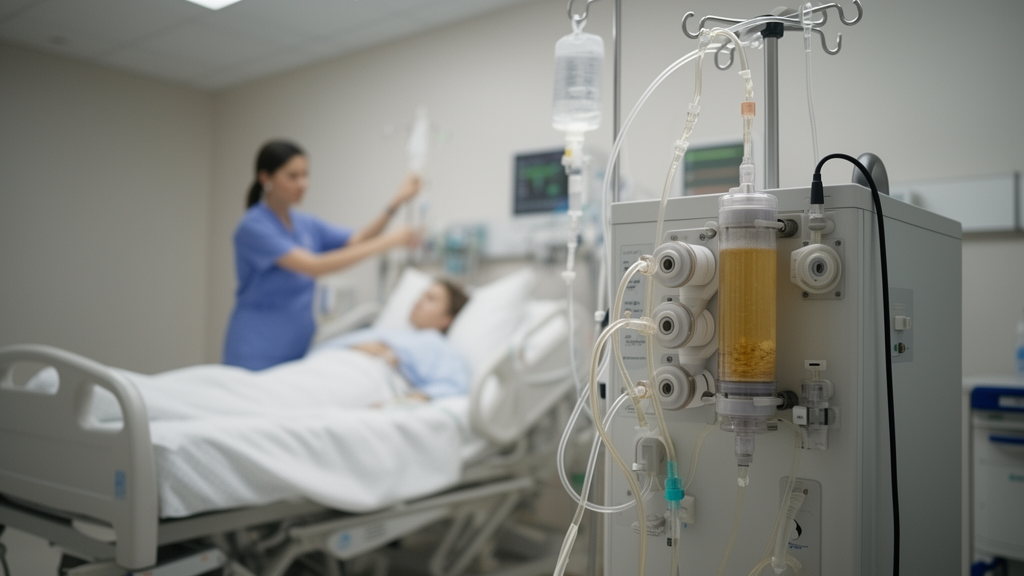
In a retrospective single-center observational study published in the European Journal of Medical Research, Can Colakoglu and colleagues analyzed 14 adults treated with continuous venovenous hemodiafiltration using calcium-free predilution, a real-world approach reserved for situations where standard anticoagulation is unsafe or cannot be operationalized.
The cohort accumulated 525 CRRT-hours in total. Twelve of the treatments lasted at least 16 hours, the threshold the researchers prespecified for their descriptive circuit-performance analysis, and the median CRRT duration reached 36 hours, with an interquartile range of 25 to 57 hours. Only three clotting events occurred across the entire experience, corresponding to 0.57 clotting events per 100 CRRT-hours. Eleven of the 14 treatments, or 78.6 percent, were completed without documented filter clotting, a circuit-performance profile the authors describe as acceptable despite the complete absence of dedicated circuit anticoagulation.
Maintaining circuit patency without heparin or regional citrate anticoagulation remains one of the persistent practical challenges in nephrocritical care. The calcium-free predilution approach evaluated here replaces citrate-based anticoagulation with a calcium-free replacement fluid delivered before the filter, an arrangement the authors frame explicitly as a rescue strategy rather than a replacement for regional citrate anticoagulation.
The metabolic implications of running CRRT without citrate were a central focus of the safety assessment. The researchers abstracted serial acid-base and ionized calcium measurements alongside the circuit data. Although baseline metabolic derangement in these patients was substantial, the study reports that serial ionized calcium and acid-base abnormalities remained clinically manageable with selective supplementation. No treatment in the cohort had to be discontinued because of uncontrolled hypocalcemia or metabolic toxicity, an outcome the authors present as evidence that the metabolic side of the strategy could be supervised safely in this setting.
The authors are careful about the limits of what this experience shows. The study was retrospective, conducted at a single center, and included only 14 critically ill adults, so the findings establish feasibility and acceptable circuit performance in a small high-risk cohort rather than comparative superiority over any anticoagulation standard. The abstract notes that the analysis was descriptive and prespecified around treatments of at least 16 hours, and the conclusion emphasizes that the approach should be viewed as an option when standard anticoagulation cannot be used or operationalized. Within those boundaries, the reported numbers, 525 CRRT-hours, a 36-hour median treatment duration, and fewer than one clotting event per 100 hours of therapy, offer a concrete real-world data point for intensive care teams confronting the recurring problem of circuit clotting in patients who cannot receive conventional anticoagulation.
Subject of Research: Calcium-free predilution as a rescue strategy for preserving CRRT circuit patency without routine anticoagulation in critically ill adults
Article Title: Calcium-free predilution for circuit preservation during CRRT without routine anticoagulation: a retrospective single-center ICU experience
Article References: Colakoglu, C. (2026). Calcium-free predilution for circuit preservation during CRRT without routine anticoagulation: a retrospective single-center ICU experience. European Journal of Medical Research. https://doi.org/10.1186/s40001-026-05354-0
Image Credits: AI Generated
DOI: 10.1186/s40001-026-05354-0
Keywords: CRRT, calcium-free predilution, continuous renal replacement therapy, circuit clotting, regional citrate anticoagulation, intensive care, critically ill adults, hemodiafiltration, hypocalcemia, retrospective study, filter patency, anticoagulation
News Source: Ophelia Keating. (October 29, 2026). Calcium-Free Predilution Keeps CRRT Circuits Open Without Anticoagulation. Scienmag.



