Modern aircraft, high-speed trains and electric vehicles face a stubborn materials dilemma: the structures that protect passengers in a crash are heavy, the coatings that hide them from radar are layered on top, and the foams that quiet engine drone add yet more bulk. Engineers have long managed these three demands with an inefficient sandwich of a thick metal frame, radar-absorbing coatings and acoustic foam panels. The stack consumes interior space, adds dead weight that burns excess fuel, and tends to peel apart over time as adhesive lines fatigue under repeated flight stresses.
Now a team led by Prof. Longqiu Li at the Harbin Institute of Technology reports in the International Journal of Extreme Manufacturing a way to eliminate the glue entirely. The researchers engineered an all-in-one printed metamaterial just 24 millimeters thick that carries immense weight, swallows microwave signals and hushes low-frequency noise. The design, described as a bioinspired hierarchical lattice trifunctional metamaterial, integrates mechanical, electromagnetic and acoustic functionality within a single printed architecture rather than a multi-material assembly.
The underlying bottleneck comes down to a conflict between air and mass. Absorbing sound waves and matching electromagnetic impedance, the property that lets radar slip into a material instead of ricocheting off its surface, demands high porosity and generous empty interior space. But the moment a panel is honeycombed with holes to soak up noise, its load-bearing backbone collapses under pressure. Conversely, beefing up a material with solid walls produces a rigid shield that reflects incoming sound like a concrete wall and bounces radar like a mirror. Decades of materials design have wrestled with this triple trade-off.
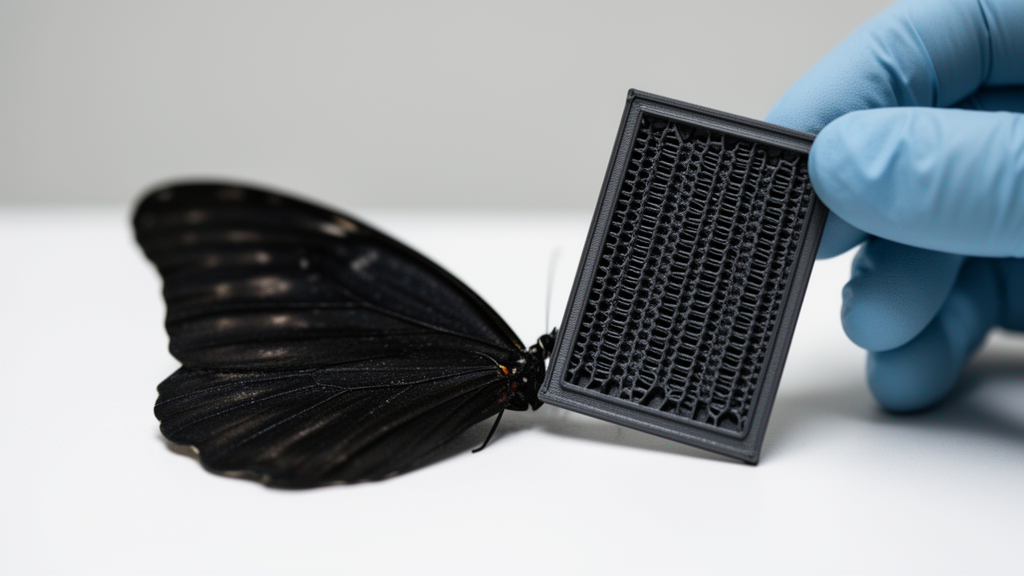
Nature, the researchers note, resolved the same dilemma millions of years ago in the delicate wings of butterflies and moths. To survive in a world of agile predators and bat sonar, lepidopteran insects evolved microscopic scale architectures that manage optical color, deaden high-frequency sound and remain featherlight without snapping mid-flight. Taking a cue from these intricate insect scales, Li’s team designed a hierarchical architecture that nests two different geometries inside one another. They began with a classic hexagonal honeycomb frame, but instead of molding the internal walls from solid plastic, they hollowed them out with a gyroid lattice, a continuous, curving three-dimensional maze that resembles the porous channels of a sea sponge.
The nested layout behaves like a multidisciplinary toolkit. Under sudden compression, ordinary honeycombs fail catastrophically at their sharp internal corners, where stress concentrates. In the bioinspired lattice, the smoothly arching gyroid pathways distribute force evenly across the surface, turning a brittle snap into an orderly, cushion-like crumple. In bench testing, this deformation mode absorbed 21.9 times more impact energy than a standard honeycomb of identical weight, a measured comparison that underscores how much performance the geometry alone contributes.
The electromagnetic function comes from chemistry as well as geometry. The team infused the interior gyroid sponge with a microscopic slurry of conductive carbon nanotubes and carbon black. Incoming radar waves enter the central cavity and plunge into the conductive maze, bouncing hundreds of times across internal surfaces until micro-currents convert the electromagnetic energy into harmless trace heat. Across a wide 2 to 40 GHz spectrum, the lattice swallows more than 90 percent of incoming wave power over 93.5 percent of that band, figures the authors report as measured absorption performance.
The acoustic function relies on a different trick. The researchers capped each cell with a tiny perforated lid, transforming the chamber into an acoustic resonator. When sound waves strike the surface, vibrating air plunges down the neck and drags against the intricate gyroid matrix inside, exhausting its energy through thermoviscous friction, the drag that arises as air molecules rub against channel walls. The result is an acoustic trap that captures 90 percent of sound energy in the persistent 600 to 900 Hz drone zone typical of commercial turboprop cabins, one of the hardest frequency ranges to silence with thin panels.
The everyday scale of the demonstration is striking. In one bench test, a 74-gram sample was placed directly under the tire of a 1,750-kilogram family car, comfortably supporting a 438-kilogram corner load without cracking. In acoustic tests, the material dropped an 88.5 dB screech down to a 45.1 dB hum, a reduction the team compares to quieting an approaching diesel truck to a hushed library whisper. Crucially, the metamaterial performs the job of conventional multi-material stacks at just 36.9 percent of their traditional thickness, shaving away nearly two-thirds of the required bulk.
To help factory engineers tailor these panels to specific frequency ranges without waiting days for complex acoustic simulations, the authors designed a physics-based neural network built on Kolmogorov-Arnold representations. The model computes custom panel layouts in a fraction of a second while using 91 percent fewer parameters than a standard artificial neural network, offering a practical route to tuning the resonator geometry for particular engine noise signatures or radar bands before any panel is printed.
For manufacturers, the single-piece design offers a direct pathway to ditching vulnerable glue lines and consolidating assembly lines into single-step additive manufacturing runs. The researchers caution that significant work remains before the tiles reach passenger airliners or electric cars: the fabrication process must be adapted from photosensitive resin printing to flight-grade carbon polymers and lightweight aluminum, and fatigue tests must confirm that the porous gyroid pores endure decades of non-stop flight vibration. Until then, the 24-millimeter lattice stands as a laboratory demonstration that a geometry borrowed from butterfly wings can carry weight, hide from radar and hush engine drone at once, dismantling a physical bottleneck that has thwarted materials designers for decades.
Subject of Research: Bioinspired hierarchical lattice metamaterial integrating mechanical, electromagnetic and acoustic performance
Article Title: Lepidopteran insect wings or lepidopteran scales geometry solves a triple trade-off in flight materials
Article References: Lepidopteran insect wings or lepidopteran scales geometry solves a triple trade-off in flight materials. Original publication (Bibliographic details unavailable.)
Image Credits: AI Generated
DOI: Not provided
Keywords: metamaterials, additive manufacturing, bioinspired design, lepidopteran scales, gyroid lattice, radar absorption, acoustic resonators, honeycomb structures, carbon nanotubes, Kolmogorov-Arnold networks, International Journal of Extreme Manufacturing, Harbin Institute of Technology
News Source: Denise Maddox. (October 25, 2026). Butterfly wing-inspired printed metamaterial absorbs impacts, radar and noise. Scienmag.