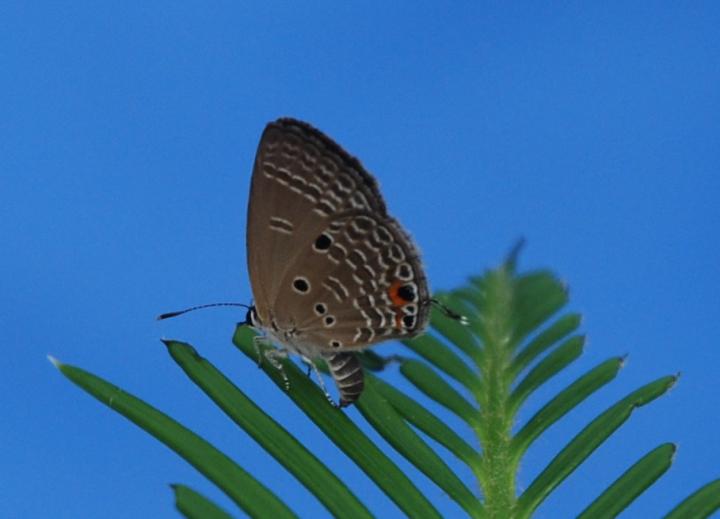

Credit: Thomas Marler
Plants communicate with animals using a blend of signals that influence animal behavior. The balance of plant attractants and deterrents partly determine the ultimate level of damage that an animal herbivore imposes on a plant. These intricate communications between the herbivore and the plant support sustainable relationships in their mutual native homelands. However, the ease of international travel in today's connected world has led to invasive alien arthropod herbivores showing up in many novel locations containing alternative host plants.
Plants that are subjected to the attacks of alien herbivores often find themselves at a disadvantage, without the communication skills needed to constrain the herbivory below sustainable levels. Guam-based Thomas Marler, Thailand-based Anders Lindström, and Philippines-based Paris Marler recently studied these phenomena for the relationship between the butterfly Chilades pandava and several Cycas host species. The experimental results appeared in the August 2016 issue of the international journal Plant Signaling & Behavior.
The authors offered gravid female butterfly adults a choice between the expanding leaves of two Cycas species for each test. The test was conducted with a wild population of the butterfly that fed exclusively on its single host Cycas nongnoochiae. The choice was comprised of a Cycas species that exhibited minimal herbivory in a common garden setting versus a Cycas species that exhibited extreme damage by the butterfly larvae. Under these conditions, the adult females preferentially selected the leaves from Cycas species that are vulnerable to the larvae herbivory over the leaves from Cycas species that are less damaged. This preferential selection resulted in a greater number eggs being deposited on leaves of the vulnerable Cycas species.
Thinking that these clear results pointed to one of the means by which the butterfly causes more damage to the vulnerable Cycas species, the authors expanded the research to include three other butterfly populations. Populations from a botanic garden setting in Thailand, an urban setting in the Philippines, and the island of Guam provided gravid female adults from populations that were highly experienced with a range of Cycas species. In all three cases, the mothers were unable to distinguish between the two choices and deposited similar numbers of eggs on the two leaves.
Invasions that force two organisms to interact when no evolutionary pressures provided them the skills to sustainably cooperate may lead to unexpected results. This case study revealed an example where the wild-collected butterfly herbivore was highly skilled at discriminating among a range of Cycas species, thereby selecting the best food supply for the offspring. This skill set was lost in the populations of the butterfly that experienced novel Cycas species over time.
The 114 described Cycas species are among the most threatened plants worldwide. The insular species are especially vulnerable to invasions of herbivores such as Chilades pandava. This research outcome provides an example of the kinds of information that conservationists utilize when formulating plans to mitigate the threats.
###
Media Contact
Olympia Terral
[email protected]
http://www.uog.edu
############
Story Source: Materials provided by Scienmag