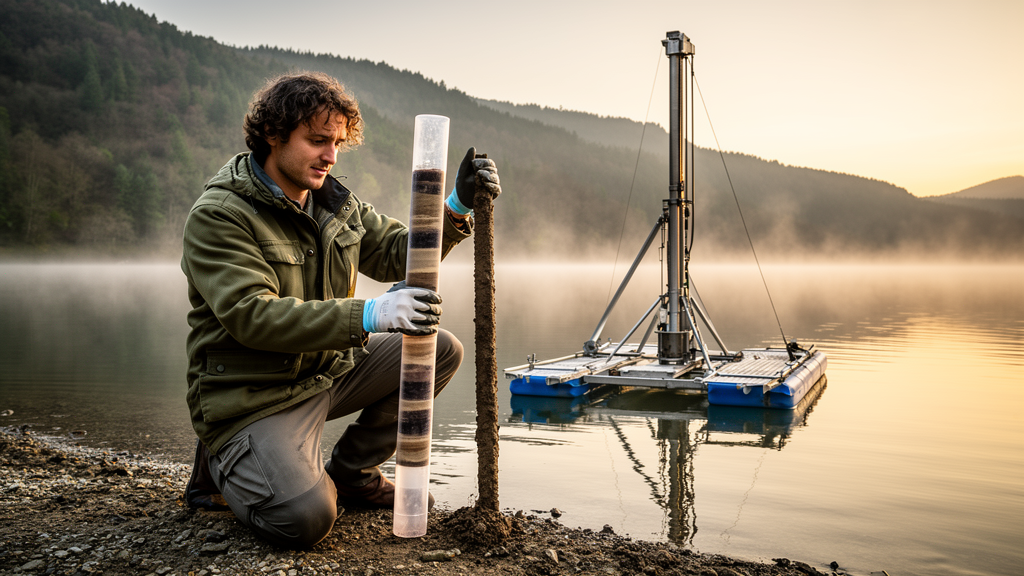
Beneath the rolling farmland of the Fucino Plain in central Italy lies what scientists believe may be the most valuable climate archive in the entire Mediterranean region: a continuous sequence of lake sediments stretching back at least 3.5 million years, and potentially to the dawn of the Pliocene epoch some 5 million years ago. In October 2023, an international team of Earth scientists gathered in the small town of Gioia dei Marsi to assess whether this buried treasure justifies one of the most ambitious continental drilling projects ever proposed in Europe. The verdict, published in the journal Scientific Drilling, was emphatic: the Fucino Basin fulfils every requirement needed to become the longest, most precisely dated terrestrial record of Earth’s climate system ever recovered.
The workshop, supported by the International Continental Scientific Drilling Program (ICDP), brought together 42 researchers from 14 countries and 32 institutions under the banner of a project known as MEME, short for the longest continuous terrestrial archive in the MEditerranean recording the last 5 Million years of Earth system history. Their goal was to evaluate existing seismic, geochronological, and paleoenvironmental data from the basin and to define the scientific and technical blueprint for a full deep-drilling proposal. Over five days of presentations, field excursions, and heated discussion, the participants converged on a shared conviction that Fucino offers something no other site on land can match.
The scientific motivation is rooted in one of the great gaps in climate science. Much of what humanity knows about the last 5 million years of Earth’s climate history comes from marine sediments and, for the most recent 800,000 years, polar ice cores. These archives have revealed the grand narrative: the warm Pliocene world giving way to the icy Pleistocene, the intensification of Northern Hemisphere glaciation, and the puzzling shift from 41,000-year glacial cycles to the 100,000-year rhythm that dominated the later ice ages. But marine records depend heavily on astronomical tuning for their chronology and largely lack independent radiometric dates, while ice cores are confined to the polar regions and the most recent portion of the record. The terrestrial dimension, where ecosystems, biodiversity, and human ancestors actually lived, remains strikingly underdocumented.
The Pliocene is a particularly tantalizing target. During the mid-Pliocene Warm Period, between roughly 3.26 and 3.02 million years ago, global mean temperatures stood 2 to 3 degrees Celsius above pre-industrial levels, peaking perhaps 4 degrees higher, with atmospheric carbon dioxide concentrations between 350 and 550 parts per million and sea levels likely 12 to 20 metres above today’s. In other words, the Pliocene offers a natural analogue for the world that current anthropogenic warming is rapidly creating. Understanding how terrestrial environments and biodiversity responded to that warmth, and to the dramatic cooling that followed, is essential for anticipating the consequences of modern climate change in the densely populated Mediterranean region.
What makes the Fucino Basin exceptional is a rare combination of geological circumstances. The basin is a tectonic depression at about 650 metres above sea level, ringed by the highest peaks of the central Apennines and formed by active normal fault systems, most notably the San Benedetto-Gioia dei Marsi fault, which generated the devastating magnitude 7.0 earthquake of January 1915 that killed some 33,000 people. Seismic reflection profiles reveal a classic half-graben geometry, a wedge-shaped sedimentary fill that thickens eastward toward the master fault, reaching an estimated 900 to 1,000 metres in the depocentre. Crucially, the youngest seismic sequence shows no significant internal deformation or unconformities, suggesting an unbroken story of sediment accumulation from the Early Pliocene through historical times, when the basin still hosted the large Lake Fucinus before its drainage was completed in the late nineteenth century.
The second ingredient is volcanism. The basin sits just 100 to 150 kilometres from the ultra-potassic volcanic centres of the peri-Tyrrhenian region, and every major eruption scattered ash across the ancient lake, where it settled into the mud as distinct tephra layers. Preliminary drilling campaigns have already demonstrated the extraordinary richness of this record: a composite 98-metre core spanning the last 430,000 years contains approximately 130 volcanic ash layers, 40 of which have been directly dated or correlated to dated eruptions using argon-40/argon-39 geochronology. This makes Fucino the most intensely and independently dated sediment record in the entire Mediterranean, a chronology built not on circular assumptions about orbital cycles but on the hard clockwork of radioactive decay in volcanic crystals.
That independent chronology is what elevates the project from impressive to transformative. Because the Fucino timescale rests on radiometric dating of tephra layers, supplemented by paleomagnetic excursions such as Laschamp and Blake and by cosmogenic nuclide markers of geomagnetic reversals, it can serve as an external calibration for other archives. The team envisions transferring the Fucino chronology to the IODP Site U1385 on the Iberian Margin, which extends back 5.3 million years, and to proposed expeditions studying the Mediterranean-Atlantic and Mediterranean-Black Sea gateways. The record could even provide a radioisotopically anchored timescale for the Antarctic ice core community as it pushes beyond the 800,000-year limit of current cores into the critical Early Middle Pleistocene Transition.
The workshop identified four candidate drilling targets exploiting the basin’s wedge-shaped architecture. MEME-1, in the central basin, would reach the base of the Quaternary infill at roughly 500 metres, capturing the most expanded and highest-resolution succession. MEME-2, further west where sedimentation rates are lower, would recover nearly the entire Pliocene-Quaternary sequence in about 600 metres. MEME-3b offers a shallower contingency at roughly 300 metres, while MEME-3a, at 200 to 300 metres on the footwall of the master fault, would serve tectonic objectives. Drilling the deepest depocentre in a single hole was judged technically risky and costly, given challenges of borehole stability and swelling clays, so the parallel-site strategy balances scientific ambition against engineering reality, using soft-sediment coring tools for the upper sections and industry-standard equipment below.
The scientific payoff would span disciplines. Pollen analyses already completed on existing cores reveal vegetation responses to abrupt climate change that closely mirror deep-sea records from the Iberian Margin, and the full record would document how Mediterranean forests, lakes, and endemic species weathered the warm Pliocene, the expansion of Northern Hemisphere ice sheets, and the reorganization of glacial cycles. The tephra archive would reconstruct the history and recurrence of explosive volcanism in Italy, including the transition from calc-alkaline to ultra-potassic magmatism and possible links between sea-level change and eruption frequency. Tectonic studies would clarify the tempo of basin opening and improve seismic hazard assessment in one of the most tectonically active regions of Europe, while post-drilling instrumentation could monitor groundwater chemistry as potential earthquake precursors and evaluate low-enthalpy geothermal resources.
The team is now assembling the full ICDP proposal, complete with detailed budgets, operations and permitting plans, and an ambitious outreach programme that includes school visits to the drill site, media releases, and training for university students from bachelor to doctoral level. If funded, the MEME project will turn a quiet Italian agricultural plain into one of the most closely scrutinized windows into Earth’s climatic past, offering the terrestrial counterpart to the great marine and ice-core archives and, perhaps, the most complete answer yet to how life on land responds when the planet’s climate undergoes its most profound transformations.
Subject of Research: Deep drilling of the Fucino paleolake sediments in central Italy to reconstruct the last 3.5 to 5 million years of terrestrial climate, ecosystem, volcanic, and tectonic history
Article Title: International Continental Scientific Drilling Program (ICDP) workshop on the Fucino paleolake project: the longest continuous terrestrial archive in the MEditerranean recording the last 5 Million years of Earth system history (MEME)
Article References: Giaccio, B., Wagner, B., Zanchetta, G., Bertini, A., Cavinato, G. P., de Franco, R., Florindo, F., Hodell, D. A., Neubauer, T. A., Nomade, S., Pereira, A., Sadori, L., Satolli, S., Tzedakis, P. C., Albert, P., Boncio, P., De Jonge, C., Francke, A., Heim, C., … the MEME team (2024). International Continental Scientific Drilling Program (ICDP) workshop on the Fucino paleolake project: the longest continuous terrestrial archive in the MEditerranean recording the last 5 Million years of Earth system history (MEME). Scientific Drilling, 33(2), 249-266. https://doi.org/10.5194/sd-33-249-2024
Image Credits: AI Generated
Keywords: Fucino Basin, ICDP, paleoclimate, lake sediments, tephrochronology, Pliocene, Pleistocene, Mediterranean, scientific drilling, Apennines, climate archive, volcanism
News Source: Violet Maxwell. (October 9, 2026). Buried Italian Lake Sediments Could Rewrite 5 Million Years of Climate History. Scienmag.