


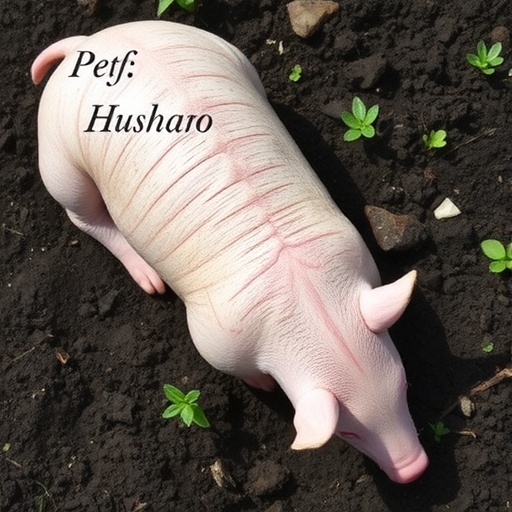
In the realm of forensic science, decompositional analysis serves as a cornerstone for unraveling the mysteries that follow death. A groundbreaking study by Maikov, Myburgh, and Keyes, soon to be published in the International Journal of Legal Medicine, delves into the nuanced effects of burial environments on decomposition rates. This pilot study employs porcine models to mimic human remains, exploring how natural soils and mine tailings, when used as burial substrates in containers, influence the physiological and chemical processes underpinning decay.
Decomposition is an intricate biological phenomenon influenced by myriad factors including temperature, humidity, microbial activity, and the burial matrix. Historically, forensic pathologists and archaeologists have emphasized soil composition as a pivotal determinant of decomposition trajectories. Yet, the impact of contaminated or acidic substrates such as mine tailings—byproducts of mineral extraction operations—remains a relatively underexplored frontier. This study bridges that gap, scrutinizing whether such anthropogenically influenced soils alter the standard stages and chemical signatures of decay, thereby affecting time since death estimations.
Utilizing porcine specimens, which share considerable anatomical and biochemical similarities with humans, the researchers designed controlled burial experiments. The samples were interred in enclosed containers replicating conditions typical of clandestine burials or mass grave scenarios. Containers were filled either with unaltered naturally occurring soils or with mine tailings collected from active and abandoned mining sites, known for their unique geochemical and mineralogical properties. This setup allowed for meticulous monitoring of environmental parameters and decomposition phases under otherwise similar conditions.
One of the pivotal revelations from this research is the differential rate at which decomposition progresses depending on the burial medium. Naturally occurring soil environments demonstrated a relatively predictable pattern of tissue breakdown, dominated by microbial succession and enzymatic autolysis. Contrastingly, specimens buried in mine tailings exhibited erratic decomposition dynamics, presumably linked to the heavy metal content and altered pH levels inherent to such substrates. These chemical alterations appear to suppress or modify microbial communities critical for the decay process, potentially leading to delayed or incomplete decomposition.
The study’s findings bear profound implications for forensic investigations and environmental toxicology. Standard postmortem interval (PMI) models, which often rely on established decay rates under presumed natural conditions, may be rendered inaccurate when applied to remains buried in industrially impacted soils. The presence of tailings and their attendant chemical milieu can mislead forensic analysts, complicating death investigations in mining regions or areas impacted by mining-related pollution. This underscores the necessity for contextualizing decomposition timelines with environmental geochemistry in mind.
Delving deeper, the researchers employed a battery of analytical techniques delineating both macro- and microscopic features of decomposition. These included gross morphological assessments, gas chromatography-mass spectrometry (GC-MS) for volatiles associated with decay, and microbial community profiling through 16S rRNA gene sequencing. Together, these methodologies painted a comprehensive picture of how substrate type molds not only the physical degradation of tissues but also the biochemical signals critical for forensic detection.
One particularly striking observation was the alteration in volatile organic compound (VOC) profiles emitted from decomposing remains in mine tailings versus soil. VOCs are pivotal in cadaver detection dogs’ ability to locate buried bodies and are increasingly harnessed in chemical sensor development for remote decomposition monitoring. The suppression or shift in these chemical markers in contaminated substrates challenges both traditional detection methods and emerging technological solutions, prompting reconsideration of how forensic search protocols are designed.
Additionally, microbial ecology changes induced by the burial media revealed that mine tailings exert selective pressure on bacterial populations involved in carrion breakdown. Certain decomposition-associated microbes were less abundant or replaced by extremophilic species adapted to metal-rich environments. This microbial community upheaval not only influences the pace of decay but may also affect subsequent forensic analyses, such as DNA degradation patterns and pathogen survival, potentially affecting public health surveillance linked to deceased subjects.
The use of containers for burial in this pilot study emulates the common scenario in clandestine burials, where remains are often concealed in confined spaces. The microenvironment within such containers can drastically differ from open-air or in-ground burials, influencing oxygen levels, moisture retention, and chemical interactions—all critical factors governing decomposition. By controlling for this variable, the researchers could isolate the specific effects of soil versus mine tailing substrates, enhancing the study’s forensic relevance.
Environmental considerations also echo strongly through this work. Mine tailings, often laden with toxic heavy metals such as arsenic, lead, and mercury, pose significant ecological risks. Their potential to alter decomposition chemistry further highlights the environmental repercussions when bodies are interred in such contexts, possibly affecting soil remediation efforts and local biogeochemical cycles. The study invites interdisciplinary dialogue among forensic scientists, environmental chemists, and land management authorities about the broader impacts of anthropogenic waste on decay processes.
The translational potential of these findings extends to forensic training and procedural standardization globally. Forensic practitioners working in mining regions or areas susceptible to industrial pollution may need to recalibrate their investigative techniques, including adopting soil chemistry analyses as routine adjuncts to decay estimation. Museums and academic institutions might also revisit their decomposition decomposition research models to incorporate such environmental variables more explicitly, ensuring the integrity of death investigations and historical bioarchaeological reconstructions.
In conclusion, this innovative research spearheaded by Maikov et al. propels forensic science into uncharted territory by exposing how human-induced environmental alterations intersect with biological decomposition. It challenges entrenched paradigms and invites a reevaluation of how forensic practitioners interpret decay evidence, especially in industrially compromised landscapes. The intricate dance between soil chemistry and microbial ecology emerges as a determinant of postmortem trajectories, spotlighting the need for nuanced, multidisciplinary forensic methodologies attuned to diverse burial settings.
As the scientific community grasps the multifaceted influences of burial substrates on cadaveric decomposition, future research may focus on expanding sample sizes and diversifying environmental contexts to validate and refine these initial observations. Pursuing models integrating geochemistry, microbiology, and forensic pathology holds promise for developing predictive tools that accommodate environmental heterogeneity, ultimately enhancing justice by improving time-of-death estimations in complex forensic cases.
This study not only enriches forensic science but also underscores the unexpected ways human industrial activity reverberates through ecological and biological processes, even after death. It exemplifies the power of combining meticulous experimental design with cutting-edge biochemical and molecular analyses to unravel the layers of complexity in postmortem decay, a quest that continues to captivate and challenge scientists worldwide.
Subject of Research: The study investigates the impact of burial in containers filled with naturally occurring soil versus mine tailings on the decomposition process, using porcine models as surrogates for human remains.
Article Title: The effect of burial in containers filled with naturally occurring soil and mine tailings on decomposition: a porcine pilot study.
Article References:
Maikov, A.V., Myburgh, J. & Keyes, C.A. The effect of burial in containers filled with naturally occurring soil and mine tailings on decomposition: a porcine pilot study. Int J Legal Med (2026). https://doi.org/10.1007/s00414-025-03715-8
Image Credits: AI Generated
DOI: https://doi.org/10.1007/s00414-025-03715-8
Tags: anthropogenic soil effects on decompositionburial environment effects on decaychemical signatures of decayclandestine burial researchcontrolled burial experiments in forensic studiesforensic decomposition analysismicrobial activity in burial substratesmine tailings impact on decayphysiological processes in decompositionporcine models in forensic sciencesoil composition and decomposition ratestime since death estimations



