• HOME
  • NEWS
  • EXPLORE
    • CAREER
      • Companies
      • Jobs
    • EVENTS
    • iGEM
      • News
      • Team
    • PHOTOS
    • VIDEO
    • WIKI
  • BLOG
  • COMMUNITY
    • FACEBOOK
    • INSTAGRAM
    • TWITTER
Tuesday, May 5, 2026
BIOENGINEER.ORG
No Result
View All Result
  • Login
  • HOME
  • NEWS
  • EXPLORE
    • CAREER
      • Companies
      • Jobs
        • Lecturer
        • PhD Studentship
        • Postdoc
        • Research Assistant
    • EVENTS
    • iGEM
      • News
      • Team
    • PHOTOS
    • VIDEO
    • WIKI
  • BLOG
  • COMMUNITY
    • FACEBOOK
    • INSTAGRAM
    • TWITTER
  • HOME
  • NEWS
  • EXPLORE
    • CAREER
      • Companies
      • Jobs
        • Lecturer
        • PhD Studentship
        • Postdoc
        • Research Assistant
    • EVENTS
    • iGEM
      • News
      • Team
    • PHOTOS
    • VIDEO
    • WIKI
  • BLOG
  • COMMUNITY
    • FACEBOOK
    • INSTAGRAM
    • TWITTER
No Result
View All Result
Bioengineer.org
No Result
View All Result
Home NEWS Science News Biology

Bumblebees have poor, but useful memories 

Bioengineer by Bioengineer
October 14, 2022
in Biology
Reading Time: 3 mins read
0
Bee drinking from artificial flower
Share on FacebookShare on TwitterShare on LinkedinShare on RedditShare on Telegram

Bumblebees  don’t seem to keep memories for how sweet a flower was, but instead only remember if it was sweeter than another flower, according to researchers at Queen Mary University of London, along with an international team of scientists. 
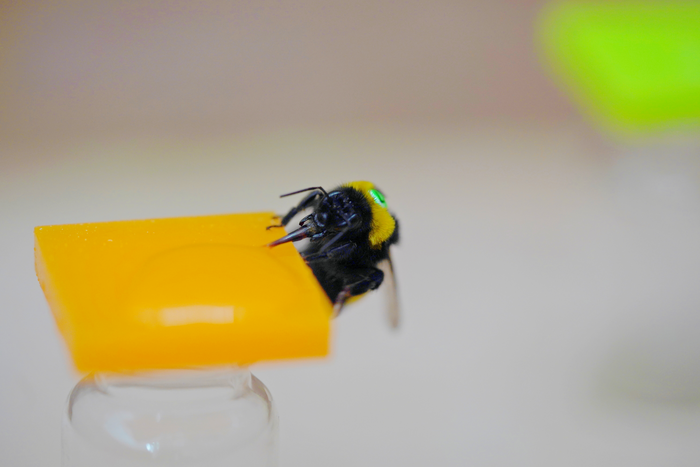
Bee drinking from artificial flower

Credit: Yonghe Zhou

Bumblebees  don’t seem to keep memories for how sweet a flower was, but instead only remember if it was sweeter than another flower, according to researchers at Queen Mary University of London, along with an international team of scientists. 

In new research in the journal eLife, bumblebees were first trained on two flowers, learning that one flower was sweeter than a second flower. Later, they learned that a third flower was sweeter than a fourth flower. Then bumblebees were given the choice between two of the flowers they hadn’t seen together before, for example the second and third or the first and third.  

Over a series of experiments, bumblebees’ preferences during the tests indicated that they could only retain very basic ranking memories for the flowers for very long. The bumblebees could only remember that a flower had been better or worse during training phase. Bees couldn’t seem to remember for more than a few minutes how sweet or rewarding the flowers were on their own or even how much sweeter they were compared to other flowers.  

Previous research shows that we humans actually keep memories for both absolute information (e.g. how sweet something is) and comparisons [Palminteri and Lebreton, 2021]. Starlings, a bird native to Europe, and the only other animal for which this question has been examined, similarly use a combination of absolute and comparative information when remembering options [Pompilio and Kacelnik, 2010].

Ms Yonghe Zhou, co-lead author on the paper and currently a PhD student at Queen Mary University of London, says: “Our results reveal an intriguing divergent mechanism for how bumblebees retain and use information about options, compared to humans and birds.” 

Prof Fei Peng, senior author currently at Southern Medical University, China, states “It may be that the different strategies used by bumblebees and humans may have evolved because of their different diets. Maybe because bumblebees evolved to mostly only eat flower nectar, they never needed to remember the details and could survive and thrive simply using simple comparisons.”  

Ms Yonghe adds: “Despite what may seem to be a poor memory strategy, bumblebees do very well in finding the most profitable flowers. It’s fascinating to consider how different animals, in their own ecological niche, can be similarly successful using such different strategies.” 


More Information: 

Research Paper: “Bumblebees retrieve only the ordinal ranking of foraging options when comparing memories obtained in distinct settings” Cwyn Solvi, Yonghe Zhou, Yunxiao Feng, Yuyi Lu, Mark Roper, Li Sun, Rebecca Reid, Lars Chittka, Andrew B Barron, Fei Peng. eLife 

DOI: https://doi.org/10.7554/eLife.78525 


Journal

eLife

DOI

10.7554/eLife.78525

Subject of Research

Animals

Article Title

Bumblebees retrieve only the ordinal ranking of foraging options when comparing memories obtained in distinct settings

Article Publication Date

27-Sep-2022
Share12Tweet8Share2ShareShareShare2

Related Posts

New Study from The Morton Arboretum Reveals Why Mexico and Central America’s Mountain Forests Are Oak Tree Hotspots — Biology

New Study from The Morton Arboretum Reveals Why Mexico and Central America’s Mountain Forests Are Oak Tree Hotspots

May 5, 2026
Gerald Joyce Elected to Prestigious American Philosophical Society — Biology

Gerald Joyce Elected to Prestigious American Philosophical Society

May 5, 2026

Author Correction: Lipopeptide Immunity Linked to Membrane Remodelling

May 4, 2026

Study Reveals Connection Between Prenatal Chemical Exposure and Chromosomal Abnormalities in Adult Sperm

May 4, 2026

POPULAR NEWS

  • Research Indicates Potential Connection Between Prenatal Medication Exposure and Elevated Autism Risk

    834 shares
    Share 334 Tweet 209
  • New Study Reveals Plants Can Detect the Sound of Rain

    719 shares
    Share 287 Tweet 180
  • Scientists Investigate Possible Connection Between COVID-19 and Increased Lung Cancer Risk

    67 shares
    Share 27 Tweet 17
  • Salmonella Haem Blocks Macrophages, Boosts Infection

    61 shares
    Share 24 Tweet 15

About

We bring you the latest biotechnology news from best research centers and universities around the world. Check our website.

Follow us

Recent News

SIRT3-DsbA-L-TFAM Axis Limits Fatty Liver Disease

Advances in Neonatal Cell Therapies: 2025 Update

New Study from The Morton Arboretum Reveals Why Mexico and Central America’s Mountain Forests Are Oak Tree Hotspots

Subscribe to Blog via Email

Enter your email address to subscribe to this blog and receive notifications of new posts by email.

Join 82 other subscribers
  • Contact Us

Bioengineer.org © Copyright 2023 All Rights Reserved.

Welcome Back!

Login to your account below

Forgotten Password?

Retrieve your password

Please enter your username or email address to reset your password.

Log In
No Result
View All Result
  • Homepages
    • Home Page 1
    • Home Page 2
  • News
  • National
  • Business
  • Health
  • Lifestyle
  • Science

Bioengineer.org © Copyright 2023 All Rights Reserved.