• HOME
  • NEWS
  • EXPLORE
    • CAREER
      • Companies
      • Jobs
    • EVENTS
    • iGEM
      • News
      • Team
    • PHOTOS
    • VIDEO
    • WIKI
  • BLOG
  • COMMUNITY
    • FACEBOOK
    • INSTAGRAM
    • TWITTER
Friday, July 3, 2026
BIOENGINEER.ORG
No Result
View All Result
  • Login
  • HOME
  • NEWS
  • EXPLORE
    • CAREER
      • Companies
      • Jobs
        • Lecturer
        • PhD Studentship
        • Postdoc
        • Research Assistant
    • EVENTS
    • iGEM
      • News
      • Team
    • PHOTOS
    • VIDEO
    • WIKI
  • BLOG
  • COMMUNITY
    • FACEBOOK
    • INSTAGRAM
    • TWITTER
  • HOME
  • NEWS
  • EXPLORE
    • CAREER
      • Companies
      • Jobs
        • Lecturer
        • PhD Studentship
        • Postdoc
        • Research Assistant
    • EVENTS
    • iGEM
      • News
      • Team
    • PHOTOS
    • VIDEO
    • WIKI
  • BLOG
  • COMMUNITY
    • FACEBOOK
    • INSTAGRAM
    • TWITTER
No Result
View All Result
Bioengineer.org
No Result
View All Result
Home NEWS Science News

Building a better microbial fuel cell — using paper

Bioengineer by Bioengineer
February 6, 2017
in Science News
Reading Time: 2 mins read
0
Share on FacebookShare on TwitterShare on LinkedinShare on RedditShare on Telegram
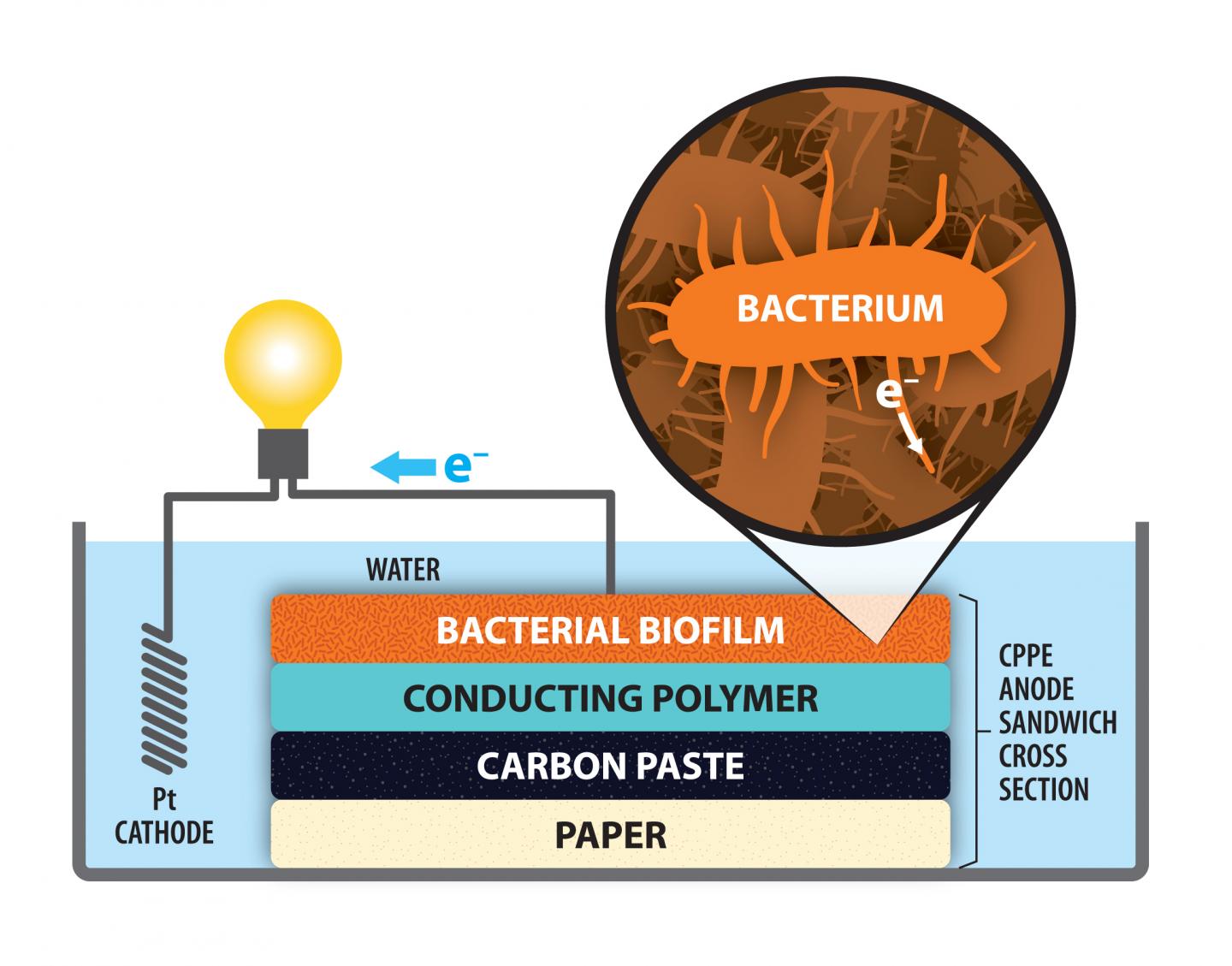
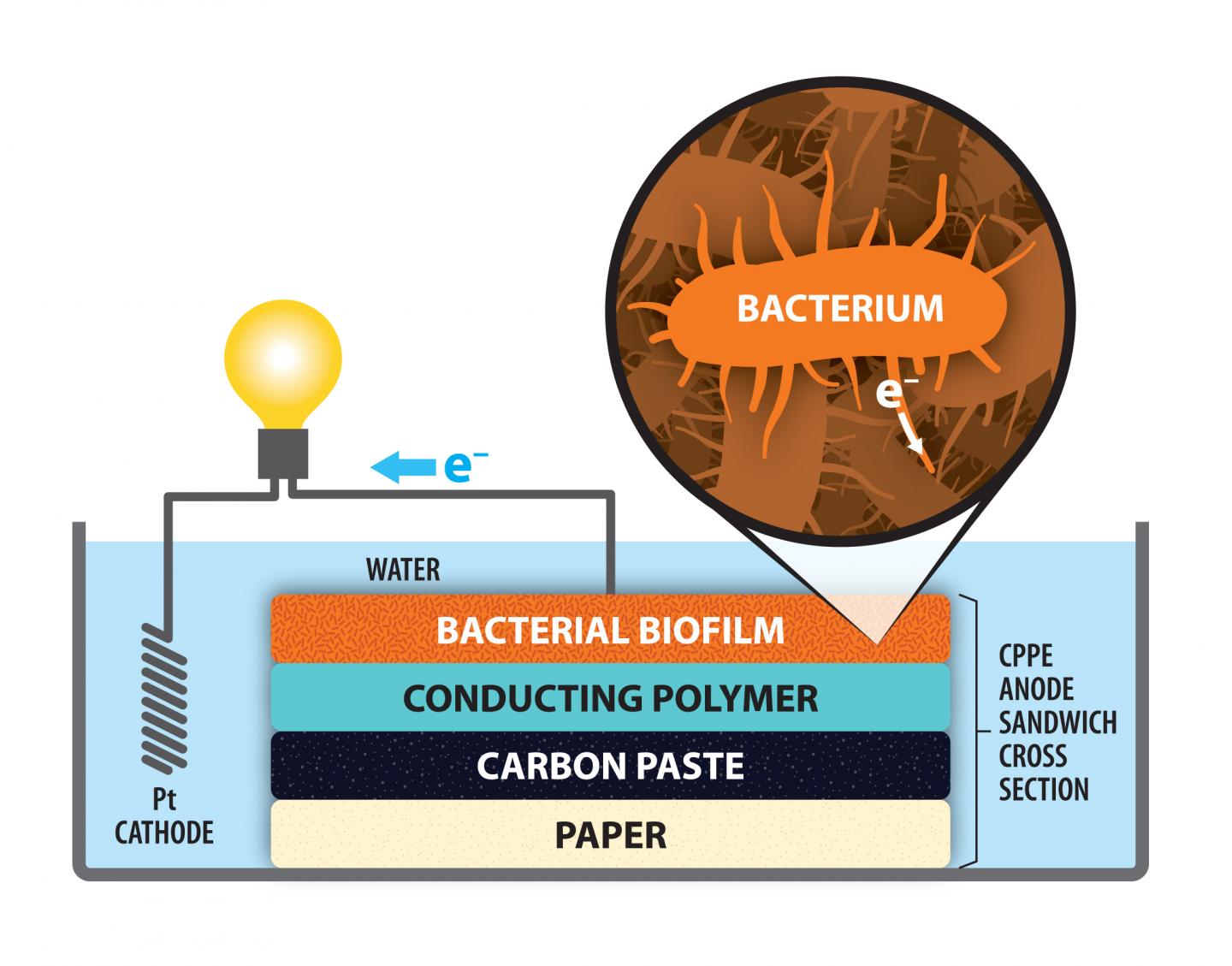
IMAGE

Credit: Illustration by Michael Osadciw/University of Rochester

The concept behind microbial fuel cells, which rely on bacteria to generate an electrical current, is more than a century old. But turning that concept into a usable tool has been a long process. Microbial fuel cells, or MFCs, are more promising today than ever, but before their adoption can become widespread, they need to be both cheaper and more efficient.

Researchers at the University of Rochester have made significant progress toward those ends. In a fuel cell that relies on bacteria found in wastewater, Kara Bren, a professor of chemistry, and Peter Lamberg, a postdoctoral fellow, have developed an electrode using a common household material: paper.

Until now, most electrodes used in wastewater have consisted of metal (which rapidly corrodes) or carbon felt. While the latter is the less expensive alternative, carbon felt is porous and prone to clogging.

Their solution was to replace the carbon felt with paper coated with carbon paste, which is a simple mixture of graphite and mineral oil. The carbon paste-paper electrode is not only cost-effective and easy to prepare; it also outperforms carbon felt.

"The paper electrode has more than twice the current density than the felt model," says Bren.

Their findings have been published in ACS Energy Letters.

Carbon paste is an essential ingredient due to its role in attracting electrons emitted by the bacteria. The specific bacterium used in Bren's project was Shewanella oneidensis MR-1, which consumes toxic heavy metal ions in the wastewater and ejects electrons. Those electrons are attracted to the carbon coating on the positive electrode–the anode. From there, they flow to the platinum cathode, which needs electrons to carry out its own electrochemical reactions.

In making their electrode, Bren and Lamberg created a layered sandwich of paper, carbon paste, a conducting polymer, and a film of the bacteria. This easily constructed electrode, surprisingly, had an average output of the circuit of 2.24 A m-2 (amps per unit area), compared to 0.94 A m-2 with the felt anode.

"We've come up with an electrode that's simple, inexpensive, and more efficient," says Lamberg. "As a result, it will be easy to modify it for further study and applications in the future."

###

Media Contact

Peter Iglinski
[email protected]
585-273-4726
@UofR

http://www.rochester.edu

############

Story Source: Materials provided by Scienmag
Share12Tweet8Share2ShareShareShare2

Related Posts

Steatosis Drives Liver Metastasis Diversity in CRC — Medicine

Steatosis Drives Liver Metastasis Diversity in CRC

July 2, 2026

Unlocking the Mysteries of Alzheimer’s Disease

July 2, 2026

Pensoft Introduces New Peer-Reviewed Journal of Regeneration to Advance Restorative Biology Across Species

July 2, 2026

Evolution-Inspired Biosensors Revolutionize Lipid Tracking in Real Time

July 2, 2026
Please login to join discussion

POPULAR NEWS

  • Detection of EDCs in Breast Milk and Infant Urine Up to Six Months Highlights Early Exposure Risks

    77 shares
    Share 31 Tweet 19
  • Saying Goodbye to PGY-6: Pediatric Fellowship Realities

    103 shares
    Share 41 Tweet 26
  • New Drug Candidate Developed at McMaster Shows Potential for Treating Brain Cancer

    58 shares
    Share 23 Tweet 15
  • KTU Researchers Explore Ultrasound’s Role in Enhancing Blood Flow Beyond Diagnostics

    53 shares
    Share 21 Tweet 13

About

BIOENGINEER.ORG

We bring you the latest biotechnology news from best research centers and universities around the world. Check our website.

Follow us

Recent News

Steatosis Drives Liver Metastasis Diversity in CRC

Unlocking the Mysteries of Alzheimer’s Disease

Pensoft Introduces New Peer-Reviewed Journal of Regeneration to Advance Restorative Biology Across Species

Subscribe to Blog via Email

Enter your email address to subscribe to this blog and receive notifications of new posts by email.

Join 83 other subscribers
  • Contact Us

Bioengineer.org © Copyright 2023 All Rights Reserved.

Welcome Back!

Login to your account below

Forgotten Password?

Retrieve your password

Please enter your username or email address to reset your password.

Log In
No Result
View All Result
  • Homepages
    • Home Page 1
    • Home Page 2
  • News
  • National
  • Business
  • Health
  • Lifestyle
  • Science

Bioengineer.org © Copyright 2023 All Rights Reserved.