


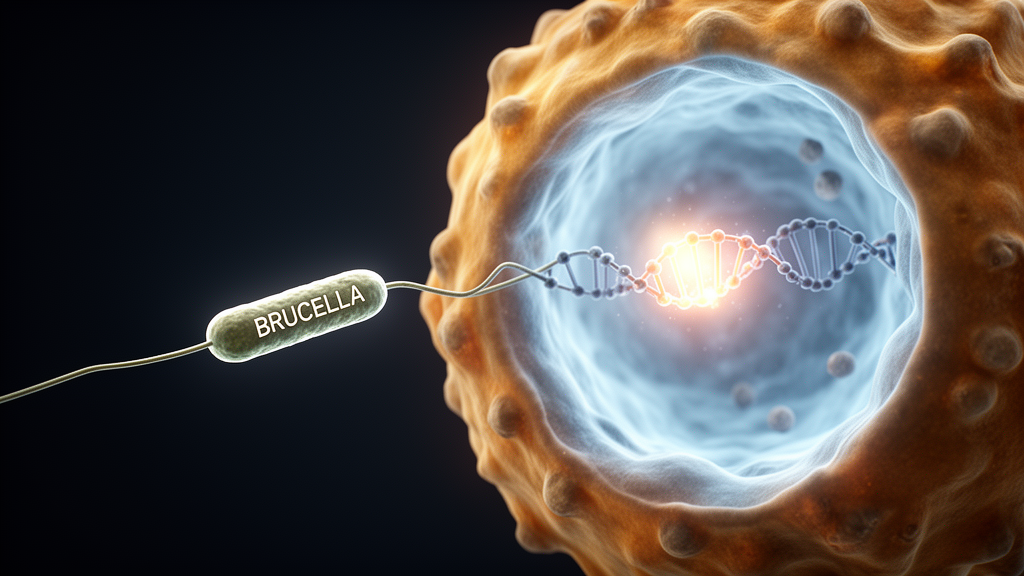
The bacterium Brucella abortus survives inside macrophages by deploying a secreted effector protein that slips into the cell nucleus and directly manipulates host gene regulation, according to a new laboratory study published in the journal Animal Diseases. The protein, BspJ, binds to the promoter region of the mouse gene Zfp740, boosting its expression and thereby shutting down a central inflammatory signaling cascade that the host would otherwise use to fight the infection.
Brucella species cause brucellosis, a globally distributed zoonotic disease that inflicts reproductive disorders on livestock and prolonged fever, arthritis, and multisystem damage in humans. The pathogen’s success rests on its ability to live as a facultative intracellular parasite. After entering a host, it preferentially targets phagocytic cells such as macrophages, steering its trafficking into replication-permissive vacuoles derived from the endoplasmic reticulum and later forming autophagosome-like vacuoles that help disseminate the infection. A key virulence factor in this lifestyle is the type IV secretion system, a molecular syringe that injects effector proteins into the host cell cytoplasm, where they interfere with immune signal transduction.
BspJ was identified in earlier work by the same group as the first known Brucella nucleomodulin, a class of bacterial effectors that enter the host nucleus. Previous studies had shown that BspJ interacts with the host proteins CKB and NME2, modulating energy metabolism and apoptosis, and that deleting the BspJ gene increases inflammatory cytokine expression in macrophages while reducing bacterial survival. What remained unclear was the precise molecular mechanism linking this nuclear activity to inflammation. The new study set out to close that gap by identifying the direct genomic targets of the protein.
The researchers began by transfecting a plasmid expressing Myc-tagged BspJ into RAW264.7 cells, a mouse macrophage cell line, and measuring cytokine messenger RNA by quantitative PCR at 24 and 48 hours. BspJ expression significantly reduced the mRNA levels of the proinflammatory cytokines IL-1β, IL-6, and TNF-α while increasing the anti-inflammatory cytokine TGF-β, with the effect intensifying over time. In parallel infection experiments, macrophages infected with a BspJ deletion strain of Brucella abortus 2308 showed significantly greater transcription of IL-1β, IL-6, and TNF-α and reduced TGF-β compared with the wild-type strain, and these changes were reversed in cells infected with a complemented strain carrying a restored BspJ copy.
To find the genomic regions BspJ contacts directly, the team performed chromatin immunoprecipitation sequencing on BspJ-transfected cells. BspJ-bound fragments mapped predominantly to intronic regions, accounting for 72.22 percent of binding, with 18.36 percent in exonic regions and 3.58 percent in promoter regions. Differential binding analysis flagged three genes as significant targets: Zfp740, Gnl3l, and Fam120c. Pathway enrichment analysis of the BspJ-bound genes pointed strongly to the NF-κB signaling pathway, and the binding peaks clustered near transcription start sites. Follow-up assays sharpened the picture: quantitative PCR showed that BspJ transfection significantly upregulated Zfp740 and Gnl3l but left Fam120c unchanged, while electrophoretic mobility shift assays demonstrated that purified BspJ bound most strongly to a Zfp740 promoter probe, weakly to Gnl3l, and not at all to Fam120c. Competitive assays with excess unlabeled probe disrupted the binding, whereas a mutated probe did not, confirming sequence specificity, and ChIP-qPCR independently verified enrichment of BspJ at the Zfp740 promoter.
The downstream consequences traced a coherent signaling circuit. In BspJ-transfected macrophages, Western blotting and immunofluorescence showed that the protein inhibited degradation of the NF-κB inhibitor IκBα, reduced phosphorylation of the P65 subunit, and decreased P65’s translocation into the nucleus, the three hallmark steps of NF-κB activation. Conversely, infection with the deletion strain increased all three markers relative to wild-type bacteria, and the complemented strain restored the suppression. Quantitative PCR in the deletion-strain infections also revealed upregulated expression of inflammatory regulators such as TRAF3IP2, IL-1α, and p62 and of proapoptotic genes including BAX, CASP3, and CASP8, alongside reduced expression of the antiapoptotic gene BCL2, with all of these shifts reversed by complementation.
Zfp740’s role as the critical intermediary was tested by silencing it with small interfering RNA, which cut its mRNA and protein levels by roughly 75 percent. When Zfp740 was overexpressed, the macrophages phenocopied BspJ transfection, showing inhibited IκBα degradation, reduced P65 phosphorylation, and diminished P65 nuclear translocation. Strikingly, in Zfp740-knockdown cells infected with wild-type, deletion, or complemented strains, the researchers detected no significant differences in IκBα degradation, P65 phosphorylation, or nuclear translocation between the deletion and wild-type groups, and the usual marked upregulation of proinflammatory cytokines upon deletion-strain infection was largely abolished, with only modest increases in IL-1β and IL-6 at 24 hours and no changes in TNF-α or TGF-β. The authors conclude from these experiments that Zfp740 knockdown eliminates BspJ-mediated NF-κB inhibition, establishing Zfp740 as a necessary downstream mediator of the effector’s function.
Molecular docking predicted that three BspJ amino acid residues mediate the promoter interaction: histidine 66 forms hydrogen bonds, for example with guanine at position -7, while arginines 87 and 96 form salt bridges, such as R87 with cytosine at position -53 and R96 with G-7. The team generated Brucella strains carrying single, double, and triple point mutations converting these residues to aspartic acid. All three mutants showed significantly reduced binding to the Zfp740 promoter, with the triple mutant nearly losing binding entirely, even though Western blotting confirmed the mutant proteins were expressed at levels comparable to wild type. Immunofluorescence, however, revealed that nuclear localization of all three mutants was markedly reduced, which the authors say explains their impaired promoter binding. Functionally, in normal macrophages the mutant strains failed to suppress inflammatory cytokines, phenocopying the deletion strain, and all showed significantly reduced intracellular survival compared with wild type, with the triple mutant faring worst. In Zfp740-knockdown cells, by contrast, all strains exhibited uniformly reduced survival, and differences between groups disappeared, consistent with BspJ’s activity depending on Zfp740.
The authors frame the findings as the first demonstration that Brucella can target a host nuclear transcription factor’s promoter to reprogram gene expression, establishing what they call the BspJ-Zfp740-P65/NF-κB regulatory axis. They draw parallels with other pathogens: HIV upregulates the human zinc finger protein hZNF-134 to facilitate infection, and other Brucella effectors, such as BspI, which inhibits IRE1 kinase activity, and OMP25, which binds the receptor SLAMF1, also temper inflammation through NF-κB-linked mechanisms. Because A20, another zinc finger protein, terminates NF-κB signaling enzymatically, the authors hypothesize that Zfp740 may act similarly, though they present this as a hypothesis rather than a demonstrated mechanism. They also note that the single H66 mutation produced only minor phenotypic changes, suggesting the effector’s function depends on the synergistic contribution of multiple interaction sites rather than any single residue.
Several boundaries on the findings deserve emphasis. All experiments were performed in RAW264.7 murine macrophage cells and Brucella abortus 2308 strains under BSL-3 conditions, with three independent biological replicates per experiment, so the results describe cell-culture mechanisms in a mouse macrophage line rather than outcomes in naturally infected animals or humans. The docking analysis of residue-promoter contacts is computational prediction, and the motif the team identified, a conserved CAGTGT sequence in the Zfp740 promoter, awaits broader validation. Within those limits, the study offers a detailed mechanistic account of how a bacterial nucleomodulin suppresses innate immune signaling by rewriting host transcriptional regulation, and the authors suggest that disrupting pathogen-host transcriptional interactions, with Zfp740 as a candidate target, could inform future strategies aimed at improving host clearance of Brucella. Whether such host-directed approaches can be realized therapeutically remains an open question for future research.
Subject of Research: How the Brucella effector protein BspJ binds the Zfp740 promoter in macrophages to inhibit NF-κB signaling and promote intracellular bacterial survival
Article Title: Brucella effector protein BspJ inhibits the NF-κB signaling pathway by targeting the Zfp740 promoter region to promote bacterial survival within macrophages
Article References: Wang, W., Cheng, X., Zhang, Q., Xu, Y., He, H., Zhang, H., Chen, C., Ma, Z., & Wang, Y. (2026). Brucella effector protein BspJ inhibits the NF-κB signaling pathway by targeting the Zfp740 promoter region to promote bacterial survival within macrophages. Animal Diseases, 6(1), Article 43. https://doi.org/10.1186/s44149-026-00257-3
Image Credits: AI Generated
DOI: 10.1186/s44149-026-00257-3
Keywords: Brucella, BspJ, Zfp740, NF-κB, macrophages, type IV secretion system, nucleomodulin, immune evasion, brucellosis, IκBα, inflammation, intracellular survival
News Source: Juliet Wilcox. (October 30, 2026). Brucella Protein BspJ Hijacks Host Gene Zfp740 to Dampen NF-κB Defenses in Macrophages. Scienmag.



