Squeezing light beyond the diffraction limit and controlling the optical processes caused by nano-confined light are central issues of nanophotonics. In particular, localized and enhanced light at the plasmonic nanogaps in scanning probe microscopes provides us with a unique platform for obtaining site-specific optical information at the molecular/atomic scale. Very recently, not only linear but also nonlinear optics have been applied to such tip-enhanced nanoscopy to gain higher sensitivity and spatial resolution. In this context, understanding the intrinsic nonlinear optical properties of plasmonic nanocavities is of growing importance in controlling nanosized nonlinear optics more precisely.
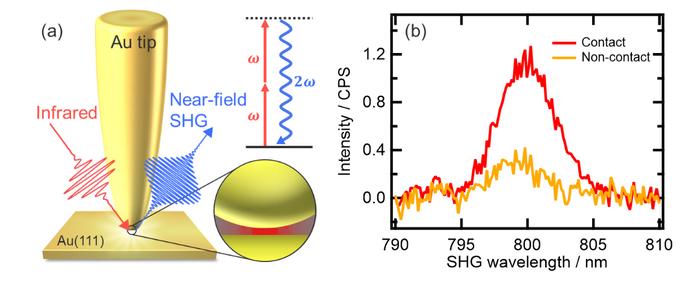
Researchers (Dr. Shota Takahashi et al.) led by Toshiki Sugimoto, Associate Professor at the Institute for Molecular Science, succeeded in elucidating the intrinsic nonlinear optical properties of tip-substrate plasmonic nanocavities. Combining a wavelength-tunable femtosecond pulse laser system with a scanning tunneling microscope and focusing on the tip-enhancement of second harmonic generation (SHG, Figure 1), they reported an unexpectedly broad tip-enhanced nonlinear optical response in a plasmonic nanocavity.
They demonstrated that the tip-enhancement of SHG is maintained over the visible to infrared wavelength range (Figure 2a-c). Moreover, the prominent geometrical effects of plasmonic tips dominating this broadband enhancement ability were also verified; the broadband nonlinear optical property of tip-substrate nanocavities is significantly influenced not only by the structures of nanosized tip apexes but also by micrometer size tip shafts (Figure 2d-i).
The origin of these geometrical effects was unveiled by precise numerical simulations of plasmonic fields inside tip-substrate nanocavities. They theoretically demonstrated that broadband tip-enhanced SHG properties can be significantly altered in response to nanometer- and micrometer-scale tip structures. The simulations incorporating this structural information excellently capture the experimentally observed behavior (Figure 2j-l). More detailed analysis of these simulated results revealed the origin of geometrical effects on tip-enhanced SHG; while the micrometer-scale tip shafts extend the spectral range of the field enhancement to the near- and mid-infrared regions, the nanometer-scale tip apexes mainly contribute to boosting visible/near-infrared light. This indicates that the micrometer-scale tip shafts and nanometer-scale tip apexes jointly enable the simultaneous enhancement of both mid/near-infrared excitation and visible/near-infrared radiation processes, respectively, realizing the strongly enhanced SHG over the visible to infrared broadband region.
This demonstration of the significant broadband enhancement ability of plasmonic nanogaps provides a new basis for intentional control of site-specific nonlinear optical phenomena that are fundamentally accompanied by drastic wavelength conversion. Moreover, the group’s findings pave the way for developing next-generation tip-enhanced nanoscopy by exploiting various nonlinear optical processes. Based on these new techniques, correlated chemical and topographic information will be successfully addressed with ultimate spatiotemporal resolution, promoting cutting-edge microscopic research in a variety of physical, chemical and biological processes occurring in heterogeneous environments.
Credit: Toshiki Sugimoto
Squeezing light beyond the diffraction limit and controlling the optical processes caused by nano-confined light are central issues of nanophotonics. In particular, localized and enhanced light at the plasmonic nanogaps in scanning probe microscopes provides us with a unique platform for obtaining site-specific optical information at the molecular/atomic scale. Very recently, not only linear but also nonlinear optics have been applied to such tip-enhanced nanoscopy to gain higher sensitivity and spatial resolution. In this context, understanding the intrinsic nonlinear optical properties of plasmonic nanocavities is of growing importance in controlling nanosized nonlinear optics more precisely.
Researchers (Dr. Shota Takahashi et al.) led by Toshiki Sugimoto, Associate Professor at the Institute for Molecular Science, succeeded in elucidating the intrinsic nonlinear optical properties of tip-substrate plasmonic nanocavities. Combining a wavelength-tunable femtosecond pulse laser system with a scanning tunneling microscope and focusing on the tip-enhancement of second harmonic generation (SHG, Figure 1), they reported an unexpectedly broad tip-enhanced nonlinear optical response in a plasmonic nanocavity.
They demonstrated that the tip-enhancement of SHG is maintained over the visible to infrared wavelength range (Figure 2a-c). Moreover, the prominent geometrical effects of plasmonic tips dominating this broadband enhancement ability were also verified; the broadband nonlinear optical property of tip-substrate nanocavities is significantly influenced not only by the structures of nanosized tip apexes but also by micrometer size tip shafts (Figure 2d-i).
The origin of these geometrical effects was unveiled by precise numerical simulations of plasmonic fields inside tip-substrate nanocavities. They theoretically demonstrated that broadband tip-enhanced SHG properties can be significantly altered in response to nanometer- and micrometer-scale tip structures. The simulations incorporating this structural information excellently capture the experimentally observed behavior (Figure 2j-l). More detailed analysis of these simulated results revealed the origin of geometrical effects on tip-enhanced SHG; while the micrometer-scale tip shafts extend the spectral range of the field enhancement to the near- and mid-infrared regions, the nanometer-scale tip apexes mainly contribute to boosting visible/near-infrared light. This indicates that the micrometer-scale tip shafts and nanometer-scale tip apexes jointly enable the simultaneous enhancement of both mid/near-infrared excitation and visible/near-infrared radiation processes, respectively, realizing the strongly enhanced SHG over the visible to infrared broadband region.
This demonstration of the significant broadband enhancement ability of plasmonic nanogaps provides a new basis for intentional control of site-specific nonlinear optical phenomena that are fundamentally accompanied by drastic wavelength conversion. Moreover, the group’s findings pave the way for developing next-generation tip-enhanced nanoscopy by exploiting various nonlinear optical processes. Based on these new techniques, correlated chemical and topographic information will be successfully addressed with ultimate spatiotemporal resolution, promoting cutting-edge microscopic research in a variety of physical, chemical and biological processes occurring in heterogeneous environments.
Journal
The Journal of Physical Chemistry Letters
DOI
10.1021/acs.jpclett.3c01343
Method of Research
Experimental study
Subject of Research
Not applicable
Article Title
Broadband Tip-Enhanced Nonlinear Optical Response in a Plasmonic Nanocavity
Article Publication Date
27-Jul-2023