• HOME
  • NEWS
  • EXPLORE
    • CAREER
      • Companies
      • Jobs
    • EVENTS
    • iGEM
      • News
      • Team
    • PHOTOS
    • VIDEO
    • WIKI
  • BLOG
  • COMMUNITY
    • FACEBOOK
    • INSTAGRAM
    • TWITTER
Monday, August 3, 2026
BIOENGINEER.ORG
No Result
View All Result
  • Login
  • HOME
  • NEWS
  • EXPLORE
    • CAREER
      • Companies
      • Jobs
        • Lecturer
        • PhD Studentship
        • Postdoc
        • Research Assistant
    • EVENTS
    • iGEM
      • News
      • Team
    • PHOTOS
    • VIDEO
    • WIKI
  • BLOG
  • COMMUNITY
    • FACEBOOK
    • INSTAGRAM
    • TWITTER
  • HOME
  • NEWS
  • EXPLORE
    • CAREER
      • Companies
      • Jobs
        • Lecturer
        • PhD Studentship
        • Postdoc
        • Research Assistant
    • EVENTS
    • iGEM
      • News
      • Team
    • PHOTOS
    • VIDEO
    • WIKI
  • BLOG
  • COMMUNITY
    • FACEBOOK
    • INSTAGRAM
    • TWITTER
No Result
View All Result
Bioengineer.org
No Result
View All Result
Home NEWS Science News Biology

Bristol scientists discover a new way to find mass extinctions

Bioengineer by Bioengineer
June 13, 2018
in Biology
Reading Time: 2 mins read
0
Share on FacebookShare on TwitterShare on LinkedinShare on RedditShare on Telegram
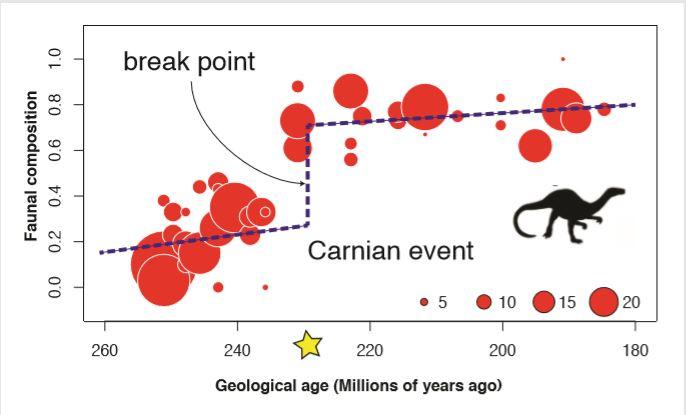
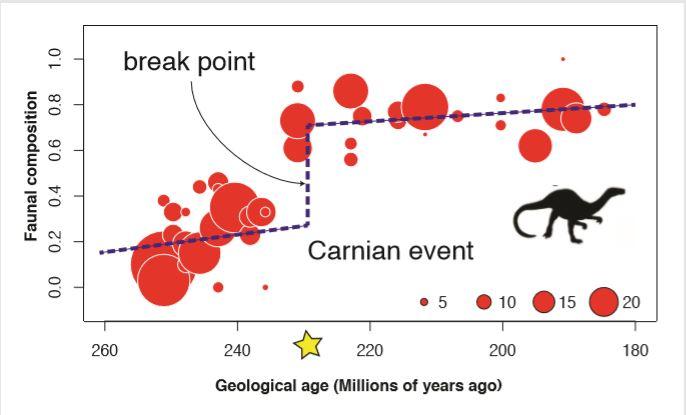
IMAGE

Credit: Mike Benton, University of Bristol

During the history of the Earth, there were many mass extinctions, when huge numbers of species died out. They are usually easy to identify because of the sudden extinctions, followed by a gap, and then the recovery of life.

A new mass extinction has been identified during the Triassic period, some 232 million years ago – called the Carnian event. It was less easy to identify because the different sites around the world were hard to date and cross-match. But it was important because it marked the likely trigger for the explosive takeover of the Earth by dinosaurs.

Using a new statistical method, a team from the University of Bristol, has pinpointed the event.

The statistical method is called breakpoint analysis. Counts of species from many samples through the Triassic were compared, and a straight line was fitted to best explain changes in the proportions of dinosaurs to other beasts. To improve the fit of the line, a model was used that allowed for one break, but the position of the break was not specified.

Professor Mike Benton from the University of Bristol's School of Earth Sciences led the project. He said: "This method is great. We know where we think the change occurred, but we don't tell the computer.

"We let it crunch the numbers and identify the break point, or the time when one kind of ecosystem ended, and the new one began. In this case, it landed precisely on the point in the Carnian when major environmental changes triggered the extinctions."

Massimo Bernardi, a co-author of the report, and now curator at MUSE – Science Museum, Trento, Italy, added: "This event had been identified before. This was a time of huge volcanic eruptions off modern Canada, and profound climate changes. The gases from the volcanoes caused long-term shuttling between dry and wet conditions."

The climate changes had been noted back in 1990, and the dry-wet-dry cycle caused a major change in plants, from succulent wet-loving seed ferns to conifers, which are better adapted to dry conditions.

Cormac Kinsella, another collaborator, and now at the University of Amsterdam, said: "We built a database of 47 faunas from different parts of the world, including 7,773 specimens of reptiles.

"Half way through the Carnian there was a sudden shift in the composition of ecosystems, from comprising a mixed assemblage, to being absolutely dominated by dinosaurs and their relatives."

This new discovery adds to growing evidence for a previously undetected mass extinction, during a time of general upheaval in evolution. There had been a huge mass extinction 252 million years ago, and life was recovering fitfully from that crisis, when it was hit again at 232 million years ago, and then at the end of the Triassic, 201 million years ago.

The Carnian event was important in heralding the explosion of dinosaurs onto the scene, but it also marked the beginning of many modern groups, such as turtles, crocodiles, lizards, and mammals.

###

Media Contact

Mike Benton
[email protected]
@BristolUni

http://www.bristol.ac.uk

Original Source

http://jgs.lyellcollection.org/content/early/2018/05/28/jgs2018-049

Share12Tweet8Share2ShareShareShare2

Related Posts

Nationwide Study Tracks Hepatitis B Reactivation and Liver Dysfunction During Infliximab Treatment

Nationwide Study Tracks Hepatitis B Reactivation and Liver Dysfunction During Infliximab Treatment

August 1, 2026
Imaging Reveals How Brain–Body Interactions Shape Systemic Disease

Imaging Reveals How Brain–Body Interactions Shape Systemic Disease

August 1, 2026

Targeting Vascular–Musculoskeletal Links May Treat Sarcopenia and Osteoporosis

August 1, 2026

Supergene solves evolutionary mystery by controlling mirror-image flower development

August 1, 2026
Please login to join discussion

POPULAR NEWS

  • Machine Learning Predicts Falls in Older Adults Using Dual-Task Gait Measures

    29 shares
    Share 12 Tweet 7
  • How Inflammatory Markers Affect Physical Performance in Community-Dwelling Older Adults: Systematic Review

    29 shares
    Share 12 Tweet 7
  • Older Adults’ Views on Managing Chronic Pain in Primary Care

    29 shares
    Share 12 Tweet 7
  • Bentham Science Launches International Journal of Wireless and Communication Engineering Innovation

    29 shares
    Share 12 Tweet 7

About

We bring you the latest biotechnology news from best research centers and universities around the world. Check our website.

Follow us

Recent News

Machine Learning Predicts Falls in Older Adults Using Dual-Task Gait Measures

How Inflammatory Markers Affect Physical Performance in Community-Dwelling Older Adults: Systematic Review

Older Adults’ Views on Managing Chronic Pain in Primary Care

Subscribe to Blog via Email

Enter your email address to subscribe to this blog and receive notifications of new posts by email.

Join 85 other subscribers
  • Contact Us

Bioengineer.org © Copyright 2023 All Rights Reserved.

Welcome Back!

Login to your account below

Forgotten Password?

Retrieve your password

Please enter your username or email address to reset your password.

Log In
No Result
View All Result
  • Homepages
    • Home Page 1
    • Home Page 2
  • News
  • National
  • Business
  • Health
  • Lifestyle
  • Science

Bioengineer.org © Copyright 2023 All Rights Reserved.