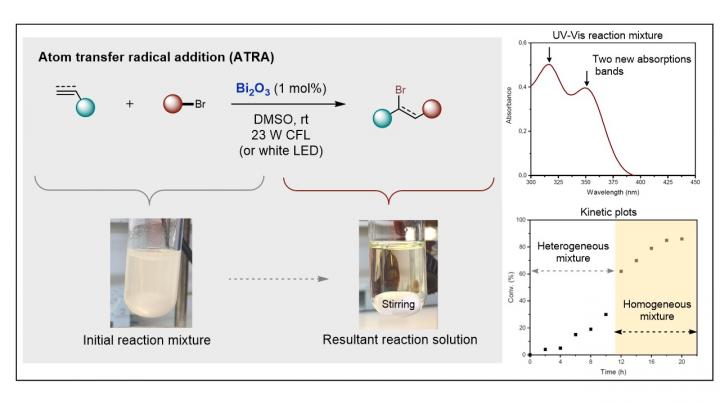
* The researchers have pinpointed that the true active photocatalytic species in a model ARTA reaction is a complex salt of bismuth hexabromide
Credit: Dr. Paola Riente
A collaboration between the Pericàs group with Prof. Timothy Noël and Dr. Paola Riente at the Eindhoven University of Technology (TU/e, The Netherlands), has crystallised in a Nature Communications paper where they provide key insight into the chemical nature of the true photocatalyst involved in the Bi2O3-driven atom-transfer radical addition (ATRA) reaction.
Back in 2014, ICREA professors Miquel Pericàs and Emilio Palomares together with former postdoctoral researcher Dr. Riente published a paper on Angewandte Chemie International Edition pioneering the research on organic transformations in mild reactions conditions by using Bi2O3 and visible light as a sustainable alternative to other transition metals. On the rise of new green approaches for efficient catalysis, Bi2O3 has become popular as a photocatalyst to drive light-induced organic transformations due to its low price, non-toxicity, solid nature, high availability and visible light response. Moreover, in some cases, it can replace the use of metal complexes based on expensive and non-abundant ruthenium and iridium transition metal photocatalysts.
The researchers set out to unravel the atom transfer radical addition (ATRA) reaction between diethyl bromomalonate (DEBM) and 5-hexen-1-ol as a reaction model. As the reaction progresses, the mixture evolves from a suspension to a yellowish transparent solution. This quickly caught the researcher’s attention, as Bi2O3 isn’t soluble in organic solvents. Therefore, “we envisaged that the interaction of Bi2O3 with some component of the reaction was forming, under irradiation, a homogeneous bismuth-based intermediate species that worked as the true photocatalyst of the reaction,” explains Dr. Riente, first author of the paper.
Reaching out to Dr. Mauro Fianchini, a theoretical postdoc working in the Pericàs group, the team devised a theoretical model that has helped elucidate that the catalytically active species involved in photocatalytic processes where Bi2O3 is used are actually closely related to pure BiBr3 or BiBr3- based complexes. In the presence of dimethyl sulfoxide (DMSO) or dimethylformamide (DMF), Bi2O3 transforms into BiBr3- based complexes, photocatalytic species able to absorb light, ultimately triggering the formation of the required alkyl radical in ATRA and alkylation reactions.
Pushing this idea forward, the researchers performed calculations of few solvate complexes where DMSO was coordinating with BiBr3 to find the ideal candidate. Combining these computational insights with the structural information provided by X-ray diffraction the team has cracked the puzzle, finding that the active photocatalytic species is a complex salt of bismuth hexabromide. In fact, a mixture composed of [(BiBr6)]3? octahedral anions balanced by [(CH3)3S]+ cations and [(CH3)3S]Br.
Using the words of Dr. Fianchini “this is a good foundation. This research is the basement of the “house” and, looking forward, we will start growing up the walls and put a roof on by proposing the mechanisms behind the solvation of the precatalyst and the ATRA activation of organic substrates of interest.”
###
Media Contact
Berta Carreño
[email protected]
Original Source
http://www.
Related Journal Article
http://dx.