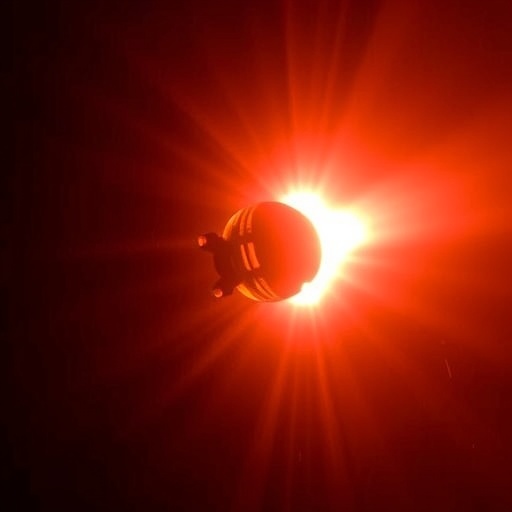
In a groundbreaking advancement from Kyushu University, researchers have synthesized a new class of chiral luminescent radicals that emit circularly polarized light (CPL) with exceptional brightness and stability in the red to near-infrared spectrum. This feat marks a significant leap forward in the development of organic materials capable of producing CPL, which is increasingly vital for applications ranging from 3D display technology to deep-tissue bioimaging and emerging quantum devices. The study, published in Angewandte Chemie International Edition, uncovers a strategic molecular design that harmonizes emission efficiency, chirality, and photostability—qualities traditionally considered mutually exclusive.
Circularly polarized light is distinguished by the helical rotation of its electric field vector, a property that enables enhanced control and interaction with chiral structures in nature and technology. Generating CPL typically relies on chiral molecules that are “handed,” possessing two non-superimposable mirror-image forms. Small organic molecules (SOMs) have been ideal targets due to their tunable emission characteristics, yet crafting SOMs that emit in the red and near-infrared range with both strong CPL activity and durability has remained an elusive goal.
Luminescent radicals, a subclass of SOMs characterized by unpaired electrons, have shown promise due to their inherently chiral structures and electron spin properties favorable for CPL. The tris(2,4,6‑trichlorophenyl)methyl (TTM) radical is a paradigmatic example, but practical hurdles such as insufficient emission efficiency and rapid photodegradation have limited real-world applications. Addressing these challenges, the team at Kyushu University embarked on a molecular engineering journey that redefined the electronic makeup of TTM-based radicals.
Starting from a bromine-substituted derivative of TTM known as TTBrM, researchers introduced carbazole (Cz) units—a nitrogen-containing aromatic compound—at strategic positions. This design yielded three novel compounds: CzTTBrM, 2CzTTBrM, and 3CzTTBrM, each varying in carbazole substitution. This donor-acceptor framework facilitated a charge-transfer emission mechanism, a departure from the localized electronic transitions traditionally observed in TTM radicals. As a result, the emission experienced a pronounced bathochromic shift, emitting robustly within the 650–800 nm window, straddling the beneficial red to near-infrared region optimal for many optical applications.
Photophysical characterization revealed quantum yields for photoluminescence in the new radicals that outperformed standard TTM radicals by nearly thirty-fold, underscoring their enhanced efficiency in converting absorbed photons into emitted light. Equally remarkable was the extraordinary photostability: continuous laser irradiation tests demonstrated that the innovative radicals remained intact and emissive for over 1,300 seconds, representing an increase of nearly two orders of magnitude compared to the original TTBrM radical’s lifespan of 19 seconds under similar conditions.
Maintaining chirality during operation is crucial for CPL materials, as racemization—the interconversion between enantiomers—can diminish CPL emission and device performance. In this investigation, all three carbazole-functionalized radicals displayed strong kinetic barriers to racemization, preserving their optical activity at ambient temperature. This enabled successful isolation of enantiopure forms that exhibited intense and stable CPL, a critical step toward practical device integration.
An innovative extension of the research involved embedding these radicals into microscopic polystyrene spheres to probe their optical behaviors under cavity confinement. Upon laser excitation, these microspheres exhibited whispering gallery mode resonance—an optical phenomenon where light propagates along the inner surface of a spherical cavity, creating conditions conducive to amplification and pre-lasing. Notably, this resonant effect had never been observed before in luminescent radical systems, illustrating the vast untapped potential of these materials in photonic devices.
The implications of this material breakthrough extend beyond conventional photonics. The intrinsic spin properties of radicals render them compelling candidates for quantum information science, where the manipulation of magnetic fields and microwave stimuli can exploit unique quantum states. The stable, bright CPL combined with radical spin chemistry heralds a new paradigm in multifunctional quantum materials, offering a versatile platform for exploring spin-photon coupling and entanglement phenomena.
At the core of this advancement lies a refined understanding of molecular electronics and chirality. By engineering a donor-acceptor system within a propeller-like chiral framework, the researchers successfully surmounted longstanding trade-offs between brightness, stability, and chirality. This molecular architecture invites further exploitation in the rational design of optoelectronic materials tailored for high-performance quantum sensors, advanced laser technologies, and bio-optical devices.
Kyushu University’s multidisciplinary team, including experts from the National Institute of Advanced Industrial Science and Technology (AIST), the University of Tsukuba, Tokyo Metropolitan University, and Kyoto University, demonstrated the power of collaborative innovation. Their synergy melded organic synthesis, photophysical analysis, and advanced optical experimentation, pushing the envelope of what chiral luminescent radicals can achieve.
Moving forward, the research paves the way for integrating these radicals into device architectures, such as circularly polarized organic light-emitting diodes (OLEDs) and laser systems, where precise control over light polarization significantly enhances performance metrics. Additionally, the enhanced photostability directly addresses a critical bottleneck in practical deployment, potentially extending device longevity and reducing operational costs.
This study not only enriches the fundamental science of chiral luminescent radicals but also crystallizes new design principles for materials science, wherein chirality and electronic interactions are judiciously balanced to unlock novel photonic functionalities. As the field advances, such materials stand to revolutionize sectors ranging from information technologies to healthcare diagnostics, underscoring the profound societal impact of molecular innovation.
Subject of Research: Not applicable
Article Title: Luminescent Donor-Acceptor Radical with Propeller Chirality: Bright and Photostable Red Circularly Polarized Luminescence and Whispering Gallery Mode Resonance
News Publication Date: 24-Apr-2026
Web References:
http://dx.doi.org/10.1002/anie.1914320
References:
Kazuhiro Nakamura, Kenshiro Matsuda, Kosuke Anraku, Keiko Yamaoka, Taisuke Matsumoto, Fumitaka Ishiwari, Takeaki Zaima, Wataru Ota, Emiko Fujiwara, Tohru Sato, Yoshitaka Inoue, Soh Kushida, Yohei Yamamoto, Takuya Hosokai, Ken Albrecht, Angewandte Chemie International Edition
Image Credits: Ken Albrecht / Kyushu University
Keywords
Circularly polarized light, luminescent radicals, chiral molecules, tris(2,4,6‑trichlorophenyl)methyl, carbazole substitution, red to near-infrared emission, photoluminescence quantum yield, photostability, racemization, whispering gallery mode resonance, quantum materials, organic light-emitting diodes (OLEDs), spin-photon coupling
Tags: 3D display technology applicationsbright CPL emitterschiral luminescent radicalschirality and photostability in opticsdeep-tissue bioimaging techniquesluminescent radical propertiesmolecular design for CPLnear-infrared circularly polarized lightorganic CPL materialsquantum device materialssmall organic molecules in photonicsstable red-NIR emission