Credit: Journal of Clinical Sleep Medicine, American Academy of Sleep Medicine.
DARIEN, IL – January 16, 2018 – Results of a randomized controlled trial suggest that systematic bright light exposure can improve sleep for fatigued people who have been treated for cancer.
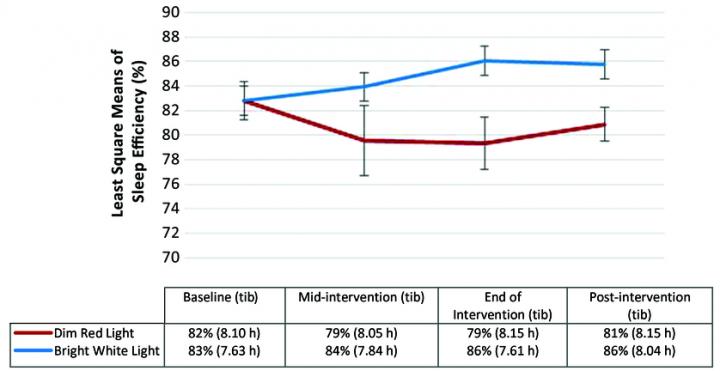
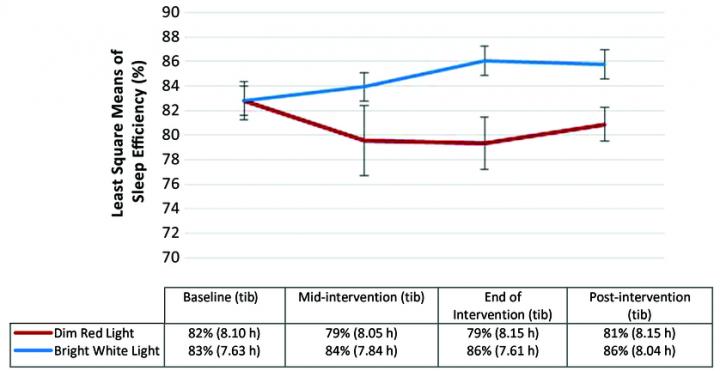
The pilot study results show that mean sleep efficiency, the percentage of time in bed when the person is sleeping, improved to clinically normal levels in the bright light therapy group. This statistically significant improvement was sustained three weeks after the intervention. In contrast, the dim light group remained at low sleep efficiency levels on average for the entire study. Medium to large effect sizes also were seen in self-reported sleep quality, total sleep time and wake time.
"In a pilot study, a systematic light exposure intervention with a mixed group of fatigued cancer survivors was significantly more effective than comparison dim light exposure in improving sleep efficiency," said lead author Lisa M. Wu, PhD, assistant professor in the Department of Medical Social Sciences at Northwestern University Feinberg School of Medicine and a member of the Robert H. Lurie Comprehensive Cancer Center at Northwestern University. Wu also serves as an adjunct assistant professor in the Department of Population Health Sciences and Policy at Icahn School of Medicine at Mount Sinai in New York City, where the study was conducted.
The study results are published in the Jan. 15 issue of the Journal of Clinical Sleep Medicine.
According to the authors, sleep disturbances are reported by cancer patients at a significantly higher rate than in the general population. Between 23 and 44 percent of cancer patients experience insomnia symptoms even years after treatment.
The research team, led by principal investigator William H. Redd, PhD, professor in the Department of Population Health Sciences and Policy at Icahn School of Medicine at Mount Sinai, studied 44 people who had completed treatment for cancer and met criteria for clinically significant fatigue at screening. Participants had an average age of about 54 years, and 75 percent were women.
Participants were randomized to either a bright white light intervention or a comparison dim light condition. They were provided a light box and instructed to use it every morning for 30 minutes for four weeks. Sleep was evaluated using wrist actigraphy and the Pittsburgh Sleep Quality Index.
"Systematic light exposure using bright white light is a low-cost and easily disseminated intervention that offers a feasible and potentially effective alternative to improve sleep in cancer survivors," said Wu.
The authors noted that larger-scale studies are needed to test the efficacy of systematic light exposure to treat sleep disturbances in people who have been treated for cancer.
###
This work was supported by a grant from the National Cancer Institute of the National Institutes of Health.
For a copy of the study, "The Effect of Systematic Light Exposure on Sleep in a Mixed Group of Fatigued Cancer Survivors," or to arrange an interview with a study author or an AASM spokesperson, please contact the AASM at 630-737-9700 or [email protected]
The monthly, peer-reviewed Journal of Clinical Sleep Medicine is the official publication of the American Academy of Sleep Medicine, a professional membership society that improves sleep health and promotes high quality, patient-centered care through advocacy, education, strategic research, and practice standards. The AASM encourages patients to talk to their doctor about sleep problems and visit http://www.sleepeducation.org for more information about sleep, including a searchable directory of AASM-accredited sleep centers.
Media Contact
Corinne Lederhouse
[email protected]
630-737-9700
@AASMorg
http://www.aasmnet.org/
Original Source
http://dx.doi.org/10.5664/jcsm.6874 http://dx.doi.org/10.5664/jcsm.6874