• HOME
  • NEWS
  • EXPLORE
    • CAREER
      • Companies
      • Jobs
    • EVENTS
    • iGEM
      • News
      • Team
    • PHOTOS
    • VIDEO
    • WIKI
  • BLOG
  • COMMUNITY
    • FACEBOOK
    • INSTAGRAM
    • TWITTER
Wednesday, November 19, 2025
BIOENGINEER.ORG
No Result
View All Result
  • Login
  • HOME
  • NEWS
  • EXPLORE
    • CAREER
      • Companies
      • Jobs
        • Lecturer
        • PhD Studentship
        • Postdoc
        • Research Assistant
    • EVENTS
    • iGEM
      • News
      • Team
    • PHOTOS
    • VIDEO
    • WIKI
  • BLOG
  • COMMUNITY
    • FACEBOOK
    • INSTAGRAM
    • TWITTER
  • HOME
  • NEWS
  • EXPLORE
    • CAREER
      • Companies
      • Jobs
        • Lecturer
        • PhD Studentship
        • Postdoc
        • Research Assistant
    • EVENTS
    • iGEM
      • News
      • Team
    • PHOTOS
    • VIDEO
    • WIKI
  • BLOG
  • COMMUNITY
    • FACEBOOK
    • INSTAGRAM
    • TWITTER
No Result
View All Result
Bioengineer.org
No Result
View All Result
Home NEWS Science News Chemistry

BridgIT, a new tool for orphan and novel enzyme reactions

Bioengineer by Bioengineer
March 26, 2019
in Chemistry
Reading Time: 2 mins read
0
IMAGE
Share on FacebookShare on TwitterShare on LinkedinShare on RedditShare on Telegram

IMAGE

Credit: EPFL

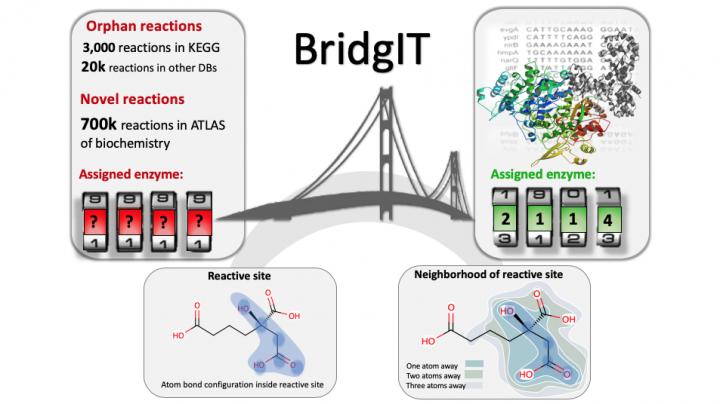
Effective protein engineering can give us control over the generated products inside a cell. However, for many of the biochemical reactions responsible for these products, we don’t we don’t know the specific protein- or enzyme-producing gene responsible. These reactions are called “orphan” and have become a big problem for protein engineers.

Moreover, software that predicts novel, hypothetical biochemical reactions – a common tool for modern biochemists and synthetic biologists – cannot assign potential genes to them, meaning that there are no recorded DNA sequences that scientists can tweak to change protein or enzyme production. And to further complicate matters, there are also many “orphan” metabolic enzymes whose particular reaction is unknown, thus leaving important gaps in our maps of metabolic networks and pathways.

In short, finding which gene(s) correspond to the enzyme/protein(s) that catalyze an orphan or novel, hypothetical reaction has grown into a critical issue for applications ranging from biotechnology to medicine.

Fortunately, chemical engineers from the lab of Vassily Hatzimanikatis at EPFL have found a solution. The group developed a new computational method and online tool, called “BridgIT”, to identify candidate genes and catalyzing proteins for orphan and novel, hypothetical reactions. All BridgIT needs to know is the four connecting bonds around the atoms of the reactive sites, and it can correctly annotate proteins for 93% of analyzed enzymatic reactions. This percentage rose to almost 100% when seven connecting bonds were included.

To test BridgIT’s accuracy, the researchers pitted it against databases of reactions that were once orphan but have now been assigned to genes and enzymes – basically, reactions that have become “non-orphan”. BridgIT predicted the exact or a highly related enzyme for 211 out of 234 reactions (>90%). And for hypothetical reactions that were once novel and have since been assigned enzymes, BridgIT found the exact enzymes for 334 out of 379 reactions (>88%).

The authors write: “BridgIT… will allow researchers to fill the knowledge gaps in metabolic networks and will act as a starting point for designing novel enzymes to catalyze non-natural transformations.”

###

Reference

Noushin Hadadi, Homa Mohammadi Peyhani, Ljubisa Miskovic, Marianne Seijo, Vassily Hatzimanikatis. PNAS 25 March 2019. DOI: 10.1073/pnas.1818877116

Media Contact
Nik Papageorgiou
[email protected]

Related Journal Article

http://dx.doi.org/10.1073/pnas.1818877116

Tags: BiochemistryBiomedical/Environmental/Chemical EngineeringChemistry/Physics/Materials SciencesComputer SciencePharmaceutical SciencesSoftware Engineering
Share12Tweet8Share2ShareShareShare2

Related Posts

Engineering Ultra-Stable Proteins via Hydrogen Bonding

Engineering Ultra-Stable Proteins via Hydrogen Bonding

November 19, 2025
Designing DNA for Controlled Charge Transport

Designing DNA for Controlled Charge Transport

November 18, 2025

Chemoselective Electrolysis Drives Precise Arene Hydroalkylation

November 17, 2025

LHAASO Sheds Light on the Origin of the Cosmic Ray “Knee” Phenomenon

November 16, 2025
Please login to join discussion

POPULAR NEWS

  • New Research Unveils the Pathway for CEOs to Achieve Social Media Stardom

    New Research Unveils the Pathway for CEOs to Achieve Social Media Stardom

    201 shares
    Share 80 Tweet 50
  • ESMO 2025: mRNA COVID Vaccines Enhance Efficacy of Cancer Immunotherapy

    211 shares
    Share 84 Tweet 53
  • Scientists Uncover Chameleon’s Telephone-Cord-Like Optic Nerves, A Feature Missed by Aristotle and Newton

    118 shares
    Share 47 Tweet 30
  • Neurological Impacts of COVID and MIS-C in Children

    90 shares
    Share 36 Tweet 23

About

We bring you the latest biotechnology news from best research centers and universities around the world. Check our website.

Follow us

Recent News

Impact of rs3802177 Variant on Gestational Diabetes

Enhancing Ancient Architecture Study with Advanced SIFT

HSP70 Family and Drought Resistance Genes in Sugar Beet

Subscribe to Blog via Email

Enter your email address to subscribe to this blog and receive notifications of new posts by email.

Join 69 other subscribers
  • Contact Us

Bioengineer.org © Copyright 2023 All Rights Reserved.

Welcome Back!

Login to your account below

Forgotten Password?

Retrieve your password

Please enter your username or email address to reset your password.

Log In
No Result
View All Result
  • Homepages
    • Home Page 1
    • Home Page 2
  • News
  • National
  • Business
  • Health
  • Lifestyle
  • Science

Bioengineer.org © Copyright 2023 All Rights Reserved.