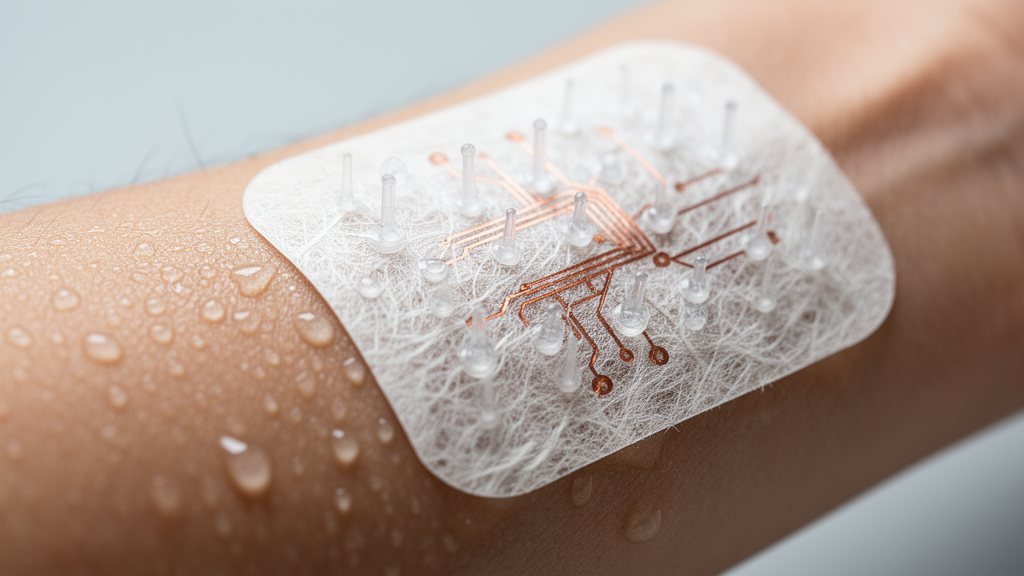
Wearable health monitors promise continuous, comfortable insight into the body, yet most current patches work against the very skin they sit on. Conventional substrates tend to block airflow, trap sweat and provoke irritation during long wear, and that trapped moisture can also disrupt the collection and analysis of sweat, the fluid many sensing platforms depend on. A research team at Jeonbuk National University in South Korea, led by Professor Sooman Lim of the Graduate School of Flexible and Printable Electronics, has now built a wearable patch on an unexpected foundation: hanji, the traditional Korean paper made from mulberry plant fibers. Reported in Chemical Engineering Journal, the platform pairs light-based 3D-printed microneedles with printed electrodes that measure uric acid in sweat and transmit the readings wirelessly, demonstrating on a single breathable substrate functions that researchers usually pursue separately.
The choice of paper is not merely aesthetic. Mulberry paper is built from a porous network of plant fibers, and that architecture moves moisture rather than sealing it in. In the team’s experiments, the porous paper wetted almost instantly: the water contact angle, a measure of how readily a surface accepts liquid, fell from 72.19 degrees to 7.96 degrees within six seconds. That rapid wetting suggests the substrate can manage sweat accumulation at the skin surface while wicking the fluid toward the sensing electrodes, addressing both the comfort problem and the analytical problem that impermeable patches create.
Onto this fibrous base, the researchers printed microneedles directly using light-based 3D printing, a process that required no additional adhesive layer to bond the structures to the paper. Geometry proved to be a powerful lever. By modifying the shape of the microneedles, the team increased how much cargo each needle could carry: the optimized design achieved a drug loading of 25.36 percent, compared with 12.6 percent for unmodified microneedles. In release testing, the needles delivered 56.41 percent of their loaded model dye over 80 hours, a slow, sustained profile relevant to future drug-delivery use.
The microneedles also passed a basic mechanical test of their intended function. Pressed into excised rat skin, they penetrated approximately 954 micrometers without structural deformation, showing they are robust enough to pierce tissue in a laboratory setting. Because the skin samples came from animals rather than human subjects, and because the delivery experiments used a model dye rather than a therapeutic drug, these results mark early feasibility work. The researchers themselves frame the findings as highlighting the patch’s potential for future drug-delivery applications, not as proof of clinical performance.
The sensing half of the platform is an electrochemical sensor printed onto the same paper. In calibration, it detected uric acid across concentrations from 0.01 to 8 micromolar, with a detection limit of 9.3 nanomolar. When tested with buffer and artificial sweat samples, the sensor returned recoveries of 98.1 to 101.3 percent, values that agreed with laboratory LC-MS analysis, the reference method for quantifying small molecules. Those numbers indicate that a printed electrode on paper can match a benchtop instrument closely enough for analytical work, at least under controlled test conditions.
Practical wearability depends on more than sensitivity, and the team addressed several operational details. The sensor dries within 13 seconds after use and produced consistent readings over three consecutive uses, suggesting it can survive repeated measurement cycles. Data left the patch through a low-power wireless system: the wireless board drew only about 15 milliwatts at peak, lower than earlier wearable IoT biosensors, which typically consume 60 to 120 milliwatts. For a device meant to sit on skin for extended periods, that reduced power draw matters for battery size, heat and overall comfort.
The target analyte gives the platform its medical rationale. Uric acid is a key marker for gout and hyperuricemia, conditions that currently require blood testing to track. A sweat-based patch could, in principle, let people check their uric acid at home without repeated blood draws, and could help track how uric acid responds to medicines, since some drugs raise uric acid levels while others lower them. The researchers note this possibility as motivation, but the published study evaluated the sensor with buffer and sweat samples rather than demonstrating home monitoring in patients, so the at-home use case remains a forward-looking application rather than a tested outcome.
Equally important is what the study did not do. Professor Lim is explicit that the microneedle delivery function and the wireless sweat-sensing function were evaluated separately, not as an integrated treatment-and-monitoring cycle on a living subject. The drug-delivery work used model dye and excised rat skin; the sensing work used buffer and sweat samples; no clinically relevant drug was delivered through the patch, and no skin-safety testing in humans has been performed. The team describes the combined platform as a foundation for future devices that could integrate treatment and real-time health monitoring, a framing that keeps the current results and the eventual ambition clearly distinct.
The next steps follow directly from those gaps. The researchers plan to test the patch with clinically relevant uric acid-lowering drugs, together with skin-safety studies and real-time testing on the body. Those experiments will determine whether the paper substrate performs as well against living, sweating skin as it did in bench tests, whether the microneedles can carry therapeutic payloads safely, and whether the wireless link remains reliable during ordinary daily activity.
Even at this early stage, the work illustrates a broader shift in wearable electronics: away from impermeable plastic toward substrates chosen for how they interact with skin and sweat. By bringing microneedle fabrication and wireless sweat sensing onto a breathable paper substrate, the Jeonbuk National University team has shown that a material as old as Korean papermaking can carry functions as new as printed biosensing. The study, published in Volume 542 of Chemical Engineering Journal with first authors Aqila Che Ab Rahman and Habibulla Imran contributing equally, establishes a foundation for future wearable technologies that could make treatment and health monitoring more convenient, comfortable and personalized, provided the remaining clinical hurdles are cleared.
Subject of Research: A breathable mulberry paper wearable patch integrating 3D-printed microneedles for drug delivery with wireless sweat-based uric acid sensing.
Article Title: Jeonbuk National University researchers develop breathable paper patch for wearable health care
Article References: Jeonbuk National University researchers develop breathable paper patch for wearable health care. Original publication (Bibliographic details unavailable.)
Image Credits: AI Generated
DOI: Not provided
Keywords: wearable health monitoring, mulberry paper, hanji, 3D-printed microneedles, drug delivery, uric acid, sweat sensing, electrochemical sensor, wireless biosensor, Jeonbuk National University, Chemical Engineering Journal, breathable substrate
News Source: Ophelia Keating. (November 11, 2026). Breathable Mulberry Paper Patch Combines 3D-Printed Microneedles With Wireless Sweat Sensing. Scienmag.