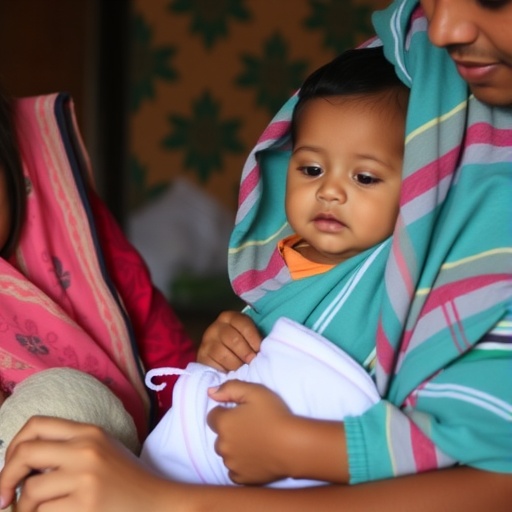
In a groundbreaking investigation that deepens our understanding of early-life nutrition and immune development, researchers have unveiled critical new evidence on how breast milk cytokines influence infant growth trajectories in vulnerable populations. This pivotal study, conducted within a low-resource community in Dhaka, Bangladesh, offers unprecedented longitudinal data on the interplay between immune modulators in breast milk and physical development during the first year of life—a crucial window for health outcomes.
Breast milk has long been recognized as a vital source of nutrition, but its role as a dynamic bioactive fluid, rich in immune factors, is increasingly coming to the forefront of scientific inquiry. Cytokines within breast milk are signaling proteins that regulate and orchestrate immune functions. They potentially condition the newborn’s developing immune system and shape growth patterns. However, empirical evidence from longitudinal human studies, particularly from low-income settings where infant growth faltering is common, has remained notably sparse until now.
The research team employed a meticulous approach by measuring an array of cytokines in breast milk samples collected from mothers within the first six weeks postpartum. This early postpartum window is essential, as it coincides with the infant’s highest vulnerability and the period during which breastfeeding practices establish foundational immunological and metabolic programming. The cytokines analyzed included both pro-inflammatory and anti-inflammatory molecules, highlighting the complexity of immune signaling in neonatal nutrition.
By following infants longitudinally from 3 to 12 months, the investigators traced growth patterns using standardized anthropometric measures, including weight-for-age, length-for-age, and weight-for-length z-scores. Their analytical framework leveraged sophisticated statistical models to ascertain how concentrations of specific breast milk cytokines correlated with subsequent growth trajectories. This approach marked a significant advancement over prior cross-sectional or short-term studies that could not capture dynamic growth changes over time.
One of the study’s most striking revelations was the differential impact of distinct cytokines on growth parameters. For example, certain pro-inflammatory cytokines, traditionally associated with immune activation, showed unexpected positive associations with length-for-age, suggesting a nuanced role in promoting linear growth under some conditions. Conversely, elevated levels of some anti-inflammatory cytokines correlated with enhanced weight gain, reflecting the delicate balance required to modulate inflammation without impairing overall growth.
These findings challenge simplistic paradigms that categorize cytokines solely as harmful or beneficial. Instead, they reveal a sophisticated bioimmune milieu in human milk, tailored to the infant’s developmental needs. This has profound implications, suggesting that breast milk immune composition dynamically contributes to shaping not only immunity but also growth patterns, especially in environments burdened by infectious disease and nutritional challenges.
Conducting the study in a low-income urban setting adds critical context to the findings. Infants in such environments are often exposed to a higher infectious burden and variable nutritional adequacy, posing risks for growth faltering and immune dysregulation. The study underscores how maternal-infant biology interacts with social determinants of health, emphasizing that breast milk cytokines potentially constitute a biological buffer against adverse growth outcomes in resource-constrained settings.
Moreover, the research carries significant translational potential. Understanding how immune factors in human milk influence growth trajectories could inform targeted interventions to optimize infant growth and reduce stunting—a pervasive public health problem affecting millions worldwide. Potential strategies might include maternal nutritional support or supplementation to modulate milk immune profiles favorably or the development of fortified breast milk substitutes that replicate critical immunomodulatory properties.
This comprehensive investigation also raises pertinent questions about the mechanisms underlying cytokine transfer into breast milk and their bioavailability and activity within the infant gut. Future research directions illuminated by this study include exploring the interplay between milk cytokines, the developing gut microbiome, and infant immune system maturation. Such integrative perspectives are needed to unpack the systemic effects of milk-borne immune signals beyond growth metrics.
The investigation advances the methodological rigor in this domain by combining precise biomarker measurement techniques with longitudinal infant growth assessments, setting a benchmark for subsequent studies. Furthermore, by situating the research in a real-world setting marked by socioeconomic vulnerability, the findings possess elevated relevance for global child health policies aimed at mitigating early life growth deficits.
In sum, the study profoundly enriches the scientific narrative on breastfeeding’s multifaceted benefits. It elaborates that beyond providing macronutrients and classical immune protection, breast milk’s cytokine milieu plays an active, modulatory role in shaping the infant’s growth trajectory. As the global health community grapples with persistent childhood malnutrition and its lifelong consequences, such insights are invaluable.
Underlying the research is the recognition that infant growth is a complex phenotype influenced by intersecting biological, environmental, and social factors. Breast milk acts as a critical microenvironment where mother-infant immunological crosstalk takes place, encoding a biological signature that resonates throughout early development.
As the field moves forward, integrating immunological biomarkers into nutritional research and public health surveillance could redefine strategies to promote optimal child development. The Dhaka cohort study exemplifies how precision epidemiology can be harnessed to unravel the subtle but impactful pathways through which early-life exposures shape lifelong health trajectories.
This paradigm shift holds promise for tailoring breastfeeding recommendations and maternal health initiatives aligned with immunonutritional science. Ultimately, recognizing and harnessing breast milk’s immune complexity may unlock new avenues to combat childhood undernutrition and foster resilience in the world’s most vulnerable populations.
The study’s comprehensive insights resonate beyond academic circles, carrying potential for viral dissemination by elucidating the invisible, yet powerful, immune dialogue between mother and child that governs growth and development during the foundational first year of life.
Subject of Research:
Breast milk cytokines and their influence on longitudinal infant growth trajectories in a low-income community in Bangladesh.
Article Title:
Breast milk cytokines and infant growth trajectories in a low-income community in Bangladesh.
Article References:
Siew, J., Shama, T., Sullivan, E.F. et al. Breast milk cytokines and infant growth trajectories in a low-income community in Bangladesh. Pediatr Res (2026). https://doi.org/10.1038/s41390-026-05232-9
Image Credits: AI Generated
DOI: 22 June 2026
Tags: breast milk bioactive components researchbreast milk cytokines and infant growthbreast milk immune modulatorscytokine signaling in breast milkearly-life nutrition in low-resource settingsimmune development in newbornsimmune system conditioning in infantsimpact of breast milk on infant healthinfant growth trajectories in Bangladeshlongitudinal studies on breastfeedingnutrition and physical development in infantspostpartum breastfeeding practices