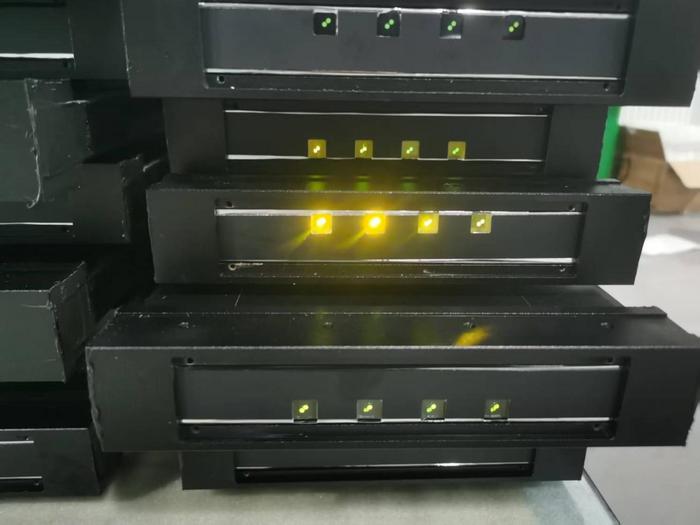

In a groundbreaking advancement for neutrino physics and low-background experimental techniques, researchers from Sun Yat-sen University (SYSU) and the Institute of High Energy Physics (IHEP) have engineered a sophisticated top veto tracker system for the Taishan Antineutrino Observatory (TAO). This novel detector system, designed to identify and filter out cosmic muons, is pivotal in addressing the persistent challenge of background noise in neutrino detection experiments. By integrating 160 meticulously crafted plastic scintillator (PS) modules, enhanced through an optimized arrangement of wavelength shifting fibers (WLS-fibers) and silicon photomultiplier (SiPM) readouts, the design ushers in a new era of precision and efficiency in muon vetoing technology.
The importance of muon veto systems cannot be overstated in the realm of neutrino observation, especially those experiments conducted close to ground level or in environments with low intrinsic background noise. Cosmic muons, being highly penetrating particles, generate secondary neutrons and radioactive isotopes when interacting with detector materials, complicating the extraction of authentic neutrino signals. At the forefront of innovation, the TAO experiment addresses these concerns with its new top veto tracker system, a crucial component that promises to markedly improve the fidelity of neutrino measurements.
Central to the tracker’s performance is its unique configuration of 160 plastic scintillator modules, each composed of elongated PS strips intricately embedded with WLS-fibers. These fibers are not arranged arbitrarily; instead, they follow an optimized bending pattern within the scintillator matrix that ensures maximal light collection and transmission. The fibers channel scintillation photons uniformly towards fiber focusing readouts, where SiPMs convert the captured light into electrical signals with exceptional sensitivity. This design synergy elevates light yield significantly beyond conventional standards, addressing a critical parameter for effective muon detection.
According to Prof. Wei Wang, the corresponding author spearheading the research, the innovation lies in the intelligent spatial arrangement of the WLS fibers combined with cutting-edge readout methodologies. “This unique design is a significant step forward in muon veto detection,” Prof. Wang notes. The improvements not only yield higher photon counts per muon event but also offer sharper differentiation between true muon signals and background noise, enhancing the accuracy and reliability essential for high-stakes neutrino experiments.
The experimental evaluations reveal intriguing spatial dependencies in light output along the length of each PS strip. When muons intersect near the extremities of the 2000-mm scintillator strips, the system records an elevated total light yield, albeit accompanied by a degree of asymmetry in signal strength from each fiber end. Quantitatively, a single end of these long modules consistently registers photoelectron yields exceeding 40.8 p.e., while slightly shorter 1500-mm modules achieve yields beyond 51.5 p.e. Such high yields are a testament to the meticulous optimization of fiber placement and the use of optical coupling techniques.
Enhancing the coupling efficiency between the WLS fibers and the SiPMs, the research team applied optical grease, a strategy that proved beneficial by boosting the effective light yield by an impressive 12.5%. This incremental improvement is crucial given the finely balanced conditions under which the veto system must operate. High light yields contribute directly to the system’s ability to distinguish genuine muon-induced signals from spurious background events, a capability that significantly suppresses false positives and ensures the integrity of neutrino event selection.
Detection efficiency, arguably the most critical metric for any veto system, was rigorously tested under multiple trigger modes. The “module” mode, which sums signals from both ends of a scintillator module, demonstrated a stellar efficiency exceeding 99.67% at a 30-photoelectron threshold. Even more impressively, in the “AND” mode, requiring concurrent threshold surpasses at both ends, efficiency remained above 99.60% at a lower 15-photoelectron threshold. Such robust performance at varying thresholds underscores the reliability of the design under diverse operational conditions.
This exceptional detection efficiency achieved even at elevated thresholds ensures that the TAO top veto tracker maintains unparalleled performance stability. It confirms that the detector can consistently and accurately flag muon events while minimizing dead time and false triggers. This level of operational precision is indispensable for the TAO experiment’s stringent requirements, which demand muon identification efficiency surpassing 99.5% to effectively counter cosmic-induced backgrounds.
Beyond TAO, the scalable nature of the plastic scintillator modules and their innovative design promises broad applicability for next-generation neutrino observatories and other particle physics experiments with stringent background suppression needs. The methodology and results set a benchmark for the deployment of cost-effective, high-efficiency muon veto systems across multi-ton volume detectors, potentially influencing the standard paradigms of low-background experimental design.
Moreover, the study’s findings provide valuable insights into fiber optics integration, photon detection efficiencies, and module scalability, all of which are critically relevant for the design of large-scale neutrino telescopes and underground physics experiments. These technological contributions not only validate the TAO top veto tracker’s capabilities but also serve as a roadmap for enhancing detector technologies where particle identification and background discrimination are vital.
The successful combination of high light yield, distinct signal-background differentiation, and sustained efficiency underlines the TAO veto system’s role as a breakthrough auxiliary technology in the neutrino research community. As cosmic ray muons remain an omnipresent challenge in particle physics, developments like this chart a pathway toward cleaner signals and more precise measurements, accelerating discoveries regarding neutrino properties and fundamental particle interactions.
This work emerges at a timely juncture, where global collaborations in neutrino science seek increasingly sensitive and reliable detection methods. The proof-of-concept demonstrated by SYSU and IHEP ensures that future experiments can adopt or adapt these technologies, enhancing the hunt for rare neutrino interactions buried beneath layers of cosmic-induced noise.
For those interested in delving deeper into this remarkable achievement, the comprehensive study detailing the performance metrics, design architecture, and experimental validation of the plastic scintillator modules for the TAO top veto tracker is published in the journal Nuclear Science and Techniques. The article, titled “Performance of plastic scintillator modules for top veto tracker at Taishan Antineutrino Observatory,” became publicly available on April 11, 2025, and can be accessed via DOI: 10.1007/s41365-025-01696-2.
Subject of Research: Not applicable
Article Title: Performance of plastic scintillator modules for top veto tracker at Taishan Antineutrino Observatory
News Publication Date: 11-Apr-2025
Web References: http://dx.doi.org/10.1007/s41365-025-01696-2
Image Credits: Feng-Peng An
Keywords
Muons, Neutron detectors, Cosmic neutrinos, Light signaling, Neutrons
Tags: background noise in neutrino experimentscosmic muon filtering systemscutting-edge detector technologieslow-background experimental techniquesMuon detection technologyneutrino physics advancementsneutrino signal extraction methodsplastic scintillator modules in detectionprecision muon veto systemssilicon photomultiplier readoutsTaishan Antineutrino Observatory innovationswavelength shifting fibers integration