Fresh techniques to aid seizure diagnosis and surgical planning stand to benefit millions of epilepsy patients, but the path to progress has been slow and challenging. New research from Carnegie Mellon University’s Bin He and his team, in partnership with UPMC and Harvard Medical School, introduces a novel network analysis technology that uses minimally invasive resting state electrophysiological recordings to localize seizure onset brain regions and predict seizure outcomes.
Credit: College of Engineering, Carnegie Mellon University
Fresh techniques to aid seizure diagnosis and surgical planning stand to benefit millions of epilepsy patients, but the path to progress has been slow and challenging. New research from Carnegie Mellon University’s Bin He and his team, in partnership with UPMC and Harvard Medical School, introduces a novel network analysis technology that uses minimally invasive resting state electrophysiological recordings to localize seizure onset brain regions and predict seizure outcomes.
Epilepsy affects about 70 million people around the world and more than 3.4 million Americans. Of those affected, roughly a third cannot be treated by drugs alone. For these patients, surgical removal of seizure originating tissues or neuromodulation procedures are potential treatment avenues in order to maintain quality of life.
In current practice, prior to any surgical removal of tissues, clinicians often drill holes into the skull to place recording electrodes atop the brain. The electrodes record electrical activity in the brain over the course of days or weeks, however long it takes for seizure(s) to materialize, to inform of where seizure(s) are taking place. While necessary, this practice can be time-consuming, costly, and uncomfortable for patients to stay in hospital for days to weeks.
An alternative to the current clinical routine has been developed by He and his collaborators and recently published in Advanced Science. Their novel network analysis technique can pinpoint seizure originating brain regions and predict a patient’s seizure outcome before surgery, using only 10 minutes of resting state recordings without the need to wait for seizures to occur.
“In a group of 27 patients, our accuracy of localizing seizure onset brain regions, was 88%, which is a fascinating result,” explained Bin He, professor of biomedical engineering at Carnegie Mellon University. “We use machine learning and network analysis to analyze a 10-minute resting state recording to predict where the seizure will come out. While this method is still invasive, it is to a significantly decreased degree, because we’ve taken the recording timeline from multiple days or even weeks down to 10 minutes.”
He continued, “In the same group of patients, our accuracy of predicting their seizure outcome, or the possibility of becoming seizure-free post-surgery, was 92%. Eventually, this type of data could guide patients toward or away from surgery, and it is information that is not readily available today.”
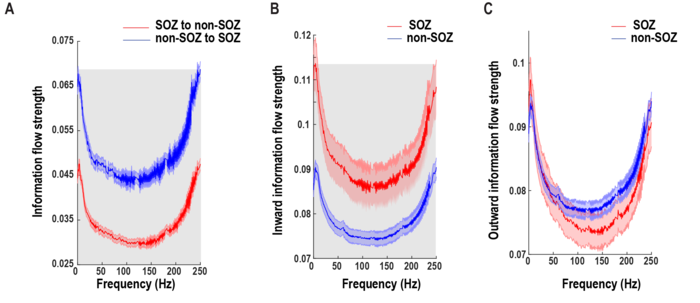
The technique extracts information flow across all recording electrodes and makes a prediction based on the different levels of information flow. He and colleagues discovered that the information flow from non-seizure generating tissue to seizure originating tissue is much larger than the inverse direction, and the notably greater difference in information flow often leads to a seizure-free outcome. Once implemented, this approach could have a major impact to inform clinicians and families if a patient should pursue a surgery and what the likelihood of surgical success would be.
Helping patients continues to be He’s driving motivation and overarching goal. By focusing on non-invasive and minimally-invasive approaches, He believes both the patient and healthcare system can benefit.
“This research not only will provide information about the likelihood of surgical success to individuals with epilepsy and their caregivers, but it will also help us to understand the underlying mechanisms of seizures using a minimally-invasive approach,” said Vicky Whittemore, Ph.D., program director, National Institute of Neurological Disorders and Stroke, a part of the National Institutes of Health.
Journal
Advanced Science
DOI
10.1002/advs.202200887