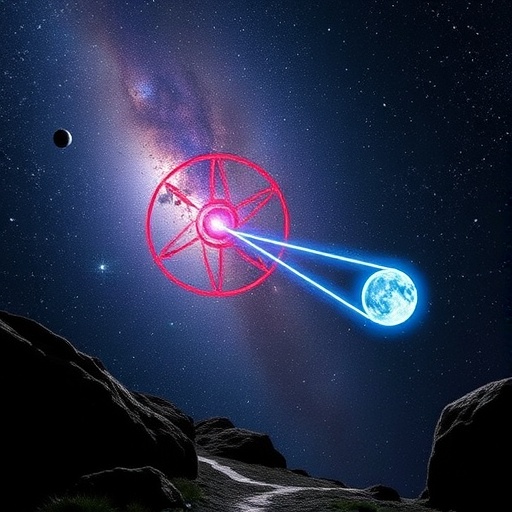
In a groundbreaking advancement at the intersection of quantum physics and cosmology, researchers at Imperial College London have unveiled a prototype quantum sensor that successfully overcomes a formidable obstacle in the quest to detect elusive cosmic phenomena such as dark matter and gravitational waves. This experimental breakthrough demonstrates, for the first time under realistic operating conditions, that a crucial principle underlying next-generation quantum detectors—differential atom interferometry—can reliably cancel out experimental noise to reveal faint signals otherwise drowned in chaotic interference.
The study centers on the use of atom interferometers—delicate instruments leveraging the wave-like nature of atoms manipulated by lasers to measure minute changes in atomic behavior with extraordinary precision. By comparing two spatially separated clouds of ultracold atoms interrogated by the same laser, researchers can isolate signals originating from anomalies in spacetime or exotic matter fields. However, fundamental to these measurements is overcoming the predominance of laser-induced phase noise, which has historically overwhelmed the subtle signals researchers aim to detect.
At the heart of the innovation is the demonstration of a differential measurement technique where two long-baseline atom interferometers, exposed to the same noisy laser environment, are compared to effectively cancel out common-mode noise. This cancellation is a seminal step toward realizing practical large-scale quantum sensors, as it preserves the integrity of signals that would be otherwise obscured. Until now, this technique had only been theoretically proposed, lacking experimental validation under conditions that closely mimic those anticipated in future detectors.
Leading the experimental effort, the Ultracold Strontium Laboratory at Imperial crafted a tabletop prototype using two macroscopically separated clouds of strontium-87 atoms cooled to near absolute zero, levitated on blue laser light. The atoms in the center of the chamber—visible as a faint glowing ball—were cooled to quantum degeneracy and manipulated by a meticulously stabilized clock laser. Within this setup, the team deliberately injected significant artificial phase noise, exceeding typical laser fluctuations, to test the sensor’s resilience against real-world disturbances expected in long-baseline detector configurations.
The outcome was remarkable: each individual interferometer’s signal was rendered indecipherable by the introduced noise, erasing the delicate interference patterns conventionally used for measurement. Yet, when the outputs of the two interferometers were compared, the noise effectively canceled, yielding a clear correlated signal. This confirmed that the combined measurement reached the fundamental quantum limit, validating the differential approach as a practical and robust solution to laser noise cancellation.
Pushing the boundaries further, researchers introduced an oscillating signal mimicking the influence of a passing gravitational wave or a transient dark matter interaction. Despite the overwhelming background noise, the combined interferometer pair detected the signal with high fidelity. This result is pivotal, illustrating the sensor’s potential to uncover minute perturbations imprinting on atom clouds—signatures that could provide new insights into the fundamental fabric of the Universe.
This breakthrough is a cornerstone of the Atom Interferometer Observatory and Network (AION) collaboration, a multidisciplinary initiative led by Imperial College London that connects experts from UK institutions. AION aims to scale these differential sensing techniques to kilometer-long baselines, thereby enabling quantum detectors capable of probing gravitational waves from the early Universe and searching for new forms of matter. The collaboration’s vision aligns with parallel international efforts, such as the MAGIS project at Fermilab in the United States and the proposed Atom Interferometry CERN Experiment (AICE), highlighting a global push to commercialize quantum sensing for fundamental physics.
The experimental confirmation that differential atom interferometry can suppress laser phase noise in realistic conditions addresses a crucial hurdle in designing next-generation quantum detectors. Such detectors promise to open unprecedented windows onto astrophysical phenomena, capturing gravitational waves in frequency bands inaccessible to existing observatories like LIGO and Virgo. Additionally, they elevate the search for dark matter fields from speculative theory toward experimental viability.
Importantly, the integration of ultracold atomic clocks and interferometers with quantum control techniques represents a fusion of two of the most precise measurement apparatuses ever constructed. By leveraging this synergy, the sensors can achieve sensitivities capable of detecting minuscule alterations in gravitational fields or transient interactions from exotic particles that form dark matter. This marriage of precision engineering and quantum technology heralds a new era in observational cosmology and particle physics.
Dr. Charles Baynham, a co-lead of the Ultracold Strontium Laboratory, articulates the profound significance of this work, emphasizing how quantum sensors embody a transformative tool for unveiling cosmic secrets once thought unreachable. The potential to “hear” signals from cataclysmic events such as black hole mergers billions of years ago exemplifies the far-reaching implications of this technology for understanding the Universe’s evolution and composition.
Looking ahead, the AION team is actively developing proposals to construct full-scale, long-baseline detectors at prominent international research centers including CERN and Fermilab. These facilities would represent monumental quantum experiments, extending the principle verified at the tabletop scale to infrastructures capable of interrogating spacetime and matter at unprecedented precision. Success in this domain would mark a paradigm shift, positioning quantum sensing as a vanguard technique in both fundamental physics and cosmological discovery.
This research receives support from a collaborative funding framework combining national and international agencies, including the Quantum Technologies for Fundamental Physics (QTFP) programme, which synergizes efforts across the Science and Technology Facilities Council and the Engineering and Physical Sciences Research Council. Such backing underscores the strategic importance of quantum sensor development in advancing frontiers of knowledge.
Professor Oliver Buchmueller, Principal Investigator of the AION programme, reflects on how this milestone marks a tangible advance towards large-scale quantum sensors that can access new regimes of physical reality. The validated technique acts as a catalyst for subsequent experimental designs, promising robust and scalable quantum devices capable of navigating the complex noise landscapes inherent in cutting-edge measurements.
As the field moves forward, the fusion of atom interferometry and quantum sensing offers a fertile landscape for breakthroughs in physics. Detecting gravitational waves beyond established frequency windows and unveiling the nature of dark matter may soon transition from theoretical aspirations into empirical reality. This pioneering achievement provides a beacon of promise, charting a course toward revolutionary observations that deepen humanity’s understanding of the enigmatic Universe we inhabit.
Subject of Research: Quantum sensing technology for detecting gravitational waves and dark matter via atom interferometry.
Article Title: A prototype differential atom interferometer for fundamental physics
News Publication Date: 17-Jun-2026
Web References: DOI: 10.1038/s41586-026-10617-1
Image Credits: Dr Thomas Walker, Imperial College London
Keywords
Physics, Dark matter, Astroparticle physics, Physical cosmology, Quantum information, Quantum information processing, Gravity waves
Tags: atom interferometers in cosmologydetecting exotic matter fieldsdifferential atom interferometry techniqueexperimental noise reduction in quantum sensorsgravitational wave detection technologylaser-induced phase noise cancellationlong-baseline atom interferometersnext-generation quantum detectorsprecision measurement with atom interferometryquantum physics and cosmology researchquantum sensor for dark matter detectionultracold atom wave measurements