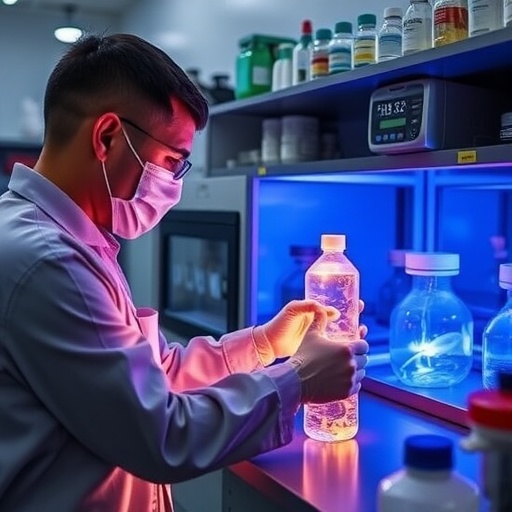
After years of meticulous investigation, an international consortium of chemists has confirmed the discovery of a groundbreaking chemical reaction that promises to revolutionize several scientific domains, ranging from sustainable plastics to advanced pharmaceuticals. Published in the prestigious journal Nature Chemistry, this pioneering work elucidates a novel type of sulfur-sulfur bond manipulation that proceeds swiftly and cleanly under ambient conditions, unlocking a myriad of transformative applications.
Unlike conventional reactions involving sulfur bonds—known for their stubborn resistance to change without harsh external inputs such as heat, light, or aggressive reagents—this newly characterized process, termed “trisulfide metathesis,” enables spontaneous and reversible cleavage and recombination of trisulfide bonds. This reaction proceeds efficiently in polar aprotic solvents at room temperature, and in some cases, achieves completion within seconds. The combination of unprecedented speed and selective precision marks a significant leap forward in sulfur chemistry, with vast implications for molecular design and synthetic methodology.
The cornerstone of this breakthrough lies in its ability to induce reversible transformations in sulfur-sulfur bonds, which are omnipresent in biological molecules such as peptides and proteins, critical drug compounds, and synthetic polymers including vulcanized rubber. Historically, the manipulation of these bonds required external stimuli, limiting practical applications. Now, the trisulfide metathesis offers a mild, reagent-free route to dynamically control these linkages, an innovation that represents a paradigm shift in chemistry.
The research spearheaded by Professor Justin Chalker from Flinders University, who has long championed eco-friendly sulfur polymer development, embodies a fruitful collaboration across continents and disciplines. Alongside colleagues from Liverpool University and other Australian and UK institutions, the team has constructed a comprehensive mechanistic model explaining the behavior of sulfur trisulfides under specific solvent conditions, shedding light on the fundamental forces governing this spontaneous reaction.
One particularly compelling aspect of this chemistry is its utility in medicinal chemistry. The selective modification of anti-tumor agents like calicheamicin, which inherently possess trisulfide motifs, underscores the reaction’s potential in targeted drug development. By enabling rapid and clean functionalization of such compounds, trisulfide metathesis paves the way for innovative therapies with enhanced specificity and reduced side effects. Dr. Harshal Patel, first author and key contributor from the Chalker Lab, notes that applying this chemistry to a diverse library of drug-like compounds opens unexplored territories in pharmaceutical research.
From a materials science standpoint, the implications are equally profound. The team demonstrated the creation of novel polymers that can be synthesized, utilized, and subsequently depolymerized back into their original monomeric units through trisulfide metathesis. This closed-loop recycling approach advances the sustainability agenda by proposing a chemical solution to plastic waste—a global environmental challenge. Unlike traditional plastics that degrade irreversibly, these innovative polymers offer the promise of infinite recyclability without compromising material integrity or performance.
The mechanistic insights crafted through intensive study reveal that trisulfide metathesis thrives in polar aprotic solvents, a medium that uniquely stabilizes reactive intermediates allowing bond rearrangement to proceed seamlessly. The reaction’s high selectivity stems from the intrinsic properties of the trisulfide bond, which exhibits both stability and lability under finely tuned conditions. These features make the reaction exceptionally adaptable for designing responsive biomolecules and dynamic materials.
Envisioning broader technological impacts, co-author Dr. Tom Hasell highlights the versatility of the reaction as a molecular switch to induce reversible changes within complex chemical systems. The swift, stimulus-free bond reshuffling could be harnessed to develop smart materials that respond dynamically to environmental cues, self-heal upon damage, or enable controlled release in drug delivery platforms.
Financially supported by multiple Australian Research Council Discovery Grants, the team’s interdisciplinary approach blends synthesis, mechanistic evaluation, and application-driven experimentation. Their collaborative use of computational infrastructure and high-impact experimental facilities underscores the contemporary fusion of theory and practice necessary for such advanced chemical innovation.
Future research aims to translate this chemistry into the mainstream synthesis of recyclable plastics, rubbers, foams, and fibers, expanding the scope of environmentally sustainable materials. The team is actively pursuing the development of generalized trisulfide metathesis polymerization techniques, striving to embed this novel chemistry into the circular economy framework at an industrial scale.
This discovery arrives at a critical juncture when global efforts to reduce carbon footprints and plastic pollution demand inventive solutions. The trisulfide metathesis not only embodies a fundamental chemical advance but also offers tangible hope for a new generation of sustainable materials and more effective medicinal agents. Its ease of operation, rapid kinetics, and environmental benignity position it as a game-changer that will undoubtedly captivate chemists and material scientists worldwide.
As researchers continue to explore this chemistry, the scientific community anticipates an unfolding cascade of applications yet to be imagined. The combination of elegant molecular control and practical utility ensures that trisulfide metathesis will become a cornerstone reaction, inspiring innovations across biotechnology, pharmacology, polymer science, and beyond.
Subject of Research: Chemistry – Discovery of a spontaneous trisulfide metathesis reaction and its applications in sustainable materials and drug development.
Article Title: Spontaneous Trisulfide Metathesis in Polar Aprotic Solvents
News Publication Date: March 13, 2026
Web References:
Nature Chemistry article: https://www.nature.com/articles/s41557-026-02091-z
DOI link: http://dx.doi.org/10.1038/s41557-026-02091-z
Image Credits: Flinders University
Keywords
Trisulfide metathesis, sulfur-sulfur bonds, recyclable polymers, sustainable plastics, anti-tumor drug modification, sulfur chemistry, closed-loop recycling, dynamic covalent chemistry, medicinal chemistry, polymer depolymerization, sulfur polymers, polar aprotic solvents.
Tags: advanced pharmaceutical drug designambient condition chemical reactionsbiochemical sulfur bond applicationsmolecular design in sulfur chemistrypolar aprotic solvent reactionsrapid sulfur bond cleavagereversible sulfur-sulfur bond manipulationsulfur bond transformations in peptidessustainable recyclable plastics chemistrysynthetic methodology innovationtrisulfide metathesis reactionvulcanized rubber recycling technology