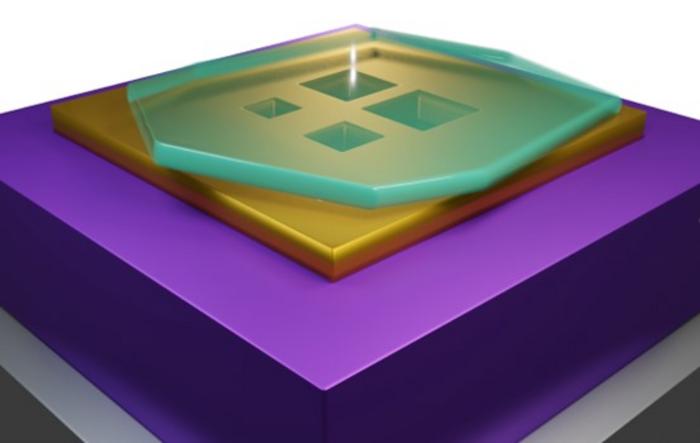
Credit: Matteo Ceccanti
In a significant leap forward for quantum nanophotonics, a team of European and Israeli physicists, introduces a new type of polaritonic cavities and redefines the limits of light confinement. This pioneering work, detailed in a study published today in Nature Materials, demonstrates an unconventional method to confine photons, overcoming the traditional limitations in nanophotonics.
Physicists have long been seeking ways to force photons into increasingly small volumes. The natural length scale of the photon is the wavelength and when a photon is forced into a cavity much smaller than the wavelength, it effectively becomes more “concentrated”. This concentration enhances interactions with electrons, amplifying quantum processes within the cavity. However, despite significant success in confining light into deep subwavelength volumes, the effect of dissipation (optical absorption) remains a major obstacle. Photons in nanocavities are absorbed very quickly, much faster than the wavelength, and this dissipation limits the applicability of nanocavities to some of the most exciting quantum applications.
The research group of Prof. Frank Koppens from ICFO in Barcelona, Spain, addressed this challenge by creating nanocavities with an unparalleled combination of subwavelength volume and extended lifetime. These nanocavities, measuring smaller than 100x100nm² in area and only 3nm thin, confine light for significantly longer durations. The key lies in the use of hyperbolic-phonon-polaritons, unique electromagnetic excitations occurring in the 2D material forming the cavity.
Unlike previous studies on phonon polariton-based cavities, this work utilizes a new and indirect confinement mechanism. The nanocavities are crafted by drilling nanoscale holes in a gold substrate with the extreme (2-3 nanometer) precision of a He focused ion beam microscope. After making the holes, hexagonal boron nitride (hBN), a 2D material, is transferred on top of it. The hBN supports electromagnetic excitations called hyperbolic-photon polaritons which are similar to ordinary light except that they can be confined to extremely small volumes. When the polaritons pass above the edge of the metal, they experience a strong reflection from it, which allows them to be confined. This method thus avoids shaping the hBN directly and preserves its pristine quality, enabling highly-confined AND long-lived photons in the cavity.
This discovery began with a chance observation made during a different project while using a nearfield optical microscope to scan 2D material structures. The nearfield microscope allows exciting and measuring polaritons in the mid-infrared range of the spectrum and the researchers noticed an unusually strong reflection of these polaritons from the metallic edge. This unexpected observation sparked a deeper investigation, leading to the realization of the unique confinement mechanism and its relation to nanoray formation.
However, upon making and measuring the cavities, the team were in for a huge surprise. “Experimental measurements are usually worse than theory would suggest, but in this case, we found the experiments outperformed the optimistic simplified theoretical predictions,” said first author, Dr. Hanan Herzig Sheinfux, from Bar-Ilan University’s Department of Physics. “This unexpected success opens doors to novel applications and advancements in quantum photonics, pushing the boundaries of what we thought was possible.”
Dr. Herzig Sheinfux conducted the research with Prof. Koppens during his postdoctoral term at ICFO. He intends to use these cavities to see quantum effects that were previously thought impossible, as well as to further study the intriguing and counterintuitive physics of hyperbolic phonon polariton behavior.
Journal
Nature Materials
Article Title
High-quality nanocavities through multimodal confinement of hyperbolic polaritons in hexagonal boron nitride
Article Publication Date
6-Feb-2024