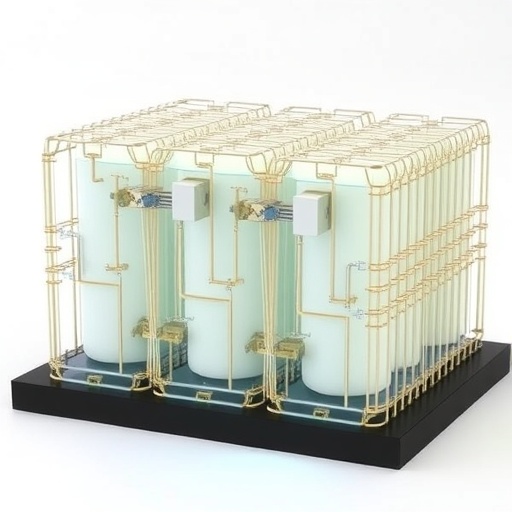
A groundbreaking advancement in fuel cell technology has been unveiled by researchers from KAIST and affiliated institutions, promising to revolutionize the landscape of clean energy generation. This innovation is centered on the direct utilization of ammonia as a fuel source in protonic ceramic fuel cells (PCFCs), which operate by transporting hydrogen ions (protons) to generate electricity. The newly developed catalyst system significantly enhances both the performance and stability of ammonia-fueled PCFCs, positioning this technology at the forefront of next-generation carbon-free power sources.
The appeal of ammonia (NH₃) as a hydrogen carrier lies in its liquid state under moderate conditions, rendering it far easier to store and transport compared to gaseous hydrogen. Unlike hydrocarbons, ammonia combustion emits almost no carbon dioxide, as its composition is solely nitrogen and hydrogen, thereby presenting a compelling option for sustainable energy infrastructure. However, until now, practical challenges such as degradation of nickel-based catalysts and sluggish reaction kinetics within fuel cells have stymied the widespread adoption of ammonia as a direct fuel.
Addressing these hurdles, the KAIST team engineered a novel catalyst architecture that leverages a “high-entropy” oxide matrix. High-entropy materials are meticulously designed by blending multiple elements to produce a robust, stable structure that resists structural collapse and deactivation. Integrating this with spontaneously formed metal alloy nanoparticles on the catalyst surface, the researchers created a synergistic system that drastically improves ammonia decomposition and hydrogen ion conduction.
Detailed atomistic simulations using Density Functional Theory (DFT) revealed that the high-entropy oxide framework effectively lowers the activation energy barrier for ammonia decomposition. This expedites the initial breaking down of ammonia molecules into nitrogen and hydrogen, with concurrent formation and stabilization of metal nanoparticle alloys that exhibit superior catalytic activity compared to traditional single-metal catalysts. This dual mechanism enhances reaction rates and reinforces catalyst longevity.
Experimental investigations corroborated these computational insights. Fuel cells equipped with the new catalyst delivered an unprecedented maximum power density of 2.04 watts per square centimeter at 700°C — a remarkable level of power output for an ammonia-based PCFC. Such efficiency translates to substantial energy generation from a remarkably compact cell footprint, akin to the size of a fingernail, making it highly attractive for scalable energy applications.
Stability tests demonstrated sustained operation over 255 hours at 600°C under demanding conditions without significant performance decay, addressing the chronic problem of catalyst degradation encountered in prior designs. This stability is crucial for real-world deployment where long-term durability under thermal and chemical stress ensures reliability and cost-effectiveness.
The team’s innovation pivots on the carefully orchestrated interplay between the engineered high-entropy oxide and the in situ formed alloy nanoparticles. This design not only protects the catalyst’s structural integrity against ammonia’s detrimental effects but simultaneously fosters enhanced surface reactions that underpin efficient power generation. This breakthrough marks a paradigm shift in the practical use of ammonia fuel cells.
Professor Kang Taek Lee emphasized the transformative potential of this synergy, stating that their catalyst design could accelerate the commercial viability of ammonia-based power generation technologies and spur widespread adoption of carbon-neutral hydrogen energy systems. The societal and environmental implications are profound, offering a viable pathway to mitigate reliance on fossil fuels and reduce greenhouse gas emissions globally.
This research effort was a collaborative enterprise comprising multidisciplinary expertise from KAIST, the Korea Institute of Ceramic Engineering and Technology (KICET), and the Korea Institute of Geoscience and Mineral Resources (KIGAM). The interdisciplinary approach facilitated innovative materials design, advanced theoretical modeling, and rigorous experimental validation, demonstrating the integrated nature of contemporary energy research.
The results are documented in a scientific paper titled “Entropy-Modulated Oxide–Metal Catalyst Architectures for Direct Ammonia Protonic Ceramic Fuel Cells,” published in the high-impact journal Nano-Micro Letters. The publication reflects a significant contribution to the energy materials research community and opens avenues for further exploration and refinement of fuel cell catalysts tailored for ammonia and other hydrogen carriers.
Supported by multiple funding initiatives, including the Mid-Career Researcher Program of the Ministry of Science and ICT and the Global Basic Research Laboratory Program, this study exemplifies how strategic investments in foundational science can yield technological breakthroughs with far-reaching economic and ecological benefits. The research sets a new benchmark for ammonia fuel cell performance and durability, inspiring optimistic prospects for a sustainable hydrogen economy.
The advent of high-entropy oxide–metal hybrid catalysts heralds a new chapter in clean energy technologies, potentially enabling efficient, stable, and practical ammonia-based fuel cells. By overcoming the intrinsic limitations of previous materials, this innovation paves the way for scalable implementation of carbon-free power generation, offering a glimpse into a future where ammonia serves as a cornerstone of sustainable energy infrastructure worldwide.
Subject of Research: Development of high-performance catalysts for ammonia-based protonic ceramic fuel cells enabling direct ammonia utilization
Article Title: Entropy-Modulated Oxide–Metal Catalyst Architectures for Direct Ammonia Protonic Ceramic Fuel Cells
News Publication Date: 20-May-2026
Web References: http://dx.doi.org/10.1007/s40820-026-02194-9
Image Credits: KAIST
Keywords
Protonic Ceramic Fuel Cells, Ammonia Fuel, High-Entropy Oxide Catalyst, Metal Nanoparticles, Catalyst Durability, Hydrogen Economy, Carbon-Free Power Generation, Density Functional Theory, Ammonia Decomposition, Catalyst Stability, Fuel Cell Performance, Sustainable Energy
Tags: ammonia as hydrogen carrierammonia fuel cell performanceammonia fuel cell stabilityammonia protonic ceramic fuel cellscarbon-free power sourcesclean energy generationhigh-entropy oxide catalystshydrogen ion transporthydrogen storage technologynext-generation fuel cellsnickel catalyst degradation solutionssustainable energy infrastructure