The term meta means a concept of transcendence or surpassing, and when applied to materials, metamaterials encompass artificially engineered substances that exhibit properties not naturally found in the environment. Metasurfaces, characterized by their thinness and lightness, have garnered considerable interest as a potential component for incorporation into portable augmented reality (AR) and virtual reality (VR) devices to facilitate holographic generation. Nonetheless, it is important to note that metasurfaces have inherent limitations, such as their restricted capacity to store information and their capability to generate holograms solely within the visible spectrum.
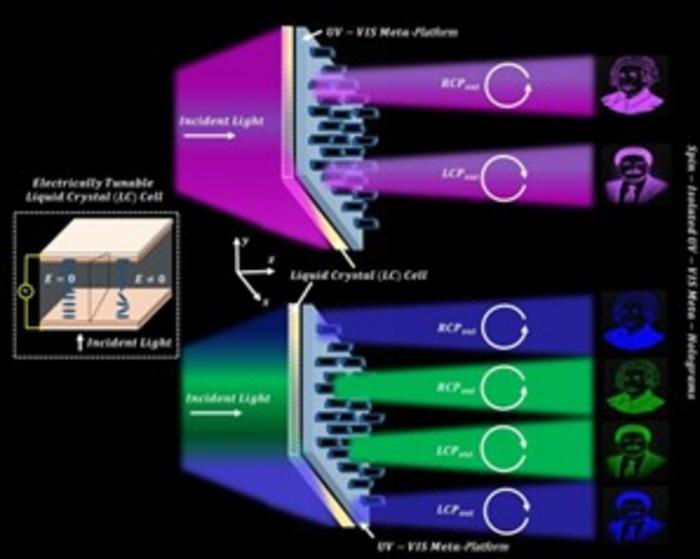
Credit: POSTECH
The term meta means a concept of transcendence or surpassing, and when applied to materials, metamaterials encompass artificially engineered substances that exhibit properties not naturally found in the environment. Metasurfaces, characterized by their thinness and lightness, have garnered considerable interest as a potential component for incorporation into portable augmented reality (AR) and virtual reality (VR) devices to facilitate holographic generation. Nonetheless, it is important to note that metasurfaces have inherent limitations, such as their restricted capacity to store information and their capability to generate holograms solely within the visible spectrum.
The research team comprising Professor Junsuk Rho from the Department of Mechanical Engineering and the Department of Chemical Engineering and Joohoon Kim from the Department of Mechanical Engineering at Pohang University of Science and Technology (POSTECH) have achieved the generation of meta-holograms applicable to both the visible and ultraviolet spectral regions. The research findings have been published in the inside front cover of Nanoscale Horizons, an esteemed international journal.
The restriction of hologram generation to the visible spectral range has been primarily attributed to light absorption exhibited by most objects in the ultraviolet regime. However, the research team has effectively addressed this challenge by incorporating a thin layer of specially formulated gas compositions into the metasurfaces, thereby achieving significant improvements in holographic transmission efficiency within both the visible and ultraviolet regimes.
Furthermore, the team has accomplished the encoding of two distinct holographic phase profiles onto a single metasurface. The polarization characteristics of light govern its propagation through space. Leveraging this phenomenon, the team’s approach enables the provision of holographic information both for clockwise circularly polarized light and counter-clockwise circularly polarized light, effectively doubling the amount of information encoded onto metasurfaces.
To facilitate practical implementation, the team employed liquid crystal, a commonly used component in cellphones and LCD displays, which enables convenient manipulation of the light’s spin direction. The experimental results demonstrated that in the absence of an electric field, the light exhibits clockwise spinning, thereby generating a type A hologram. Conversely, the application of an electric field induces a different light spinning direction, resulting in the generation of a type B hologram. In essence, the research team engineered a device capable of presenting distinct holograms based on the presence or absence of an electric field.
Professor Junsuk Rho – who led the research – emphasized this breakthrough by commenting, “This study is significant in that it overcomes the limitations associated with meta-holograms solely applicable to the visible regime and we have achieved the concurrent generation of meta-holograms in both the visible and the UV domains.” He added, “This proposed metasurface can have promising applications in security technologies such as anti-counterfeiting measures, identifications, and passports.”
The study was conducted with the support from the STEAM Research Program (Center for Nano-optics-based Smart Data Security Technology) of the National Research Foundation of Korea funded by the Ministry of Science and ICT and a program of POSCO’s Industry-Academic Integrated Research Center.
Journal
Nanoscale Horizons
DOI
10.1039/D2NH00555G
Article Title
Spin-isolated ultraviolet-visible dynamic meta-holographic displays with liquid crystal modulators
Article Publication Date
18-Apr-2023