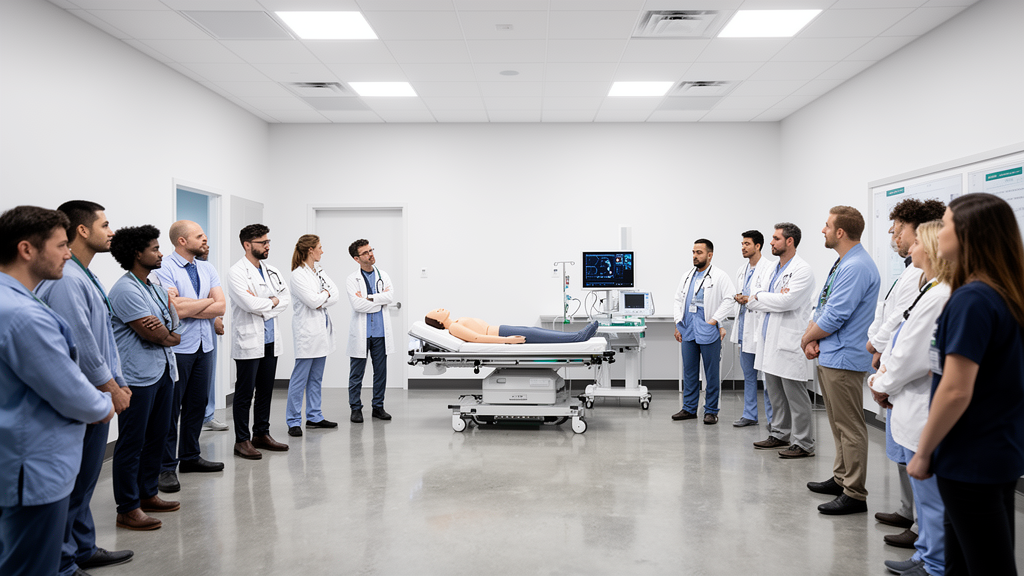
A practice-based implementation study conducted within a Brazilian higher education institution has demonstrated the operational feasibility and distinct structural trade-offs of a hybrid, context-sensitive faculty development architecture designed to train healthcare simulation facilitators. Published in Advances in Simulation, the research, formally registered in the Brazilian Registry of Clinical Trials under identifier RBR-4dqtygd, evaluated an institutional initiative intended to reconcile international pedagogical standards with the real-world operational constraints of limited institutional resources, heterogeneous educator backgrounds, and heavy teaching workloads. Led by Daniel Gonçalves Campos, Juliany Lino Gomes Silva, Fernanda Magalhães Arantes-Costa, and Ana Railka de Souza Oliveira-Kumakura, the project investigated how higher education institutions can systematically prepare educators to design realistic clinical scenarios and lead structured debriefings without demanding unsustainable investments of time or capital. Across four successive training cohorts conducted over a six-month period, the program achieved high participant acceptability and stable core attendance, while simultaneously revealing that voluntary, passive longitudinal support structures encountered substantial participation hurdles among busy academic staff.
The development of the training architecture arose directly from an institutional challenge encountered during a broader curricular reform that significantly expanded active learning methodologies and simulation-based education across the university. Although simulation had been formally embedded into curricular planning, faculty preparation had not expanded at a commensurate pace, creating an implementation gap frequently reported across health professions education literature. Within the Brazilian institution, a cohort of approximately 1,600 healthcare students depended on a very small group of trained simulation facilitators, generating acute pedagogical strain and raising urgent concerns regarding educational quality assurance and long-term scalability. In response, the investigative team initiated an institutional diagnosis informed by faculty discussions, comprehensive curriculum reviews, and detailed utilization analyses of the campus simulation laboratory. This needs assessment identified four interrelated baseline conditions that dictated subsequent curricular planning: widespread lack of familiarity with simulation pedagogy, inconsistent scenario design methodologies, excessive faculty teaching workloads combined with an absence of protected development time, and strong institutional leadership commitment to expanding simulation capacity.
Rather than adopting an existing faculty development framework wholesale, the researchers formulated an adaptive architecture grounded in experiential learning theory, adult learning principles, and perspectives from implementation science. The conceptual framework explicitly recognized that healthcare faculty operate under competing clinical, administrative, teaching, and research responsibilities that regularly impede participation in traditional, resource-intensive development pathways. To avoid the familiar dichotomy between idealistic educational standards and pragmatic operational realities, the team designed an integrated structure balancing foundational training with flexible, low-intensity follow-up mechanisms. Crucially, the authors clarified that the architecture was conceived not as a formal competency certification or performance management system, but as an implementation layer to support progressive educator growth within local constraints. Promotion and recruitment were strategically integrated into the university’s Annual Pedagogical Meeting two months before the inaugural edition, establishing formal governance endorsement, reinforcing alignment with broader institutional priorities, and fostering voluntary engagement without imposing mandatory administrative participation mandates.
The resulting curriculum established a total workload of sixteen instructional hours, evenly divided between eight hours of theoretical preparation and eight hours of immersive practical training. The preparatory theoretical segment incorporated four asynchronous video lectures developed via the Canva platform, totaling two hours of viewing, complemented by multiple-choice quizzes administered through Google Classroom, which functioned as the virtual learning environment. The asynchronous modules systematically addressed core themes identified during the diagnostic phase: program orientation and guidelines, the pedagogical profile of twenty-first-century adult learners, foundational principles of clinical simulation in health professions, and objective assessment strategies utilizing validated evaluation instruments. This asynchronous foundation was designed to optimize synchronous contact time, respect diverse study rhythms, and establish a common conceptual baseline across heterogeneous participant groups. The theoretical phase subsequently culminated in three two-hour online synchronous evening sessions that explored facilitator professional profiles, scenario design methodologies, and structured debriefing stages through interactive lectures, case design workshops, role play, and video analysis, supported by self-reflection via the Brazilian version of the Facilitator Competency Rubric.
The practical component of the architecture operationalized Kolb’s experiential learning cycle across two mandatory in-person sessions lasting four hours each. To safeguard instructional quality and active involvement during hands-on activities, each of the four program editions was restricted to a maximum of twelve participants, guided by two certified instructors in accordance with staffing ratios recommended by the Société Francophone de Simulation en Santé. During the initial practical session, participants convened in multidisciplinary working groups to construct realistic, simulation-based scenarios tailored specifically to their own academic disciplines and institutional learning objectives. In the second in-person session, faculty implemented these newly developed scenarios within the simulation laboratory, cycling through prebriefing, scenario execution, and debriefing phases while alternating between facilitator and learner roles. Following every completed scenario, course instructors delivered structured feedback functioning as a debriefing of the debriefing, fostering immediate critical reflection on facilitation choices. To guarantee genuine experiential consolidation, attendance at both in-person workshops was established as the non-negotiable prerequisite for institutional program certification.
Quantitative tracking and operational indicators demonstrated robust initial interest and feasibility across the targeted academic population. Of the 346 faculty members formally invited to participate, 79 individuals voluntarily enrolled in the program, and 46 successfully completed all mandatory theoretical and practical requirements across the four separate editions. Participant satisfaction was notably high among completing educators, yielding a mean rating of 9.6 on a ten-point evaluation scale, with 64 percent of completers reporting a high likelihood of integrating simulation-based activities into their future teaching assignments. Longitudinal tracking of facilitator readiness profiles using descriptive rubric evaluations indicated developmental movement over time, showing an increased proportion of faculty classified at advanced readiness levels alongside a marked reduction in the beginner tier six months after program completion. However, the study authors emphasized that these descriptive readiness profiles provide contextual evidence of educator progression within an institutional learning architecture rather than definitive proof of verified individual clinical teaching competence.
Recognizing that isolated workshops rarely produce enduring pedagogical transformation, the authors integrated a six-month responsive longitudinal support component intended to act as an accessible scaffold for authentic curricular transfer. Rather than imposing rigid, compulsory mentorship appointments that might conflict with busy schedules, the program made expert guidance available on demand through familiar communication channels, designating WhatsApp as the primary messaging portal alongside institutional email and optional scheduled in-person meetings. In addition, the longitudinal strategy incorporated spaced microlearning through brief, practice-oriented educational resources termed knowledge pills. These digital capsules were distributed periodically across WhatsApp channels, Google Classroom announcement boards, and institutional email networks to provide low-burden reinforcement. The microlearning materials targeted recurrent real-world implementation dilemmas, including formulating precise simulation learning objectives, managing challenging prebriefing and debriefing dynamics, and curating open-access clinical scenarios, thereby maintaining ongoing cognitive engagement without increasing formal workload expectations.
Despite the deliberate accessibility of the longitudinal support mechanisms, post-training activation revealed notable operational tensions regarding participant engagement. Over the six-month follow-up window, only four distinct faculty members actively solicited consultative support from the program facilitator, resulting in a total of seven documented interactions across the entire completing cohort. All four consulting educators possessed extensive academic backgrounds: two were physicians and two were nurses, three held doctoral degrees and one possessed post-doctoral training, their average teaching tenure reached 18.25 years, and all four had self-rated as competent on the Facilitator Competency Rubric prior to instruction. Consultations occurred predominantly through digital channels, comprising five exchanges on WhatsApp, one via institutional email, and one extensive two-hour face-to-face planning conference. Requests directly addressed concrete implementation challenges, including pre-implementation scenario refinements, multi-semester curricular scheduling, role clarification, standardized patient management in debriefings, and selection of validated evaluation instruments, illustrating that on-demand support was activated exclusively around specific, perceived operational needs.
The investigation critically framed these outcomes through established faculty development frameworks and educational evaluation hierarchies, notably drawing upon Kirkpatrick’s four-level model. Within the program’s design logic, the initial hybrid workshops explicitly targeted reaction and learning, while the longitudinal support structure was formulated to support Level 3 behavioral transfer into regular classroom practice, though broader organizational impacts corresponding to Level 4 were outside the investigation’s formal scope. In contextualizing their findings alongside prominent international models, such as the developmental expertise continuum described by Cheng and colleagues and the Entrustable Professional Activities proposed by Kaba and associates, the authors noted that existing literature focuses predominantly on individual educator trajectories and competency milestones. By contrast, the Brazilian project addressed the practical implementation architecture required to operationalize these principles in settings constrained by heterogeneous staff experience and limited supervisory resources, demonstrating how structural pragmatism can complement established competency milestones.
Reflective analysis of the implementation process generated five core design principles for establishing sustainable simulation development initiatives within resource-variable academic centers. First, institutions must prioritize foundational experiential alignment before attempting complex longitudinal mentorship, as establishing a shared baseline enables partial autonomous transfer. Second, programs should design for feasibility before intensity, aligning instructional expectations with institutional workload capacities. Third, educational leaders must recognize that availability does not guarantee activation; passive, on-demand consultation leaves an unresolved ambiguity between self-sufficient adoption and silent disengagement, underscoring the necessity of structured follow-up checkpoints. Fourth, support mechanisms should be embedded directly into preexisting institutional digital ecosystems to reduce cognitive and technical friction. Fifth, ongoing procedural adaptations must be embraced as context-sensitive calibration rather than implementation fidelity failures. As preserved in the Unicamp Research Data Repository under digital object identifier 10.25824/redu/QTV2FH, the study provides a pragmatic framework for institutions seeking to expand simulation capacity within authentic organizational realities.
Subject of Research: Implementation and evaluation of a context-sensitive faculty development architecture for simulation facilitators
Article Title: Designing a context-sensitive faculty development architecture for simulation facilitators: lessons from a practice-based implementation
Article References: Gonçalves Campos, D., Lino Gomes Silva, J., Magalhães Arantes-Costa, F., & de Souza Oliveira-Kumakura, A. R. (2026). Designing a context-sensitive faculty development architecture for simulation facilitators: lessons from a practice-based implementation. Advances in Simulation, 11(1), Article 72. https://doi.org/10.1186/s41077-026-00465-4
Image Credits: AI Generated
DOI: 10.1186/s41077-026-00465-4
Keywords: simulation-based education, faculty development, clinical simulation, medical education, experiential learning, implementation science, scenario design, debriefing, Designing, context-sensitive, faculty, development
News Source: Courtney Benton. (November 9, 2026). Brazilian Study Tests Pragmatic Faculty Architecture for Clinical Simulation Facilitators. Scienmag.