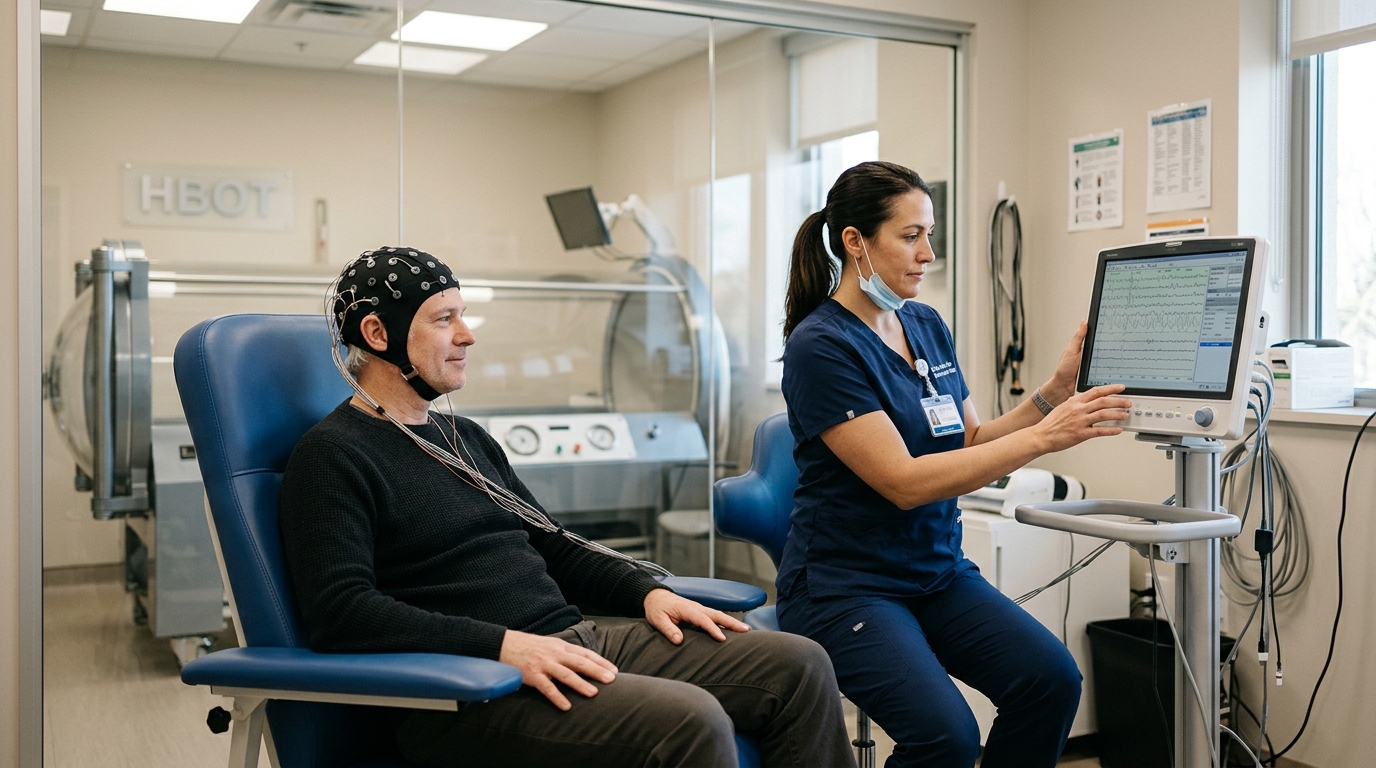
A clinical trial conducted by researchers at Ningbo Rehabilitation Hospital demonstrates that combining intermittent theta burst stimulation with hyperbaric oxygen therapy and routine cognitive training improves cognitive function and cortical hemodynamics in patients experiencing post-stroke mild cognitive impairment. Published in Frontiers in Human Neuroscience, the study used functional near-infrared spectroscopy to evaluate how this dual-intervention approach influences task-evoked cerebral oxygenation and neural activation patterns over a six-week intervention course.
The randomized clinical trial recruited sixty eligible patients presenting with post-stroke mild cognitive impairment and assigned them evenly into two parallel cohorts: an observation group comprising thirty patients and a control group comprising thirty patients. Both groups underwent a standard six-week rehabilitative regimen consisting of hyperbaric oxygen therapy alongside routine cognitive training. The observation group received additional intermittent theta burst stimulation throughout the same six-week intervention window to investigate potential cumulative therapeutic effects on post-stroke cognitive rehabilitation.
Before beginning the therapeutic interventions, the clinical research team conducted baseline assessments across both cohorts to establish statistical equivalence across all primary indicators. The evaluation confirmed that baseline demographic characteristics and clinical features did not differ significantly between the observation group and the control group, with all initial comparisons yielding p-values greater than 0.05. Similarly, initial baseline evaluations showed no statistically significant differences between the two study arms regarding Mini-Mental State Examination scores, prefrontal oxygenated hemoglobin integral values, or channel-wise cortical activation parameters.
To assess changes in global cognitive function, investigators administered the Mini-Mental State Examination before treatment initiation and again following the conclusion of the six-week protocol. Within-group comparisons performed using paired t-tests demonstrated that both the observation cohort and the control cohort experienced statistically significant increases in Mini-Mental State Examination scores relative to their respective pre-treatment baselines, with all p-values falling below 0.05. These within-group gains indicated that both intervention schedules were associated with measurable improvements in global cognitive performance over the course of the six-week rehabilitation schedule.
Alongside standard cognitive testing, the researchers deployed functional near-infrared spectroscopy to detect task-evoked cortical oxygenated hemoglobin responses during cognitive activity. This optical imaging framework recorded two primary physiological indices: prefrontal oxygenated hemoglobin integral values and channel-wise oxygenated hemoglobin beta values, which reflect cortical activation intensity across individual monitoring channels. Paired t-tests examining pre-treatment and post-treatment records showed that both study groups achieved statistically significant within-group increases in prefrontal oxygenated hemoglobin integral values after six weeks of therapy, with all p-values remaining below 0.05.
To compare post-treatment outcomes between the two arms while controlling for initial values, the investigators performed an analysis of covariance using baseline levels as covariates. The analysis revealed that after adjusting for pre-treatment baseline measurements, the observation group achieved significantly higher post-treatment Mini-Mental State Examination scores and significantly greater prefrontal oxygenated hemoglobin integral values than the control group. These statistically significant between-group differences established that adding intermittent theta burst stimulation to hyperbaric oxygen therapy and routine cognitive training produced superior cognitive and oxygen-metabolic outcomes compared to hyperbaric oxygen therapy and cognitive training alone.
To examine localized neural dynamics across individual cortical channels, the researchers applied a two-way mixed-design analysis of variance to channel-wise beta values, setting group as the between-subject factor and time as the within-subject factor. This statistical model was followed by simple effects analyses using false discovery rate corrections for multiple comparisons. The channel-wise analysis revealed significant group-by-time interaction effects across six specific channels: CH7, CH8, CH14, CH32, CH40, and CH45. These interactions indicated that the temporal trajectories and patterns of task-related cortical activation changes differed significantly between the observation and control groups across the intervention period.
Based on these cognitive and neuroimaging findings, authors Ling Ling Wu, Shuang Gong, Ge Chen, and Min Tang concluded that combining intermittent theta burst stimulation with hyperbaric oxygen therapy effectively enhances cognitive function in patients with post-stroke mild cognitive impairment. The investigators noted that the observed elevations in task-evoked oxygenated hemoglobin levels and prefrontal neural activation likely reflect favorable modulation of cerebral oxygen metabolism and enhanced functional plasticity within prefrontal-temporal cognitive neural networks during post-stroke rehabilitation.
Subject of Research: Effects of combined intermittent theta burst stimulation and hyperbaric oxygen therapy on post-stroke cognitive impairment
Article Title: Effects of intermittent theta burst stimulation combined with hyperbaric oxygen therapy on cognitive function and cerebral blood flow in patients with post-stroke mild cognitive impairment
Article References: Wu, L., Gong, S., Chen, G., & Tang, M. (2026). Effects of intermittent theta burst stimulation combined with hyperbaric oxygen therapy on cognitive function and cerebral blood flow in patients with post-stroke mild cognitive impairment. Frontiers in Human Neuroscience, 20, Article 1966062. https://doi.org/10.3389/fnhum.2026.1966062
Image Credits: AI Generated
DOI: 10.3389/fnhum.2026.1966062
Keywords: intermittent theta burst stimulation, hyperbaric oxygen therapy, post-stroke cognitive impairment, functional near-infrared spectroscopy, Mini-Mental State Examination, oxygenated hemoglobin, prefrontal cortex, cortical hemodynamics, cognitive rehabilitation, stroke recovery, neural plasticity, cerebral oxygen metabolism, prefrontal-temporal networks, channel-wise cortical activation, task-evoked hemodynamics, clinical trial
News Source: Cassandra Pierce. (November 17, 2026). Brain Stimulation and Hyperbaric Oxygen Therapy Improve Post-Stroke Cognitive Recovery. Scienmag.