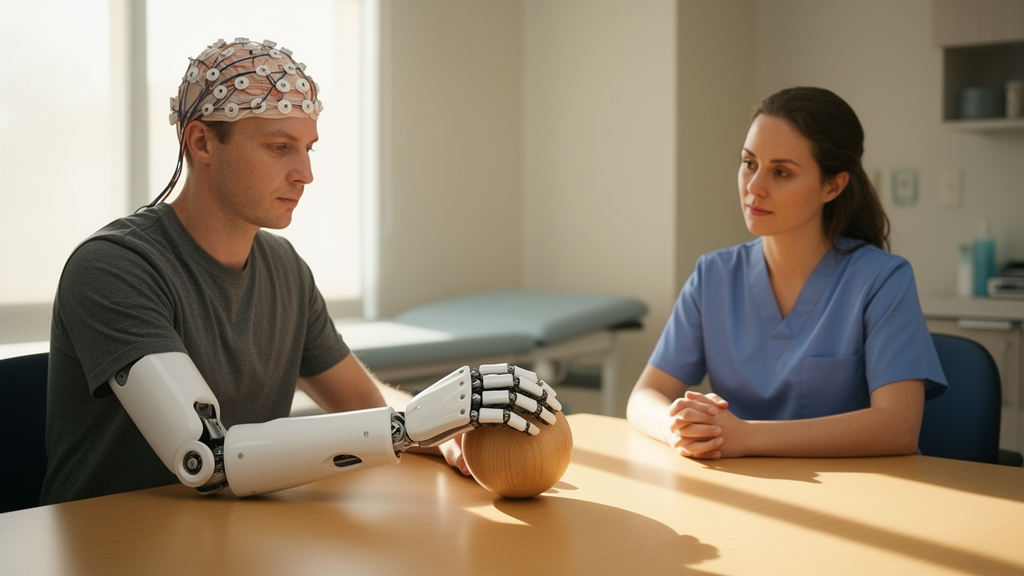
An editorial published in Frontiers in Neurology synthesizes findings from five recent studies evaluating brain-computer interface technologies and robotic systems, concluding that while brain-contingent devices and robotic movement assistance demonstrate meaningful improvements in post-stroke upper-limb motor function, clinical outcomes vary substantially across intervention types and study methodologies.
Upper-limb dysfunction remains among the most persistent long-term sequelae following stroke, presenting particular challenges for the recovery of distal hand function such as grasping, pinching, and fine object manipulation. As the editorial outlines, these manual skills rely on coordinated motor planning, the structural integrity of residual descending motor pathways, precise proprioceptive sensory feedback, and intensive, task-specific training regimens that are difficult for severely impaired patients to execute independently.
To address these physiological and motor limitations, researchers combine brain-computer interfaces that decode movement intentions directly from cortical signals with external robotic effectors that deliver timely physical movement assistance. The primary clinical objective highlighted across the research collection is the development of adaptive closed-loop systems capable of dynamically responding to individual patient states, establishing bidirectional interactions among motor-intention decoding, physical assistance, and multimodal sensory feedback.
The editorial establishes a critical mechanistic distinction between assistive brain-computer interfaces, which compensate for lost physical capacity, and restorative systems designed to drive neural recovery through intention-contingent sensorimotor feedback and activity-dependent neuroplasticity. However, the author cautions that clinical functional improvements resulting from feedback do not constitute definitive proof of underlying neuroplastic reorganization, and that continuous individualized adaptation according to fluctuating neural or behavioral states remains a future goal rather than a demonstrated capability of all current devices.
Broadening the evaluation beyond isolated motor metrics, a meta-analysis by Wang and colleagues encompassing 13 studies and 488 stroke patients identified an association between robot-assisted rehabilitation and improved scores on the Montreal Cognitive Assessment. Although these cognitive findings highlight how attention, engagement, and cognitive status can influence motor learning and system interaction, sensitivity analyses revealed instability across cognitive outcomes, the overall evidence quality remained limited, and the evaluated protocols involved robotic training without brain-computer interface control.
Focusing specifically on motor outcomes, a systematic review by Zheng and colleagues evaluating 27 randomized controlled trials reported significant improvements in both upper- and lower-limb Fugl-Meyer scores following brain-computer interface rehabilitation. Subgroup analyses demonstrated that functional recovery varied substantially depending on the feedback modality applied, the specific post-stroke stage of participants, and overall training intensity, while notable between-study heterogeneity constrained the generalizability and interpretation of the pooled statistical estimates.
Direct experimental evidence supporting brain-contingent control was provided by Jin and colleagues in an assessor-blinded randomized pilot trial of 40 subacute stroke patients, which compared closed-loop electroencephalography-contingent motor imagery training utilizing a soft robotic glove against a dose-matched active control group receiving non-contingent robotic assistance. Participants in the closed-loop group exhibited greater gains on the Fugl-Meyer Assessment for Upper Extremity, the Action Research Arm Test, and the Modified Barthel Index, alongside exploratory electroencephalographic shifts in sensorimotor alpha- and beta-band activity, though the small pilot sample and absence of long-term follow-up preclude definitive conclusions regarding permanent recovery mechanisms.
Complementary neurophysiological findings from Zhao and colleagues examined 38 stroke patients receiving multimodal sensory-feedback robot-assisted training alongside conventional rehabilitation, demonstrating greater short-term upper-limb motor improvements than conventional therapy alone. Functional near-infrared spectroscopy measurements revealed intervention-related alterations in resting-state fronto-motor functional connectivity and task-evoked cortical activation, although the authors noted that these hemodynamic observations represent neurophysiological correlates rather than causal evidence of recovery, particularly since brain activity did not directly trigger or drive the robotic device.
Methodological optimization remains an ongoing area of investigation, represented by a study protocol from Li and colleagues designed to conduct a network meta-analysis evaluating comparative feedback architectures, including functional electrical stimulation, robotic exoskeletons, visual feedback, virtual reality, and multimodal sensory delivery. Because this contribution is an uncompleted research protocol outlining planned analytical procedures rather than completed empirical trials, it currently provides no comparative clinical outcome data regarding relative therapeutic efficacy.
Synthesizing these varied contributions across conventional robotics, multimodal sensory feedback, and electroencephalography-contingent systems, the editorial emphasizes that future investigations must implement adequately powered multicenter randomized trials featuring active control conditions capable of isolating genuine neural contingency. The author further underscores the necessity of standardized reporting for decoding latency and accuracy, harmonized assessments spanning impairment, cognition, independent grasping, and spontaneous real-world paretic arm use, and longitudinal neuroimaging to definitively distinguish transient neurophysiological modulation from durable neuroplastic reorganization.
The editorial establishes that post-stroke recovery of distal manual function, specifically grasping, pinching, and fine object manipulation, is constrained by four key physiological factors: coordinated motor planning, the integrity of residual descending motor pathways, accurate proprioceptive feedback, and sustained task-specific practice. Brain-computer interfaces decode motor intentions directly from cortical activity even during severe voluntary paralysis, while robotic effectors convert decoded intentions into timely movement assistance and task-matched sensory feedback. Rather than merely automating rehabilitation exercises, the central objective of this research topic is advancing toward adaptive closed-loop systems. Such architectures establish bidirectional interactions among intention decoding, physical assistance, and multimodal feedback to support potential activity-dependent neuroplasticity.
A fundamental conceptual distinction separates assistive brain-computer interfaces, which compensate for lost motor capacity, from restorative devices designed to facilitate recovery through intention-contingent feedback and activity-dependent plasticity. These approaches can be complementary, particularly for severely impaired individuals who need robotic assistance to execute meaningful motor tasks. However, the author cautions that feedback-related clinical gains alone do not prove underlying neuroplastic reorganization. While electroencephalography-triggered robotic assistance provides brain-contingent control, more sophisticated neuroadaptive platforms dynamically adjust assistance, sensory feedback, or task difficulty based on evolving neural or behavioral states. Continuous individualized adaptation remains a future objective rather than an established capability across current systems.
Broadening the clinical evaluation beyond motor metrics, the meta-analysis by Wang and colleagues evaluated 13 studies comprising 488 stroke patients to examine cognitive outcomes after robot-assisted rehabilitation. Robot-assisted training was associated with improvements in Montreal Cognitive Assessment scores. Nonetheless, sensitivity analyses demonstrated instability across several cognitive measures, and the overall quality of evidence was limited. These cognitive findings remain relevant to neuroadaptive systems because attention, cognitive status, and task engagement influence motor learning and affect how patients interact with robotic systems. Importantly, this meta-analysis examined robotic training conducted without brain-computer interface control, meaning it cannot establish the clinical effects of brain-contingent rehabilitation.
Regarding physical recovery, the systematic review by Zheng and colleagues analyzed 27 randomized controlled trials and identified improvements in both upper-limb and lower-limb Fugl-Meyer scores following brain-computer interface rehabilitation. Subgroup analyses indicated that functional outcomes varied according to feedback modality, stroke stage, and training intensity. These findings underscore an essential principle: brain-computer interface rehabilitation must not be treated as a single homogeneous intervention, because therapeutic gains depend on specific motor-intention decoding methods and feedback delivery protocols. Furthermore, substantial between-study heterogeneity across the reviewed trials limits the interpretation and generalizability of the pooled effect estimates.
Direct clinical evidence for brain-contingent control was evaluated by Jin and colleagues in an assessor-blinded randomized pilot trial involving 40 patients with subacute stroke. Participants received either electroencephalography-contingent closed-loop motor imagery training with a soft rehabilitation glove or dose-matched motor imagery training with non-contingent glove assistance. The closed-loop group exhibited greater gains on the Fugl-Meyer Assessment for Upper Extremity, Action Research Arm Test, and Modified Barthel Index, while exploratory neurophysiological analyses revealed shifts in alpha-band and beta-band sensorimotor activity. The active control condition rigorously matched motor imagery practice, robotic exposure, training duration, and multisensory feedback, isolating the specific contribution of electroencephalography contingency. However, the small pilot sample lacked long-term follow-up, limiting conclusions about lasting benefits and recovery mechanisms.
Complementing these findings, Zhao and colleagues examined 38 stroke patients receiving multimodal sensory-feedback robot-assisted training paired with conventional therapy, reporting greater short-term upper-limb motor improvements than dose-matched conventional rehabilitation alone. Functional near-infrared spectroscopy demonstrated intervention-related changes in resting-state fronto-motor functional connectivity and task-evoked cortical activation. The editorial emphasizes that these hemodynamic findings constitute neurophysiological correlates rather than causal proof that cortical alterations produced motor recovery. Moreover, unlike closed-loop brain-computer interface paradigms, brain activity did not control the robotic system in this trial.
Regarding optimal feedback architecture, the protocol by Li and colleagues proposes a network meta-analysis evaluating comparative feedback modalities for post-stroke upper-limb rehabilitation. Their framework plans to analyze functional electrical stimulation, robotic or exoskeleton assistance, visual feedback, virtual reality, and multimodal sensory feedback. Because this work represents a research protocol outlining planned methodology rather than completed experimental research, it provides no comparative clinical outcome data on therapeutic efficacy.
Looking toward future research, the editorial concludes that studies must prioritize adequately powered multicenter randomized trials featuring active control conditions that isolate the specific contribution of neural contingency. Researchers must implement standardized reporting of decoding performance and system latency alongside harmonized assessments spanning impairment, hand dexterity, activities of daily living, cognition, and real-world arm use, including independent grasping, bimanual activities, spontaneous use of the paretic hand, and functional independence. In addition, longitudinal electroencephalography and functional near-infrared spectroscopy measurements, incorporating source-level and functional connectivity analyses, are necessary to differentiate transient neurophysiological modulation from durable neural reorganization. Ultimately, clinically effective neuroadaptive rehabilitation will require the tailored integration of decoding, robotics, and sensory feedback guided by individual lesion characteristics, residual motor pathways, sensory function, cognition, and motor imagery ability.
Subject of Research: Brain-computer interface-driven robotic systems for post-stroke hand rehabilitation
Article Title: Editorial: Neuroadaptive brain-computer interface-driven robotic system for hand rehabilitation in stroke patients
Article References: Guo, K. (2026). Editorial: Neuroadaptive brain-computer interface-driven robotic system for hand rehabilitation in stroke patients. Frontiers in Neurology, 17, Article 2006620. https://doi.org/10.3389/fneur.2026.2006620
Image Credits: AI Generated
DOI: 10.3389/fneur.2026.2006620
Keywords: Brain-computer interfaces, Stroke rehabilitation, Hand motor recovery, Neuroadaptive robotics, Motor imagery, Soft rehabilitation glove, Closed-loop systems, Functional near-infrared spectroscopy, Electroencephalography, Fugl-Meyer Assessment, Action Research Arm Test, Modified Barthel Index, Montreal Cognitive Assessment, Restorative BCIs, Sensorimotor feedback, Activity-dependent neuroplasticity, Upper-limb dysfunction, Distal hand function
News Source: Cassandra Pierce. (November 16, 2026). Brain-Computer Interface Robotic Systems Aid Post-Stroke Hand Rehabilitation Across Studies. Scienmag.