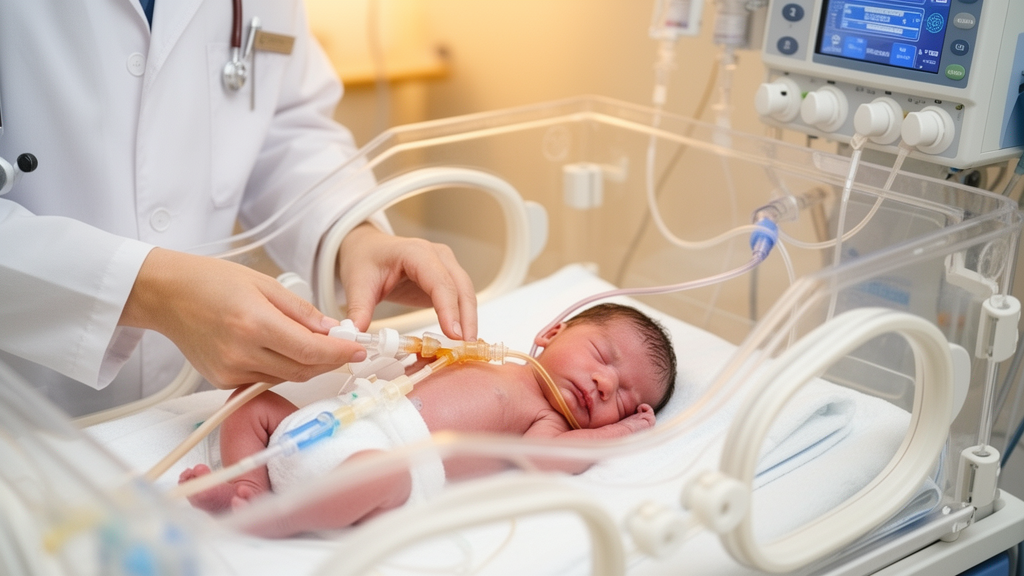
In a multicenter retrospective cohort study evaluating very low birth weight infants undergoing enterostomy, researchers observed that postoperative mucous fistula refeeding was associated with substantial reductions in both blood-culture–proven sepsis and clinical sepsis compared to standard care without refeeding. Very low birth weight infants weighing under 1500 grams who develop severe abdominal complications frequently require surgical enterostomy as an emergency intervention to decompress the gastrointestinal tract and prevent peritoneal contamination. While enterostomy creation is life-saving, it disrupts normal intestinal passage and excludes the distal bowel segment from continuous exposure to nutrients, digestive secretions, and luminal microbiota. This prolonged exclusion and dependence on central venous access routinely predispose premature infants to systemic inflammation, central line-associated infections, and parenteral nutrition-related complications.
To investigate whether restoring luminal continuity mitigates these systemic infectious risks, investigators analyzed clinical records from five hospital centers participating in the German Neonatal Network between 2009 and 2022. The study evaluated sixty infants who met rigorous eligibility criteria, including birth weights below 1500 grams, enterostomy creation due to severe abdominal complications, complete documentation of nutritional management, and survival until hospital discharge. Among this cohort, twenty-six infants received mucous fistula refeeding, whereas thirty-four infants were managed without refeeding prior to surgical stoma reversal. The primary objective of the multicenter analysis was to determine postoperative infectious morbidity from the date of stoma formation until surgical reanastomosis, specifically evaluating the incidence of blood-culture–proven sepsis and clinical sepsis based on standardized national infection surveillance criteria.
The procedural approach to mucous fistula refeeding across participating centers relied on the collection of proximal stoma effluent under sterile conditions and its subsequent manual reinfusion into the distal mucous fistula. In the evaluated cohort, twenty-two infants received intermittent refeeding administered multiple times per day in small aliquots using sterile syringes and soft feeding catheters, while four infants received continuous infusions. Reinfused volumes corresponded to the collected proximal output and were carefully titrated according to individual tolerance, monitoring for signs such as abdominal distension, increased gastric residuals, or leakage around the stoma. Infusion pumps were not utilized in the refeeding process, and refeeding protocols were directed by local center practices rather than a single mandated regimen, reflecting practical bedside adaptation in fragile neonates.
Univariate comparisons between the study groups revealed significant differences in infectious outcomes. Infants managed with mucous fistula refeeding exhibited a blood-culture–proven sepsis rate of 11.5 percent, compared to 36.4 percent in infants who did not receive refeeding, yielding a statistically significant difference. Similarly, clinical sepsis occurred in 50.0 percent of infants in the refeeding group compared to 78.8 percent in the non-refeeding group. Recurrent inflammatory activity, defined by researchers as at least two separate elevations of C-reactive protein above 1 milligram per deciliter spaced at least fourteen days apart with an intervening decline below 0.5 milligrams per deciliter, was documented in 46.2 percent of refed infants versus 75.8 percent of non-refed infants.
Refed infants also required fewer courses of antibiotic treatment during the postoperative period, receiving a median of 7.0 courses compared to 7.7 courses among infants without refeeding. A non-significant numerical trend toward shorter cumulative antibiotic exposure was also noted, with a median of 80.7 days of therapy in the refeeding cohort compared to 91.4 days in the non-refeeding group. In contrast to infectious parameters, measures of hepatobiliary function and physical development did not differ significantly between groups. Total bilirubin, direct bilirubin, and gamma-glutamyl transferase values measured at stoma reversal and at estimated due dates showed comparable profiles, and somatic growth trajectories for body weight, body length, and head circumference remained equivalent across both cohorts at all standardized time points.
To account for baseline clinical disparities and potential confounding influences, the researchers conducted multivariable logistic regression analyses adjusting a priori for gestational age, birth weight, total number of central venous catheters, probiotic administration, cumulative antibiotic exposure, and treating medical center. Following these adjustments, mucous fistula refeeding remained independently associated with a 78 percent reduction in the odds of blood-culture–proven sepsis, demonstrating an adjusted odds ratio of 0.22 with a 95 percent confidence interval ranging from 0.05 to 0.97. The independent association was also evident for clinical sepsis, where refeeding corresponded to an adjusted odds ratio of 0.10 with a 95 percent confidence interval from 0.02 to 0.58.
The biological mechanisms underpinning the observed reduction in systemic infections are thought to stem from preserving distal intestinal mucosal architecture and supporting localized immune defenses. Prior histopathological examinations cited by the researchers have demonstrated that premature infants receiving mucous fistula refeeding maintain greater mucosal thickness, preserved villous architecture, and enhanced mucosal lymphoid follicle formation in the distal ileum at the time of stoma closure. Enteral deprivation of the distal bowel, triggered by surgical diversion, compromises the epithelial barrier and may facilitate transluminal passage of opportunistic pathogens into the circulation. By maintaining continuous nutrient and fluid transit through the distal loop, refeeding appears to sustain mucosal barrier integrity and mitigate systemic inflammatory triggers.
Surgical outcomes after stoma reversal provided additional descriptive observations, with the rate of repeat operations following reanastomosis being numerically lower among refed infants at 12.5 percent compared to 31.3 percent in non-refed infants. Although this numerical difference did not achieve statistical significance, it aligns with previous surgical reports indicating that luminal stimulation conditions the distal bowel segment, preserving its caliber and potentially supporting structural readiness for surgical reconstruction. At the same time, the authors highlighted that the comparable somatic growth metrics observed between refed and non-refed infants confirm that refeeding proximal succus entericus does not adversely affect overall metabolic stability in very low birth weight populations.
The study authors acknowledged important methodological limitations inherent to their retrospective design, noting that treatment allocation was determined by institutional practice rather than randomized assignment, which leaves open the possibility of unmeasured selection bias. Furthermore, laboratory monitoring of cholestasis markers was performed based on clinical indication rather than a fixed study schedule, leading to missing data that restricted definitive evaluations of liver function. Crucial nutritional endpoints, such as the exact time required to attain full enteral feeding and post-discharge developmental outcomes, were not systematically captured across all centers and could not be evaluated. The overall sample size of sixty patients also limited statistical power to conduct granular subgroup analyses.
Practical considerations surrounding the routine clinical implementation of mucous fistula refeeding were also underscored by the researchers. The procedure introduces substantial technical and nursing demands, necessitating meticulous aseptic handling during the collection and manual reinfusion of effluent to avoid contamination. Catheterization of the distal mucous fistula carries risks of mechanical tissue trauma, local irritation, and leakage, particularly in extremely premature infants with highly fragile tissue. Despite theoretical concerns that reinfusion might induce ascending infections or bacterial translocation, the study observed no increase in bloodstream infections among refed infants, leading the authors to conclude that mucous fistula refeeding appears to be a feasible and safe adjunct that warrants standardized protocols and prospective randomized trials.
Baseline demographic characteristics and perinatal histories across the evaluated infants showed broad comparability between those managed with refeeding and those receiving non-refeeding care. Median gestational ages and birth weights were closely matched across both clinical cohorts, though female infants constituted a slightly higher proportion within the refeeding group. Spontaneous deliveries occurred in 15.4 percent of refeeding cases compared to 29.4 percent among non-refeeding controls, whereas emergency cesarean deliveries took place in 15.4 percent of refed neonates and 23.5 percent of non-refed neonates. Documented exposure rates to maternal antibiotic treatments prior to labor, antenatal steroid administration, and baseline major neurological outcomes also demonstrated comparable distributions between the two study arms.
Diagnostic criteria for postoperative sepsis adhered strictly to standardized definitions established by the national infection surveillance framework. Clinical sepsis classifications required the presence of at least two systemic signs, such as body temperatures exceeding 38 degrees Celsius or dropping below 36.5 degrees Celsius, heart rates above 200 beats per minute, newly emerging or worsening bradycardias or apneas, blood glucose levels exceeding 140 milligrams per deciliter, base excess measurements below minus 10 milliequivalents per liter, marked skin pallor, or escalating supplemental oxygen demands, or alternatively one clinical indicator combined with a C-reactive protein measurement exceeding 1 milligram per deciliter in the absence of a confirmed microbiological pathogen. Blood-culture–proven cases met these clinical parameters while demonstrating definitive laboratory isolation of a causative organism from circulating blood.
Regarding secondary systemic pathways, researchers examined whether reductions in central venous line dependence contributed to the diminished sepsis rates observed in refed infants. Although infants across the study cohort who experienced infectious complications tended to endure longer cumulative exposures to central venous catheters, this specific correlation did not reach statistical significance, suggesting that mechanisms beyond central vascular access duration primarily drove the lower rates of systemic sepsis. Furthermore, early postoperative systemic inflammation was monitored via standardized C-reactive protein levels measured on postoperative day three, providing an initial baseline before tracking recurrent inflammatory surges and longitudinal clinical trajectories until reanastomosis.
Subject of Research: Association of mucous fistula refeeding with sepsis incidence in very low birth weight infants
Article Title: Sepsis profile among preterm infants with enterostomy and fecal transfer: a multicenter retrospective cohort study
Article References: Al-Kudsi, Z., Wieg, C., Fortmann, M. I., Faust, K., Herting, E., Linnemann, K., Weller, U., Potratz, J., Göpel, W., & Humberg, A. (2026). Sepsis profile among preterm infants with enterostomy and fecal transfer: a multicenter retrospective cohort study. Molecular and Cellular Pediatrics, 13(1), Article 15. https://doi.org/10.1186/s40348-026-00227-2
Image Credits: AI Generated
DOI: 10.1186/s40348-026-00227-2
Keywords: mucous fistula refeeding, preterm infants, very low birth weight infants, enterostomy, sepsis, blood-culture-proven sepsis, clinical sepsis, German Neonatal Network, fecal transfer, neonatal intensive care, C-reactive protein, antibiotic therapy, parenteral nutrition, stoma reversal, gut motility, pediatric surgery
News Source: Harold Sullivan. (November 20, 2026). Bowel Effluent Refeeding Associates With Lower Sepsis in Vulnerable Preterm Infants. Scienmag.