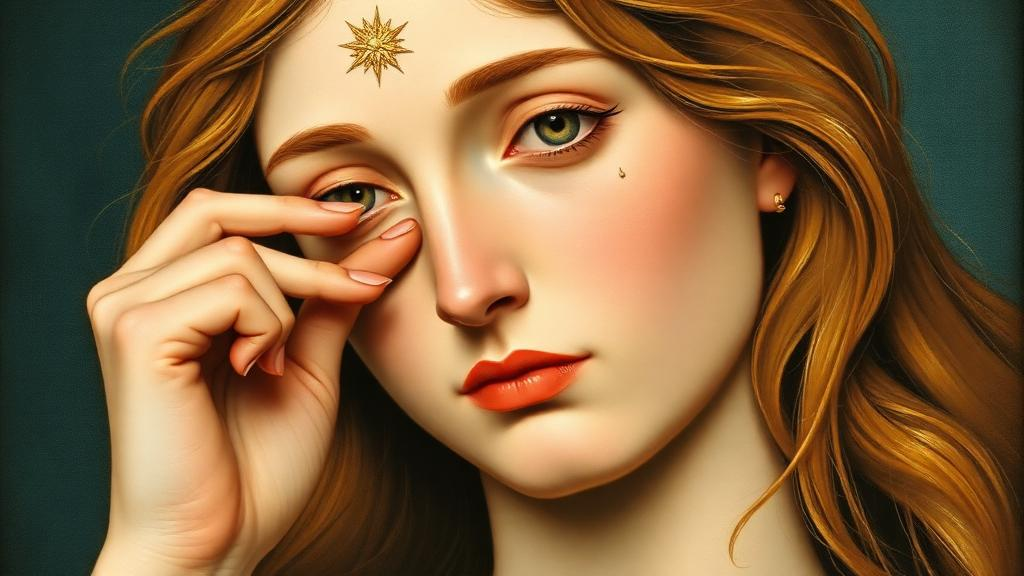
For more than five centuries, the face of Sandro Botticelli’s Venus has been celebrated as the supreme expression of Renaissance beauty, her softly tilted gaze imitated by painters across Italy and admired by generations of viewers. Now a team of researchers argues that the very features that made the model immortal may also record the medical drama that ended her life. In a paper published in the journal Medical Humanities by the BMJ, Professor Paolo Pozzilli and colleagues present new evidence supporting the theory that Simonetta Vespucci, the aristocrat widely identified as Botticelli’s muse, died in 1476 from complications of a pituitary tumour rather than from the tuberculosis long suspected as the cause of her death at the age of 23.
The new study, titled Pituitary neuroendocrine tumour and strabismus in a young woman who died in 1476, is the third in a series of investigations led by Pozzilli, an Honorary Professor of Diabetes and Clinical Research at Queen Mary University of London. His earlier work, published in 2019 and again in 2026, examined historical documents describing Vespucci’s final illness and the portraits that preserve her likeness, and proposed that an expanding tumour of the pituitary gland culminated in pituitary apoplexy, an acute event in which the gland bleeds and can rapidly prove fatal. The latest paper turns to the eyes themselves, reading anatomical detail in Botticelli’s Birth of Venus and in other portraits of the same woman as clinical evidence preserved in pigment.
Simonetta Vespucci, born Simonetta Cattaneo in Genoa around 1453, arrived in Florence as one of the most celebrated beauties of her age. Married at sixteen to Marco Vespucci, she moved in the highest circles of the city, captivating the elite of the Medici era and earning the epithet La Bella Simonetta. Botticelli painted her in both The Birth of Venus and Primavera, and his attachment to his model was so profound that he asked to be buried at her feet, a wish that was ultimately granted after his death decades later. Her distinctive gaze, the so-called Venus squint, was copied by other artists, including Bronzino, and became a hallmark of idealised Renaissance beauty.
It is precisely that celebrated squint, the researchers argue, that deserves a medical reading. In the new paper, Pozzilli’s team examines the depiction of Vespucci’s eyes across the famous canvases and finds changes that, in a living patient, would raise immediate clinical suspicion. The descriptions include swelling around the eyes, most marked on the left side, where the tissue covering the white of the eye appears loose or folded and the tissue beneath it is swollen with fluid. Similar, milder swelling is visible around the right eye. Taken together with the strabismus, the misalignment in which the eyes do not point in the same direction, these signs may be associated with a large tumour of the pituitary gland.
The clinical logic behind this interpretation rests on the anatomy of the skull. The pituitary gland sits in a bony cavity at the base of the brain, immediately above and behind the structures that control eye movement and adjacent to the optic pathways. A tumour expanding within this confined space can compress the nerves that coordinate the extraocular muscles, producing the kind of divergent gaze captured in the portraits, and can also cause congestion and oedema of the surrounding tissues, changes that Botticelli, painting from life with celebrated realism, may have reproduced with striking fidelity. In such a scenario, the final event would be pituitary apoplexy, an acute haemorrhage into the gland that can precipitate collapse and death within hours.
Historical documents about Vespucci’s death, examined in Pozzilli’s earlier papers, suggested possible triggers for such an acute event. The record points to two candidates: dancing, the physical exertion that filled the life of the Florentine aristocracy, or a violent rape, an act that the historical sources themselves suggest. Either, the researchers propose, could have served as the precipitating stress that transformed a slowly growing tumour into a fatal apoplexy. This reading of the documents challenges the traditional attribution of her death at twenty-three to tuberculosis, a disease that was rampant in Renaissance cities and has long been the default explanation for the early deaths of young women of that era.
The research is explicitly observational and interpretive, and its subject is a woman who can never be examined directly. No skeletal remains have been analysed for this purpose and no contemporary medical record survives beyond the documentary fragments and painted likenesses that the team has studied. What the paper offers is a convergence of evidence: portrait features consistent with the ocular consequences of an enlarging pituitary lesion, a documented pattern of sudden death compatible with apoplexy, and historical circumstances suggesting an acute physical trigger. Each strand is individually circumstantial, but Pozzilli argues that together they point away from consumption and toward a neuroendocrine tumour as the true cause of death.
The paradox at the heart of the study is one that Pozzilli himself frames with unusual directness. Sandro Botticelli was, he observes, a brilliant artist who depicted his subjects with great realism, so it is not surprising that he left medical evidence in his paintings that can be read centuries later. The squint of Venus, he notes, embodies a poignant contradiction: the very feature once exalted as the epitome of divine allure in Renaissance art, and copied by painters such as Bronzino, now reveals itself as a subtle harbinger of her doom. Beauty iconography and pathology, in this account, are the same image seen from different distances in time.
For historians of medicine, the study sits within a growing tradition of retrospective diagnosis, in which portraits, letters and chronicles are mined for clinical insight into the diseases of past centuries. Such work cannot meet the evidentiary standards of bedside medicine, and its conclusions are necessarily provisional, but it can reshape how scholars understand the lives and deaths of historical figures and how art historians read the physical details that painters chose to record. If Botticelli indeed painted the oedema and misalignment of a gland under siege, then The Birth of Venus is not only a mythological allegory but also one of the most beautiful clinical portraits ever made, a document in which the tragic final illness of La Bella Simonetta has been hiding in plain sight for five hundred years.
The paper, authored by Paolo Pozzilli, Maria A Camilletti, Giovanna Strano and Andrea Salerno, was published on 12 October 2026 in Medical Humanities under the DOI 10.1136/medhum-2026-014199, and the authors declared no competing interests. Whether the medical community will accept the pituitary tumour hypothesis remains to be seen, and alternative explanations for the painted gaze will surely be debated. What the study already demonstrates, however, is that the intersection of art history and clinical medicine can still yield surprising dividends, and that the face that launched countless imitations may have been quietly recording its own mortality all along, waiting for viewers with the right training to look closely enough to see it.
Subject of Research: Retrospective diagnosis of a fatal pituitary tumour in Botticelli's muse Simonetta Vespucci through analysis of Renaissance portraits
Article Title: New research on Botticelli’s Venus supports a death from a pituitary tumour diagnosis
Article References: New research on Botticelli’s Venus supports a death from a pituitary tumour diagnosis. (n.d.). Original publication
Image Credits: AI Generated
DOI: Not provided
Keywords: Botticelli, Simonetta Vespucci, pituitary tumour, pituitary apoplexy, strabismus, Medical Humanities, retrospective diagnosis, Renaissance art, The Birth of Venus, medical history, ophthalmology, BMJ
News Source: Nathaniel Bowman. (October 14, 2026). Botticelli’s Venus: Signs in Her Eyes Point to Fatal Pituitary Tumour, Study Says. Scienmag.