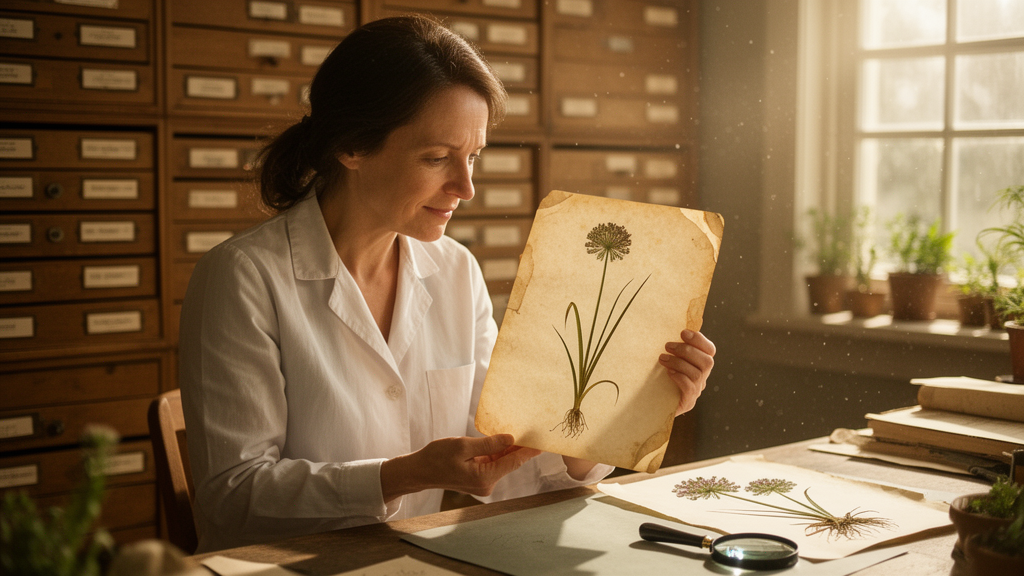
Botanists have finally pinned down the identity of a wild allium described from the mountains around Milan more than 250 years ago, and in doing so they have quietly reshuffled the official name of a plant that appears in European floras under several different labels. In a study published in Italian Botanist, researchers designated a lectotype and an epitype for the name Allium cirrhosum, a slender purple-flowered relative of chives and garlic that was first described in 1771 by the Italian naturalist Domenico Vandelli. The typification does more than tidy up an old name: it establishes that Allium cirrhosum has priority at species rank over the younger name Allium coloratum, published more than half a century later in 1825.
The case is a textbook example of how botanical nomenclature works under the International Code of Nomenclature for algae, fungi, and plants, known informally as the Shenzhen Code. When a species name is published, its precise application depends on its type, the specimen or illustration to which the name is permanently attached. Vandelli described Allium cirrhosum in his Fasciculus plantarum with a short Latin diagnosis, a detailed description, and a provenance note reading Habitat in Montibus Mediolanensibus, meaning it grows in the mountains of the Milan region. Crucially, he cited no herbarium specimen and no illustration, which left later botanists to argue for two and a half centuries about what plant he actually meant.
The research team searched for surviving original material in the major European herbaria where Vandelli-related collections might be expected, including LISU, LINN, P, PAD, PAV, and PI. They found eight herbarium specimens at LISU, where Vandelli’s main collection is housed, but none carried the name Allium cirrhosum, and no relevant material turned up in the other herbaria. With no extant specimens, the name risked remaining a nomenclatural ghost, variously treated as a synonym of Allium coloratum, as a distinct species, or as a variety of Allium carinatum by different authorities over the decades.
The breakthrough came not from a herbarium sheet but from an unpublished manuscript. Reconstructing Vandelli’s peregrinations around Milan, the researchers revisited a survey he undertook from May 20 to August 31, 1763, in the surroundings of Lake Como together with Giulio Mattiazzi, on behalf of Count Carlo G. di Firmian, Austria’s minister in Milan. The expedition collected mineral and biological samples, and Vandelli compiled a travel journal titled Saggio d’Istoria naturale del Lago di Como, della Valsassina ed altri luoghi lombardi, in which he reported all the plants observed and described some new species with descriptions and illustrations. Vandelli never managed to publish the manuscript, but in 1771 he described many of the plants he had collected in the mountains around Milan in his Fasciculus plantarum, probably drawing on material from that 1763 journey.
The original manuscript is lost, but a copy, probably the only one left, is preserved at the University Library of Pavia. It was published in part without illustrations by Provasi in 1923, and later in full with all illustrations in 1989. In the journal, Vandelli described and illustrated, in Table XX, an Allium he saw on August 14 in the valley of Boaccio or Caldone. The description in the manuscript matches the one published in 1771 in the protologue of Allium cirrhosum. The researchers therefore concluded that Table XX, certainly made before 1771 and probably by Vandelli himself, forms part of the original material for the name, and given the absence of extant herbarium specimens, it is the obligate choice for lectotypification under Articles 9.4 and 9.12 of the Code.
But the illustration alone was not enough. The lectotype does not include a complete set of significant distinguishing features, such as the morphology of the spathe, the color of the tepals and anthers, or the length of the stamens, and cannot be critically identified for the precise application of the name. To resolve this, the team designated an epitype under Article 9.9 of the Code, a specimen preserved at PI, the Herbarium Horti Botanici Pisani in Pisa, collected by Gysperger on July 10, 1899, at Ballabio in the Val Sassina near Lake Como, the same area Vandelli visited in 1763. The epitype serves as an interpretative type, anchoring the name to a physical specimen that can be examined in detail.
Even with the types in place, some doubts remain about characters in Vandelli’s description that are unusual for the plant currently known as Allium coloratum. Vandelli described a stem of about three feet, roughly 98 centimeters, a spathe attenuated into a narrow curled appendage, and yellow anthers. Allium coloratum rarely exceeds 60 centimeters, usually has purple anthers, and only occasionally has spathes ending in a narrow curled appendage. All other characters in the description, however, correspond with the current conception of Allium coloratum, and the researchers note that Scopoli had already commented on Table XX of the manuscript with the words Ex data descriptione agnosci non potest, meaning it cannot be identified from the given description. Earlier, Cesati in 1842 had suggested the plant was referable to Allium paniculatum, a name mistakenly used by Italian authors to indicate Allium longispathum.
Based on the typification now proposed, the name Allium cirrhosum Vand. has priority at species rank over Allium coloratum Spreng., published by Sprengel in 1825. The researchers agree with the taxonomic treatment of Jauzein and Tison, who recognize this taxon at species rank, a status also accepted in several authoritative national floras and taxonomic databases. The study is part of an ongoing project aimed at typifying all taxa described from Italy and recognizing their loci classici, the type localities, in order to serve as a basis for further taxonomic studies.
The genus Allium is one of the richest in the Amaryllidaceae, comprising about 1,000 species worldwide, naturally distributed in temperate, semi-arid, and arid regions of the Northern Hemisphere, with a center of diversity extending from the Mediterranean basin to Central Asia and a smaller center in western North America. Clarifying the identity of Allium cirrhosum through its typification contributes to a more stable taxonomy for this diverse genus, and demonstrates how historical manuscripts, herbaria, and careful application of nomenclatural rules can together resolve long-standing taxonomic uncertainties.
Subject of Research: Typification of the name Allium cirrhosum Vand. (Amaryllidaceae)
Article Title: Typification of the name Allium cirrhosum Vand. ( Amaryllidaceae )
Article References: Bartolucci, F., Tison, J.-M., & Galasso, G. (2025). Typification of the name Allium cirrhosum Vand. (Amaryllidaceae). Italian Botanist, 20, 1-8. https://doi.org/10.3897/italianbotanist.20.159744
Image Credits: AI Generated
DOI: 10.3897/italianbotanist.20.159744
Keywords: Typification, name, Allium, cirrhosum, Vand, Amaryllidaceae, scientific research
News Source: Drew Townsend. (October 17, 2026). Botanists settle a 250-year-old Allium name with a lost manuscript drawing. Scienmag.