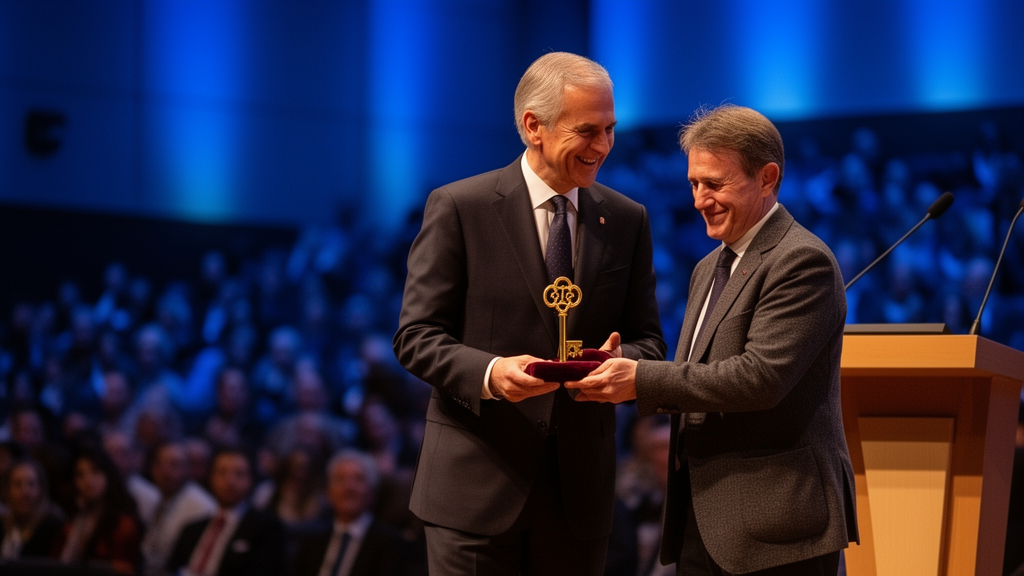
Douglas I. Katz, MD, professor of neurology at Boston University Chobanian & Avedisian School of Medicine, has received the Gold Key award from the American Congress of Rehabilitation Medicine, the highest honor the organization bestows. The award was presented at the ACRM annual meeting in Washington, D.C., marking a moment of recognition for a physician whose career has spanned more than three decades of clinical care, research, and mentorship in the field of brain injury medicine and neurorehabilitation.
The Gold Key award carries a long history within the congress. Established in 1932 as a certificate of merit, it was created to recognize members of the medical and allied professions who had rendered extraordinary service to the cause of rehabilitation. In the more than nine decades since its founding, the award has come to signify a career of sustained contribution to rehabilitation science and practice, and it remains the most prestigious distinction the interdisciplinary association confers on its members.
Katz is board certified in adult neurology, brain injury medicine, and neural repair and rehabilitation. He practices as a neurologist at Boston Medical Center and at Encompass Health Braintree Rehabilitation Hospital, where he has served as medical director of the Brain Injury Program for more than 35 years. That longevity in a single clinical leadership role reflects the depth of institutional knowledge required to guide patients and families through the often prolonged and uncertain course of recovery after serious brain injury.
The clinical domain in which Katz has built his career is one of the most challenging in neurology. Traumatic brain injury can produce a wide spectrum of impairment, from subtle cognitive changes to profound disorders of consciousness in which patients may emerge only slowly, or incompletely, from coma and unresponsiveness. Understanding the neuropathology of injury, the natural history of recovery, and the factors that shape long-term outcome is central to designing rehabilitation programs that can meaningfully improve patients’ lives.
Katz’s research interests map closely onto these clinical challenges. His published work spans traumatic brain injury and neurorehabilitation, including neuropathology, natural history and outcome, disorders of consciousness, post-traumatic confusional state, and pharmacologic treatment of cognitive problems. He has also contributed to work on structural and functional imaging and on chronic traumatic encephalopathy, the degenerative brain disease associated with repetitive head trauma that has drawn increasing public and scientific attention in recent years.
Imaging has become a particularly important tool in modern brain injury research. Structural imaging can reveal lesions, hemorrhages, and diffuse axonal injury, while functional imaging techniques can probe patterns of brain activity that may not be apparent at the bedside. Research in this area has helped clinicians better characterize disorders of consciousness and refine prognostic assessment, informing decisions about treatment intensity and rehabilitation planning for patients with severe injuries.
Beyond his research, Katz has played a substantial role as an educator. He has mentored many trainees in neurorehabilitation and brain injury medicine, and he has been a national leader in developing training and certification standards for the field. He serves on several advisory boards, study sections, and editorial boards for major journals on brain injury and neurorehabilitation, positions through which he has helped shape the scientific agenda and the professional infrastructure of the discipline.
His leadership within professional organizations extends to service at the highest levels. Katz served as president of the American Congress of Rehabilitation Medicine from 2015 to 2017, guiding the association during a period in which rehabilitation science has increasingly emphasized interdisciplinary collaboration and evidence-based practice. He is a fellow of the American Congress of Rehabilitation Medicine, the American Academy of Neurology, the American Society of Neurorehabilitation, and the American Neurological Association.
The Gold Key award is not the first recognition of Katz’s contributions. His earlier honors include the Sheldon Berrol Clinical Services Award from the Brain Injury Association of America, awarded in 2001; the Ken Viste, Jr. award from the American Society of Neurorehabilitation, awarded in 2012; and the Compassionate Care Award of the Brain Injury Association of Massachusetts, awarded in 2013. Together, these distinctions reflect recognition from both professional societies and patient advocacy organizations, a combination that underscores the clinical and human dimensions of his work.
The American Congress of Rehabilitation Medicine describes itself as a global, interdisciplinary medical association advancing rehabilitation science, clinical practice, and the lives of people with disabling conditions through evidence-based research. Its mission is to improve the lives of people of all abilities through education, research, and advocacy that enable interdisciplinary, science-based, and person-centered rehabilitation. In honoring Katz with its Gold Key award, the organization has recognized a career that embodies those aims, from bedside care of patients with brain injury to the training of the next generation of neurorehabilitation specialists.
The Gold Key award’s origins in 1932 place it among the older continuously conferred honors in American rehabilitation medicine, a field that itself underwent profound transformation during the twentieth century. When the certificate of merit was first conceived, rehabilitation largely centered on the retraining of workers injured in industrial accidents and on the care of soldiers returning from the First World War. The decades since have seen the discipline expand to encompass stroke, spinal cord injury, traumatic brain injury, and a broadening array of disabling conditions, with the American Congress of Rehabilitation Medicine growing into an interdisciplinary body whose membership spans physicians, therapists, psychologists, and researchers. An award that has persisted across that entire arc connects its recipients to a lineage of practitioners who shaped rehabilitation as a distinct medical enterprise rather than an adjunct to acute care.
Brain injury medicine, the subspecialty in which Katz is board certified, gained formal recognition relatively recently compared with older neurological disciplines, and the development of its training and certification standards represents a significant institutional milestone. Establishing accredited fellowship training, board certification pathways, and consensus standards for a field that sits at the intersection of neurology, physiatry, neuropsychology, and rehabilitation therapy required sustained effort from clinicians and educators across multiple organizations. National leadership in that process, as the release describes, carries implications well beyond any single institution, since the standards developed shape who enters the field and how uniformly patients with brain injury are assessed and treated across care settings.
The specific research areas attributed to Katz reflect themes that have driven progress in neurorehabilitation over recent decades. Post-traumatic confusional state, for example, is now recognized as a distinct and clinically important phase of recovery after traumatic brain injury, with its duration and severity carrying prognostic weight for functional outcome. Pharmacologic approaches to cognitive problems after brain injury remain an area of active investigation, as clinicians seek evidence-based strategies for attention, memory, and processing speed deficits that often persist long after motor recovery has plateaued. Work on the natural history and outcome of injury, meanwhile, provides the longitudinal data on which realistic expectations for recovery and appropriate rehabilitation planning depend.
Chronic traumatic encephalopathy, listed among Katz’s research interests, has become one of the most consequential topics in sports medicine and public health. The condition, characterized by abnormal deposits of a protein called tau in the brain, is associated with repetitive head impacts and has been identified posthumously in athletes from contact sports as well as in military veterans. Because the disease can currently be diagnosed with certainty only after death, research into its clinical presentation, risk factors, and potential detection through imaging or biomarkers remains a priority, and clinicians who treat brain injury patients are frequently called upon to counsel patients and families about the condition’s implications.
Disorders of consciousness represent another area where clinical practice has evolved substantially. The distinction between coma, the vegetative state, and the minimally conscious state carries significant weight for prognosis and for decisions about ongoing care, and behavioral assessment alone can miss signs of covert awareness in some patients. Functional imaging research has contributed to understanding these conditions, and the careful longitudinal evaluation of patients emerging from unresponsiveness remains a core competency of specialized brain injury programs such as the one Katz has directed at Braintree for more than three decades.
The pattern of honors recognized in the release also illustrates the distinct constituencies within the brain injury community. The Sheldon Berrol Clinical Services Award, named for a physician known for advancing clinical services for people with brain injury, and the Compassionate Care Award from a state advocacy organization both emphasize the bedside and family-facing dimensions of the field, while society awards recognize scholarly and professional leadership. Recognition across these categories suggests a career in which clinical service, research, and advocacy were pursued together rather than in isolation, a combination that the Gold Key award’s historical emphasis on extraordinary service to the cause of rehabilitation is designed to honor.
Leadership of a professional congress such as the ACRM, as Katz did from 2015 to 2017, involves stewarding an organization whose annual meetings serve as a venue where rehabilitation scientists, clinicians, and consumers of research exchange findings across disciplinary boundaries. The congress’s emphasis on evidence-based and person-centered rehabilitation mirrors broader movements in medicine toward outcomes measurement and shared decision-making, and the organization’s global scope reflects the international growth of rehabilitation research in recent decades.
For patients and families affected by brain injury, the significance of such a career lies in the accumulated infrastructure it leaves behind: trained specialists now practicing across the country, standardized approaches to assessment and certification, published guidance on prognosis and treatment, and clinical programs equipped to manage the long and often unpredictable course of recovery after severe injury. The Gold Key award, in recognizing that accumulation of service, highlights how individual clinical leadership over decades contributes to the maturation of an entire medical field.
Subject of Research: Recognition of a Boston University neurologist's career in brain injury medicine and neurorehabilitation with the ACRM Gold Key award
Article Title: BU’s Dr. Douglas Katz receives highest honor from the American Congress of Rehabilitation Medicine
Article References: BU’s Dr. Douglas Katz receives highest honor from the American Congress of Rehabilitation Medicine. Original publication (Bibliographic details unavailable.)
Image Credits: AI Generated
DOI: Not provided
Keywords: Douglas Katz, Gold Key award, American Congress of Rehabilitation Medicine, Boston University, brain injury medicine, neurorehabilitation, traumatic brain injury, disorders of consciousness, chronic traumatic encephalopathy, neurology, rehabilitation science, Boston Medical Center
News Source: Cassandra Pierce. (October 19, 2026). Boston University Neurologist Douglas Katz Receives ACRM Gold Key Award. Scienmag.