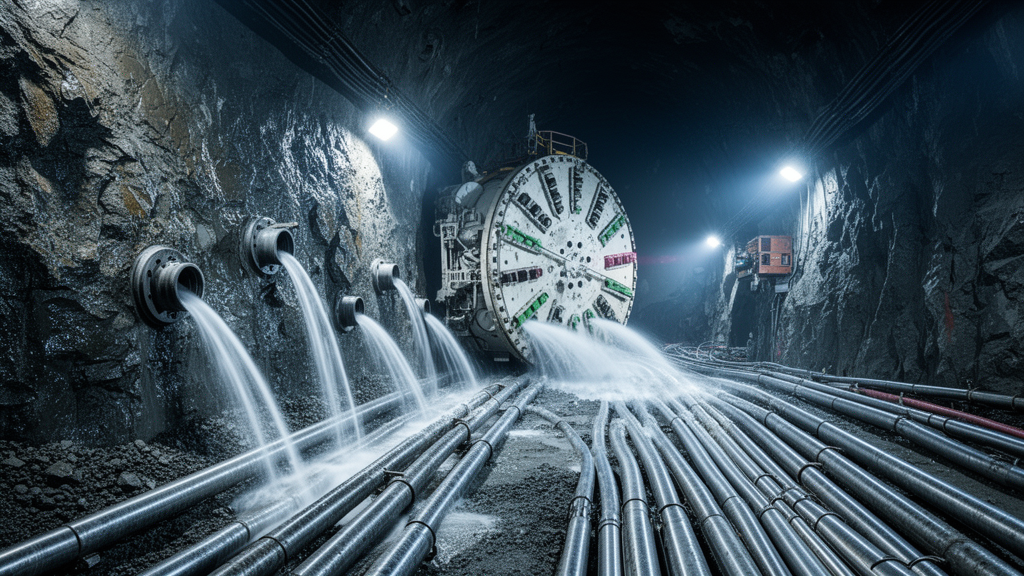
During deep underground construction within faulted or fractured bedrock, unexpected water ingress poses immediate operational challenges that disrupt schedules, elevate project budgets, and threaten worker safety. By tracking drainage rates over time using log-log analytical plots anchored in classical hydraulic diffusion theory, the investigators showed that hydrological discharge follows an orderly power law decay governed by local fracture connectivity. This empirical and analytical framework provided civil engineers with actionable on-site diagnostic criteria, ultimately enabling the excavation of a deep experimental gallery at five hundred meters depth without injecting a single batch of preliminary grout.
Subsurface tunneling projects around the globe have frequently observed significant reductions in water inflow over time without mechanical remediation, but historical operations lacked rigorous analytical tools to forecast these declines prior to driving full-scale excavation headings forward. High-profile excavations, including Switzerland’s Gotthard Base Tunnel as well as earlier construction campaigns at the Horonobe research facility, recorded temporary surges of groundwater inflow reaching one hundred to one thousand cubic meters per day that subsequently subsided primarily through natural reservoir depressurization rather than artificial sealant barriers. In both operational cases, engineers had committed to post-excavation grouting after encountering high initial discharges, even though subsequent hydrological analyses revealed that natural pressure dissipation within the rock mass accounted for the eventual stabilization. When tunnelers can confidently distinguish between a transient burst from poorly connected fractures and sustained drainage from an extensive, recharging aquifer, they can avoid unnecessary delays and optimize construction logistics without compromising structural or occupational safety.
The foundational physics governing this forecasting method rests upon the hydraulic diffusion equation, which describes how transient fluid pressure changes propagate through saturated porous media and discrete fracture networks under constant head boundary conditions. When groundwater discharges into an opening from an idealized fracture zone or fault structure under uniform hydraulic conductivity, uniform specific storage, and uniform flow dimension, the mathematical relationship between the volumetric inflow rate and elapsed time is expressed by complementary incomplete gamma functions assuming an infinitesimal cylindrical source and an infinite flow regime. Crucially, this analytical formulation simplifies into a robust power law relationship where the slope of the inflow rate over elapsed time plotted on logarithmic axes directly reflects the natural decline rate. The physical exponent of this decay is predominantly controlled by the flow dimension, an intrinsic geometric parameter describing how the effective cross-sectional flow area expands radially away from the borehole or tunnel wall into the surrounding rock mass.
Geometrically, the flow dimension parameter indicates the degree of internal interconnectedness within the fracture network feeding water toward the subsurface opening. A lower flow dimension signifies that conducting pathways are restricted, compartmentalized, or poorly interconnected throughout the host rock, which inevitably causes rapid localized pressure depletion and an accelerated drop in total discharge over time. Conversely, higher flow dimensions reflect extensively networked pathways capable of mobilizing groundwater across broader catchment volumes, sustaining higher yields over prolonged intervals. By establishing whether the log-log drainage slope exhibits a steep or shallow trajectory during initial borehole outflow, field engineers can quantitatively diagnose fracture connectivity directly at the tunnel face within days of drilling.
This formation comprises a massive, highly homogeneous siliceous mudstone possessing an intact matrix permeability ranging between ten to the negative twentieth and ten to the negative eighteenth square meters, alongside an effective porosity of thirty to fifty percent. Although the intact sedimentary matrix contains trace smectite, its swelling capacity remains minimal, meaning that discrete fault zones and tectonic damage zones constitute the sole primary fluid conductors across the formation. The fault zones feature narrow fault cores with thicknesses of ten centimeters or less containing cataclastic breccia and gouge, bounded by extensive damage zones up to one hundred meters wide filled with unmineralized tensile, shear, and hybrid fractures whose local transmissivities range widely between ten to the negative tenth and ten to the negative sixth square meters per second.
The spatial variability of fracture connectivity within the Wakkanai Formation is intrinsically controlled by the mechanical ductility index of the rock mass, a dimensionless ratio defined by the effective mean stress divided by the tensile strength of intact rock. Below this transitional boundary, such as at depths of five hundred meters, the ductility index exceeds two, causing significant fracture closure under elevated confinement that restricts contact apertures and reduces the characteristic flow dimension to one or lower.
Before attempting to apply the predictive log-log technique to active horizontal tunnel headings, the research team conducted a rigorous proof-of-concept test within an existing vertical exploration borehole designated 350-FZ-01. Drilled from the bottom of the facility’s east shaft at three hundred and eighty meters depth down to four hundred and eighty-nine meters depth, the vertical borehole intersected a distinct, centimeter-thick brecciated fault zone dipping seventy-one degrees at an along-hole distance of ninety-six point eight meters. Isolating this fault zone between eighty-seven point eight and one hundred and one point nine meters using pneumatic straddle packers, the investigators executed a controlled four-day constant-rate water injection test at zero point six liters per minute. Inverse numerical modeling using the specialized nSIGHTS hydraulic code established baseline properties for the modeled aquifer, yielding a mean flow dimension of one point two nine, a hydraulic conductivity of eight point five seven times ten to the negative sixth meters per second, and a specific storage of nine point one three times ten to the negative sixth per meter.
Following injection characterization, the straddle packer assembly was opened exclusively via valve operation to initiate an unpumped, gravity-driven drainage test lasting fifty continuous days while operators systematically recorded discharge volumes using a calibrated beaker and timing device. Forward numerical simulations based on the hydraulic diffusion equation had predicted that the drainage discharge rate would follow a power law decay with a characteristic logarithmic slope of minus zero point three five six. When the team plotted the actual physical measurements collected across the fifty-day open drainage window, the observed inflow rate against elapsed time revealed a power law slope of minus zero point three six one, matching the forward numerical prediction with exceptional precision. This tight correspondence verified that real-time log-log slope evaluation could accurately capture natural fluid pressure diffusion in fractured mudstone under field conditions without requiring protracted computational modeling.
Armed with this experimental validation, the engineers evaluated two new horizontal pilot boreholes drilled ahead of advancing gallery headings at depths of three hundred and fifty meters and five hundred meters below surface ground level. For the construction of Niche Number Six at the three-hundred-and-fifty-meter level, crews advanced pilot borehole 350-PBH to a length of thirty-two point four meters with a seventy-six millimeter diameter, encountering an inflow surge exceeding sixty liters per minute at thirty-one point nine meters along the core run. Core analysis revealed elevated tensile fracture densities consistent with an impending fault damage zone, and logarithmic plotting of the outflow yielded a shallow decay slope of minus zero point two five zero, which aligned closely with a simulated flow dimension of one point five. Because discharge remained substantial at twelve point three liters per minute after nine full days of open flow, the engineering team confirmed that natural drainage was far too sluggish to mitigate operational impacts on muck hauling and wastewater treatment, prompting managers to shorten the planned gallery excavation from thirty to twenty-five meters to bypass the wet structure entirely.
In stark contrast, drilling the horizontal exploratory borehole 500-PBH ahead of the East Connecting Gallery at five hundred meters depth yielded a dramatically different hydrological outcome. Drilled with a sixty-six millimeter bit to a total length of sixty-four meters, the deep borehole struck water at fifty-seven meters along its length, initially discharging more than twenty liters per minute from a natural fracture set identified by drillcore loss and nearby floor mapping. Plotting the discharge rate over nine elapsed days revealed an aggressive power law reduction with a steep log-log slope of minus zero point five two four, corresponding precisely to an analytical flow dimension of one point zero. The inflow plunged to just one point two liters per minute within nine days, reassuring engineers that localized pore pressure was rapidly collapsing within the poorly connected fractures. Relying on this rapid forecasted decline, project leadership deliberately waived pre-excavation grouting, driving the gallery successfully through the target zone without incurring major water ingress, construction delays, or unnecessary grouting expenditures.
Subject of Research: Real-time prediction of groundwater inflow decline rates in fractured rock tunnels using pilot borehole monitoring
Article Title: Real-time prediction of the natural decline rate of groundwater inflow from a fault zone or fractures during tunnel excavation and application to deciding on whether to implement grouting
Article References: Murakami, H., Ishii, E., & Yagi, K. (2026). Real-time prediction of the natural decline rate of groundwater inflow from a fault zone or fractures during tunnel excavation and application to deciding on whether to implement grouting. Bulletin of Engineering Geology and the Environment, 85(9), Article 592. https://doi.org/10.1007/s10064-026-05253-y
Image Credits: AI Generated
DOI: 10.1007/s10064-026-05253-y
Keywords: Groundwater inflow, Tunnel excavation, Grouting decision, Horonobe Underground Research Laboratory, Hydraulic diffusion equation, Flow dimension, Pilot boreholes, Siliceous mudstone, Wakkanai Formation, Ductility index, Power law relationship, Fracture connectivity, Borehole drainage, Hydraulic diffusivity, Straddle packer testing, Specific storage, Engineering geology
News Source: Denise Maddox. (November 23, 2026). Borehole Drainage Plots Rapidly Predict Groundwater Inflow Declines During Deep Tunneling. Scienmag.