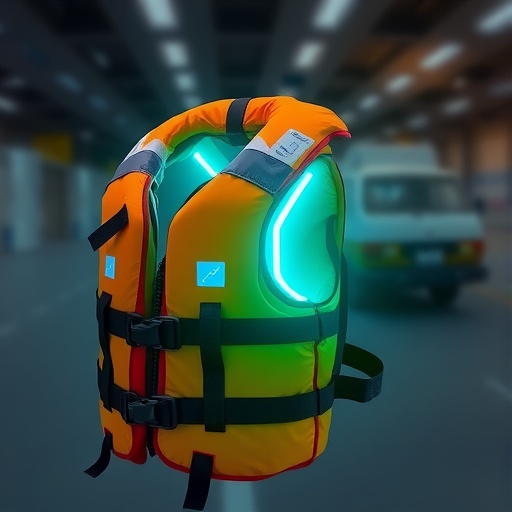
In the vast expanse of the world’s oceans, timely and accurate detection of individuals in distress remains a critical challenge for maritime search and rescue operations. Recent advancements in artificial intelligence and computer vision have opened promising avenues to enhance these lifesaving missions. At the forefront of this progress is a pioneering study led by Kwong, J., Kwan, BH., and Nisar, H., who have developed an innovative framework for detecting life jackets in maritime environments using cutting-edge YOLO (You Only Look Once) deep learning models supplemented by illumination-robust preprocessing techniques. Their work, set to transform the way search and rescue teams identify vulnerable individuals at sea, was published in Scientific Reports in 2026.
The study addresses one of the most pressing hurdles in maritime safety—how to reliably detect life jackets under highly variable lighting conditions, which range from glaring sunlight and reflections on water surfaces to dim twilight and night scenarios. Traditional object detection algorithms, while powerful, often falter when faced with the dynamic, ill-conditioned visual environments typical of open water. Kwong and colleagues approached this problem by redesigning the image preprocessing pipeline to enhance the visibility and feature consistency of life jackets prior to feeding images into the YOLO model. This step ensures the algorithm retains high detection accuracy across an array of challenging illumination scenarios.
YOLO, a fast and effective object detection architecture, operates by treating detection as a single regression problem, directly predicting bounding boxes and class probabilities from full images. However, raw image inputs captured in maritime environments frequently suffer from distortions such as glare, shadowing, and uneven lighting, which undermine prediction reliability. The ingenious element of Kwong et al.’s research lies in its sophisticated preprocessing regime that incorporates adaptive histogram equalization, color normalization, and novel illumination-insensitive feature extraction methods. These preprocessing techniques substantially increase the distinction of life jacket features and effectively mitigate the negative impact of visual noise.
The ramifications of these enhancements extend beyond improving detection performance. Enhanced detection fidelity translates into rapid identification of individuals in distress, significantly accelerating response times during search and rescue missions. The team rigorously tested their system on diverse datasets collected from real-life maritime scenarios including coastal waters, open seas, and harbor environments, ensuring the algorithm’s robustness and generalizability. Results demonstrated an impressive increase in detection precision and recall rates compared to baseline methods, including earlier versions of YOLO and conventional image processing pipelines.
Furthermore, the system’s real-time processing capabilities enable on-the-fly alerts to rescue operators, who can then deploy resources more effectively and confidently. In life-or-death situations, shaving seconds off detection time can mean the difference between successful rescue and tragedy. The integration of this technology atop existing vessel-mounted sensors or unmanned aerial vehicles presents exciting possibilities for maritime operations, offering a scalable solution applicable to both commercial shipping and coastal defense agencies.
Key to the study was the interdisciplinary collaboration that brought together expertise in computer vision, maritime navigation, and human factors engineering. This synthesis ensured that the technical solutions developed were not only theoretically sound but also pragmatically aligned with the operational realities faced by search and rescue personnel. By calibrating the system to detect variances in life jacket designs—accounting for different colors, materials, and patterns—the researchers expanded the applicability of their model across different countries and manufacturers, emphasizing the global utility of their approach.
The research team also addressed challenges related to false positives and detection in cluttered backgrounds, common pitfalls in real-world maritime settings. Their approach leveraged spatial coherence filtering combined with temporal smoothing to minimize erroneous alerts triggered by waves, debris, or marine wildlife. This filtering mechanism was critical in ensuring that rescue teams receive reliable actionable information, thereby optimizing the balance between sensitivity and specificity.
Another fascinating dimension of the work is its potential adaptability to changing environmental conditions driven by climate change. Increasingly unpredictable weather patterns and reduced visibility due to fog, rain, or storm conditions pose heightened risks for maritime safety. The robustness of Kwong et al.’s illumination-robust preprocessing pipeline means that even under extreme and evolving atmospheric conditions, life jacket detection remains consistent, helping to future-proof search and rescue capabilities.
Crucially, the algorithm was designed with computational efficiency in mind, making it feasible to deploy on hardware platforms with limited processing power—such as drones or embedded systems aboard rescue boats. This flexibility enables broader access to the technology, including resource-constrained regions where maritime accidents are prevalent but access to cutting-edge tools has traditionally been limited. By optimizing both accuracy and speed, the model sets a new benchmark for practical AI applications in maritime safety.
The work represents a significant step toward autonomous maritime monitoring systems where continuous environmental scanning facilitates proactive risk detection before emergencies escalate. Combined with GPS tracking, wireless communication protocols, and integration with satellite systems, the technology could underpin comprehensive maritime situational awareness frameworks in the near future. This fusion of deep learning, sensor technology, and operational logistics epitomizes the future of smart maritime safety ecosystems.
Critically, the authors underscored the importance of ethical data practices and privacy. Their datasets were carefully curated to exclude personally identifiable information, and deployment scenarios were designed to promote transparency and accountability. As AI-driven life jacket detection tools begin integrating into international maritime safety protocols, such considerations will ensure that technological progress aligns with human rights and legal standards worldwide.
Looking ahead, Kwong and the team envision extending their research to encompass detection of other safety equipment and distress signals, including flares, lifeboats, and emergency radios. Their successful application of YOLO models combined with illumination-robust preprocessing opens avenues for multi-modal detection systems that could transform how maritime safety is managed across the globe. Collaborative partnerships with maritime authorities and industry stakeholders will be critical to scale these advancements beyond the experimental stage.
The publication of this groundbreaking research invites deeper exploration into the intersection of AI, computer vision, and maritime safety innovation. As AI models continue to evolve and computational power grows more accessible, the ability to save lives through intelligent, automated monitoring becomes increasingly tangible. The maritime domain, with its inherent unpredictability and vast scale, stands to benefit immensely from such technological breakthroughs.
In sum, the work by Kwong, Kwan, Nisar, and colleagues delivers a visionary combination of expertise and technology that redefines how life jackets — essential signals of distress at sea — are detected under challenging conditions. Their integration of YOLO deep learning frameworks with advanced illumination preprocessing marks a new frontier in maritime search and rescue operations. Moving forward, this integration of AI-driven detection systems represents a beacon of hope for rescuers battling the clock and the elements to save lives on the water.
Subject of Research: Enhancing life jacket detection in maritime search and rescue using YOLO models combined with illumination-robust preprocessing techniques.
Article Title: Enhancing life jacket detection for maritime search and rescue using YOLO models and illumination-robust preprocessing techniques.
Article References:
Kwong, J., Kwan, BH., Nisar, H. et al. Enhancing life jacket detection for maritime search and rescue using YOLO models and illumination-robust preprocessing techniques. Sci Rep (2026). https://doi.org/10.1038/s41598-026-55717-0
Image Credits: AI Generated
Tags: advanced image preprocessing techniques for detectionAI in maritime safety operationscomputer vision for life jacket identificationdeep learning under variable lighting conditionsenhancing maritime search and rescue accuracyillumination-robust preprocessing for object detectionimproving rescue missions with AIlife jacket detection in maritime environmentsmaritime distress signal recognitionobject detection in challenging outdoor environmentsreal-time life jacket detection technologyYOLO deep learning for search and rescue