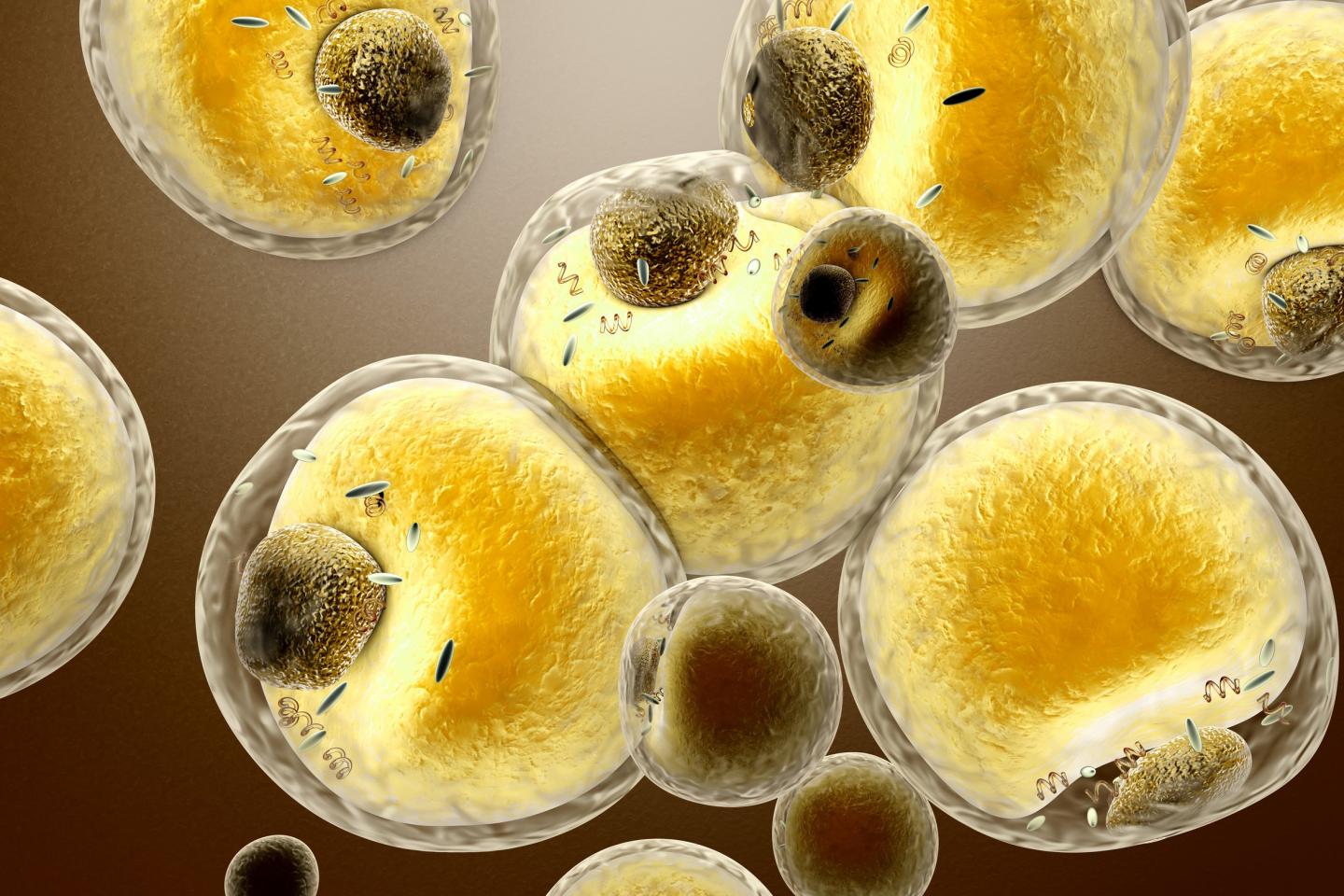
Credit: © spectralDesign – fotolia.com
No lipids, no life. In all organisms, lipids form cell walls, store energy and release it when necessary, and play an important role in cell signalling. It has been proved that changes in the composition of lipids play a causal role in illnesses such as cancer, fatty liver and multiple sclerosis. According to rough estimates, there are about 300,000 different lipid species. For the detection of lipids indicative for diseases, healthy and sick organisms are typically compared quantitatively. This comparison requires reliable and detailed information about the structure and composition of lipids from tissue samples – and to this end researchers from the BioTechMed-Graz initiative have developed a tool which is presented in the current issue of Nature Methods.
Lipids with character
Lipids – often just called fats – are complex substances which in addition to various other components predominantly consist of fatty acids. In lipid research, however, there are still many things unknown. Also, the detection of structural properties of lipid molecules in high-throughput profiling is still in its infancy. In the presented high-throughput method, a large number of samples are measured using mass spectrometry. These data (i.e., spectra) provide information for identification of the type and class of lipid or the type and position of the fatty acyl chains. However, the measured spectra can differ between one and the same lipid species, because lipids show different fragments in the spectra depending on the setup of the mass spectrometer and the ionization. Due to this spectral diversity, up to now there has been no universally applicable bioinformatics software for the automated detection of lipid structures.
Gerhard Thallinger of TU Graz's Institute of Computational Biotechnology explains the necessity of automated lipid characterisation: "Fast and reliable details on the lipid composition of cell samples are a prerequisite for comparisons with reference samples from healthy cells – which are required for the detection of biomarkers characteristic for diseases. The important question is which changes in the lipid composition of cells are relevant in diagnostics?"
The "Lipid Data Analyzer", which researchers of TU Graz, Med Uni Graz and University of Graz have published in Nature Methods, will facilitate work tremendously in biomedical research and definitely accelerate lipid research – of this Jürgen Hartler, also at the Institute of Computational Biotechnology, is convinced: "The method which we have developed in collaboration with colleagues from Med Uni Graz and Uni Graz, interprets lipid spectra using intuitive rule sets and can be as such flexibly accommodated to various fragmentation characteristics. This makes it possible for the first time to identify lipids at a very detailed structural level more precisely and reliably than previous solutions." The TU Graz team was responsible for the software development, the mass spectrometric experiments and usability tests were carried out at the Center for Medical Research (ZMF) of the Medical University of Graz and the University of Graz, and biological experiments were carried out at the University of Graz.
Extendable to other metabolic products such as sugars
In the presented study, the Lipid Data Analyzer detected more than 100 novel lipid species, which were previously unreported. The tool can be flexibly adapted – and not just for new classes of lipids. It may be used, for instance, to characterise polysaccharides and glycolipids, i.e. lipids with attached sugars. The researchers provide their Lipid Data Analyzer as open source to the scientific community.
###
About the Nature Methods paper:
Deciphering lipid structures based on platform-independent decision rules. J. Hartler*, A. Triebl*, A. Ziegl, M. Trötzmüller, G.N. Rechberger, O.A. Zeleznik, K.A. Zierler, F. Torta. A. Cazenave-Gassiot, M.R. Wenk, A. Fauland, C.E. Wheelock, A.M. Armando, O. Quehenberger, Q. Zhang, M.J.O Wakelam, G. Haemmerle, F. Spener, H.C. Köfeler, G.G. Thallinger. DOI 10.1038/nmeth.4470, Link: http://doi.org/10.1038/nmeth.4470. *equal contribution
The current publication in Nature Methods was supported by the project "LDA – High Throughput Identification of Lipid Molecular Species in LC MS/MS Data", which ends on 30 October 2017, coordinated by Gerhard Thallinger at TU Graz and financed by the Austrian Science Fund FWF. Furthermore, the project was collaborative work of researchers from TU Graz, Med Uni Graz and Uni Graz within the framework of the BioTechMed-Graz initiative.
This research topic is anchored in the Field of Expertise "Human & Biotechnology", one of the five strategic research foci at TU Graz.
Contact:
Gerhard THALLINGER
Dipl.-Ing. Dr.techn.
TU Graz | Institute of Computational Biotechnology
Phone: 43-316-873-5343
Email: [email protected] http://genome.tugraz.at
Jürgen HARTLER
Dipl.-Ing. Dr.techn.
TU Graz | Institute of Computational Biotechnology
Phone: 43-316-873-5322
Email: [email protected]
Media Contact
Gerhard Thallinger
[email protected]
43-316-873-5343
http://www.tugraz.at
Related Journal Article
http://dx.doi.org/10.1038/nmeth.4470