• HOME
  • NEWS
  • EXPLORE
    • CAREER
      • Companies
      • Jobs
    • EVENTS
    • iGEM
      • News
      • Team
    • PHOTOS
    • VIDEO
    • WIKI
  • BLOG
  • COMMUNITY
    • FACEBOOK
    • INSTAGRAM
    • TWITTER
Friday, May 15, 2026
BIOENGINEER.ORG
No Result
View All Result
  • Login
  • HOME
  • NEWS
  • EXPLORE
    • CAREER
      • Companies
      • Jobs
        • Lecturer
        • PhD Studentship
        • Postdoc
        • Research Assistant
    • EVENTS
    • iGEM
      • News
      • Team
    • PHOTOS
    • VIDEO
    • WIKI
  • BLOG
  • COMMUNITY
    • FACEBOOK
    • INSTAGRAM
    • TWITTER
  • HOME
  • NEWS
  • EXPLORE
    • CAREER
      • Companies
      • Jobs
        • Lecturer
        • PhD Studentship
        • Postdoc
        • Research Assistant
    • EVENTS
    • iGEM
      • News
      • Team
    • PHOTOS
    • VIDEO
    • WIKI
  • BLOG
  • COMMUNITY
    • FACEBOOK
    • INSTAGRAM
    • TWITTER
No Result
View All Result
Bioengineer.org
No Result
View All Result
Home NEWS Science News Biology

Bonobos, chimpanzees, and oxytocin

Bioengineer by Bioengineer
January 21, 2021
in Biology
Reading Time: 3 mins read
0
IMAGE
Share on FacebookShare on TwitterShare on LinkedinShare on RedditShare on Telegram

A key hormone may underlie social differences among great apes
IMAGE

Credit: Kyoto University/Kano Lab

Japan — Despite being our two closest relatives — separated by just two million years of evolution from one another and six million from us — chimpanzees, bonobos, and humans have numerous important differences, such as in lethal aggression demonstrated by chimpanzee males and the high social status of bonobo females.

Now a research study suggests that the hormone oxytocin may have played a central role in this evolutionary divergence.

“Oxytocin is a hormone neuropeptide found in mammals,” explains author James Brooks, “but despite its ancient origins, its role can vary even among closely-related species.” Among these roles are a wide array of social behaviors, some of which have recently been associated with certain species-typical behaviors in great apes.

Based on these behavioral findings, a team from Kyoto University and Azabu University in Japan examined oxytocin’s effect on eye contact, a key social behavior that is known to both differ widely between bonobos and chimpanzees and is tightly tied to the oxytocin system in humans, monkeys, and dogs.

The researchers predicted that if oxytocin is key to the divergence of social traits, it would act differently in the two species and promote species-specific behaviors.

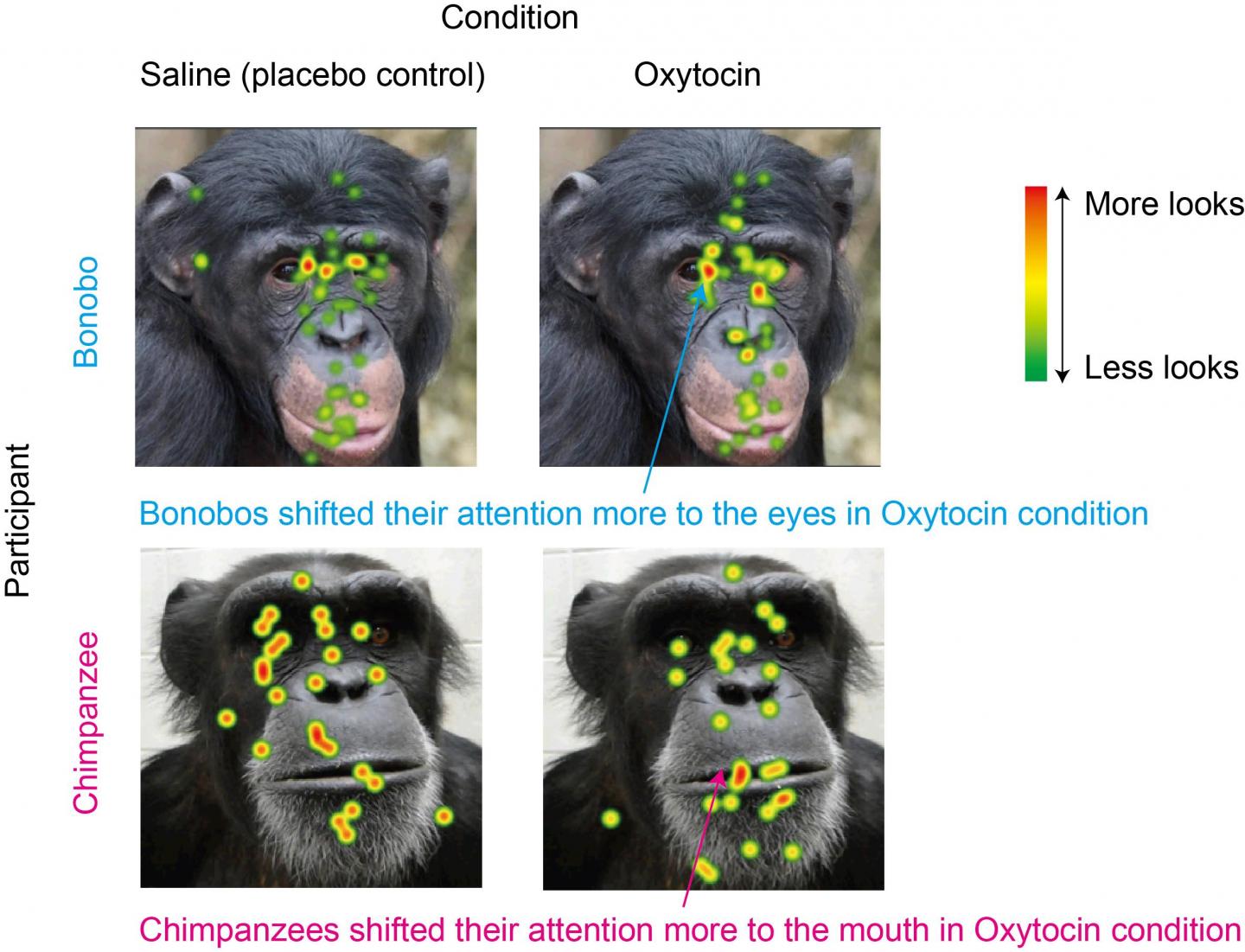
Using a non-invasive technique similar to that employed in tests with humans, oxytocin was nebulized — made into an aerosol — into a box where the apes had access to juice should they choose to participate. While drinking the juice, the apes passively inhaled the nebulized mist and were then shown still and video images prepared for each species, while their gaze was recorded with an eye-tracking device.

The team found that for bonobos — as with humans — oxytocin shifted attention more to the eyes in the images, while chimpanzees instead shifted their gaze more to mouths. Significantly, these changes enhanced known species differences.

“Due to the importance of eye contact in many social behaviors, such discrepancies could lead to broader behavioral differences through feedback loops, with greater eye contact leading to species-typical behavior leading to further oxytocin release,” says co-author Fumihiro Kano.

“These are the first results to demonstrate an effect of administered oxytocin on great ape behavior, pointing to the significant role this hormone plays in the critical differences among the species.”

###

The paper “Divergent effects of oxytocin on eye contact in bonobos and chimpanzees” appeared 21 December 2020 in the journal Psychoneuroendocrinology, with doi: 10.1016/j.psyneuen.2020.105119

Author contacts:

James Brooks ([email protected], +81 80 8495 3884) and Fumihiro Kano ([email protected], +81 80 6477 1127)

About Kyoto University

Kyoto University is one of Japan and Asia’s premier research institutions, founded in 1897 and responsible for producing numerous Nobel laureates and winners of other prestigious international prizes. A broad curriculum across the arts and sciences at both undergraduate and graduate levels is complemented by numerous research centers, as well as facilities and offices around Japan and the world. For more information please see: http://www.kyoto-u.ac.jp/en

Media Contact
Raymond Kunikane Terhune
[email protected]

Related Journal Article

http://dx.doi.org/10.1016/j.psyneuen.2020.105119

Tags: BehaviorBiologyEvolutionSocial/Behavioral ScienceZoology/Veterinary Science
Share13Tweet8Share2ShareShareShare2

Related Posts

Supercomputer Simulations Uncover How Bacterial Enzyme Pumps Sodium Ions, Opening Doors to Novel Antibiotics — Biology

Supercomputer Simulations Uncover How Bacterial Enzyme Pumps Sodium Ions, Opening Doors to Novel Antibiotics

May 15, 2026
New Astrobiology Special Collection Highlights Emerging Evidence Supporting Land-Based Origins of Life — Biology

New Astrobiology Special Collection Highlights Emerging Evidence Supporting Land-Based Origins of Life

May 14, 2026

Revolutionizing Textiles: Engineered Protein Fibers Pave the Way for Sustainable, Recyclable Fabrics

May 14, 2026

URI Master’s Student Emilio Pedroza Lopez Awarded Prestigious NSF Graduate Research Fellowship

May 14, 2026
Please login to join discussion

POPULAR NEWS

  • Research Indicates Potential Connection Between Prenatal Medication Exposure and Elevated Autism Risk

    843 shares
    Share 337 Tweet 211
  • New Study Reveals Plants Can Detect the Sound of Rain

    729 shares
    Share 291 Tweet 182
  • Salmonella Haem Blocks Macrophages, Boosts Infection

    62 shares
    Share 25 Tweet 16
  • Breastmilk Balances E. coli and Beneficial Bacteria in Infant Gut Microbiomes

    58 shares
    Share 23 Tweet 15

About

We bring you the latest biotechnology news from best research centers and universities around the world. Check our website.

Follow us

Recent News

Digital Health Fear Patterns in Older Cancer Patients

A*STAR Scientists Unveil Novel Technique to Decipher RNA Structure’s Impact on Health and Disease

Smart Hydrogels Revolutionize Information Security with Photo-Patterning and Multi-Stimuli Responsive Structural Colors

Subscribe to Blog via Email

Enter your email address to subscribe to this blog and receive notifications of new posts by email.

Join 82 other subscribers
  • Contact Us

Bioengineer.org © Copyright 2023 All Rights Reserved.

Welcome Back!

Login to your account below

Forgotten Password?

Retrieve your password

Please enter your username or email address to reset your password.

Log In
No Result
View All Result
  • Homepages
    • Home Page 1
    • Home Page 2
  • News
  • National
  • Business
  • Health
  • Lifestyle
  • Science

Bioengineer.org © Copyright 2023 All Rights Reserved.