The endangered bonobo, the great ape of the Central African rainforest, has a reputation for being a bit of a hippie. Known as more peaceful than their warring chimpanzee neighbors, bonobos live in matriarchal societies, engage in recreational sex, and display signs of cooperation both inside and outside their immediate social groups.
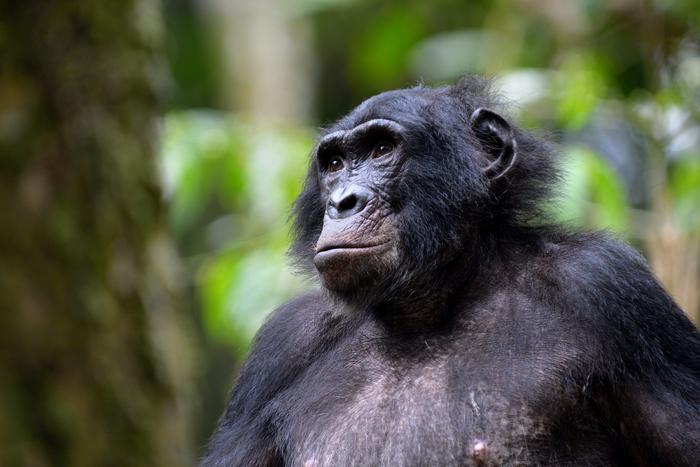
Credit: Lukas Bierhoff / Kokolopori Bonobo Research Project
The endangered bonobo, the great ape of the Central African rainforest, has a reputation for being a bit of a hippie. Known as more peaceful than their warring chimpanzee neighbors, bonobos live in matriarchal societies, engage in recreational sex, and display signs of cooperation both inside and outside their immediate social groups.
But this relaxed reputation isn’t quite reality, according to a new Harvard study in Current Biology. Observing bonobos and chimps in their natural environments over roughly three years, researchers found that actual rates of aggressive acts among male bonobos were notably higher than among male chimps.
“These findings draw a much more nuanced picture of the use of different forms of aggression in our closest living relatives,” said senior author Martin Surbeck, professor in the Department of Human Evolutionary Biology, who conducted the field study with first author Maud Mouginot, Michael Wilson, and Nisarg Desai of the University of Minnesota.
The researchers point to the different ways “aggression” can be defined and measured. Males of the two species exhibit consistently contrasting patterns of aggression: male chimpanzees sexually coerce females and sometimes kill their male competitors; in contrast, male bonobos exhibit less of this sexual coercion and have never been reported to kill a competitor.
But when looking at overall rates of aggression, which constitute acts that don’t necessarily result in injuries, bonobos overtook chimps. Using 14 community-years of data (years multiplied by number of communities observed), the researchers found that male bonobos engaged in about three times the number of aggressive acts toward other male bonobos than chimps did, even when limiting for only “contact aggression” – physical violence, as opposed to charging or chasing. Observations between females and males were less surprising: as expected, given that females often outrank males in bonobo communities, bonobos exhibited lower rates of male-female aggression and higher rates of female-male aggression than chimps.
In other words, when chimps are aggressive, they’re aggressive to a more lethal degree. But bonobos, you could say, engage in more frequent, less intense squabbling.
The researchers think these comparisons may boil down to different ways chimps and bonobos evolved to form coalitions. Chimps depend heavily on the strength of their male coalitions to defend territories and achieve reproductive success by mating with fertile females. Infighting within those coalitions thus “costs” chimps more, so they do it with less frequency.
Bonobos are more independent, less in need of strong coalitions, so they can “afford” to fight more and risk group strife, with less at stake for their reproductive success, according to Surbeck.
“I think what this study reminds us to do is be more specific and more nuanced about understanding that there are different types of aggression, which may underlie different selection pressures,” Surbeck said.
For the study, the researchers and their local partners on the ground observed three bonobo communities in the Kokolopori Bonobo Reserve in the Democratic Republic of the Congo, and two chimpanzee communities at Gombe National Park in Tanzania.
Journal
Current Biology
Method of Research
Observational study
Subject of Research
Animals
Article Title
Differences in expression of male aggression between wild bonobos and chimpanzees
Article Publication Date
12-Apr-2024