Bone sialoprotein operates as a multifaceted, context-dependent molecular bridge between the mineralized matrix and cellular signaling networks rather than serving as a simple unidirectional driver of bone formation or resorption, according to a systematic scientific review published in Frontiers in Endocrinology. Synthesizing evidence from molecular biochemistry, genetically engineered animal models, and clinical genetic associations, the investigation evaluates the biological architecture through which this non-collagenous extracellular matrix protein regulates skeletal turnover. While bone sialoprotein has long been recognized for its prominent presence in mineralizing tissues, the authors demonstrate that its regulatory effects are profoundly shaped by microenvironmental cues, mechanical loading, cellular maturation stages, and specific pathological states. Crucially, the analysis reveals that although functional interventions confirm its active participation in mineral deposition and remodeling dynamics, current scientific evidence remains insufficient to establish bone sialoprotein alterations as a direct causal initiator of osteoporotic bone loss.
Skeletal integrity throughout adult life relies on bone remodeling, a continuous and tightly coupled physiological cycle in which osteoclastic resorption of aged or damaged mineralized tissue is matched by osteoblastic deposition of new organic osteoid and subsequent hydroxyapatite mineralization. Under healthy conditions, this synchronized exchange preserves mechanical competence, repairs microdamage, and maintains systemic calcium and phosphate homeostasis. When remodeling balance uncouples—whether through excessive osteoclast activity, inadequate osteoblast replenishment, or disrupted signaling between these cell lineages—bone microarchitecture progressively deteriorates, predisposing individuals to fragile osteoporotic fractures. The review underscores that the pathophysiology of osteoporosis extends beyond cellular dysfunction alone, encompassing significant disturbances in the extracellular matrix microenvironment that directly modulate the osteogenic and resorptive capacities of resident cells.
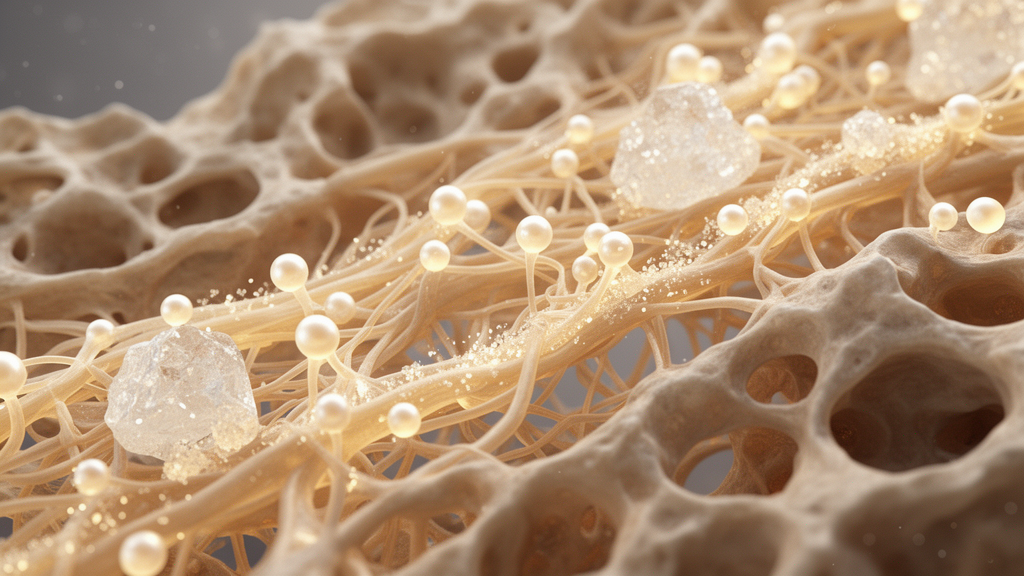
Encoded by the Ibsp gene and classified as a prominent member of the small integrin-binding ligand N-linked glycoprotein family, bone sialoprotein possesses a specialized molecular architecture designed to coordinate physical matrix organization with cellular transduction. The protein features a dedicated collagen-binding domain that facilitates its physical association with type I collagen fibrils, establishing a structured organic framework for mineral nucleation. Adjacent to this region, dense polyglutamate sequences generate strong localized negative electrostatic charges that attract calcium ions and catalyze the initial precipitation and crystal growth of hydroxyapatite. Anchoring its communicative functions at the C-terminal region is an Arg-Gly-Asp sequence motif that serves as a high-affinity binding ligand for cell-surface integrin heterodimers, thereby physically connecting mineral crystals to intracellular signaling cascades in surrounding bone cells.
Integrin engagement by bone sialoprotein triggers cytoskeletal rearrangements, regulates focal adhesion assembly, and directs the migration and functional differentiation of both osteoblasts and osteoclasts.
During osteoblast-mediated bone formation, bone sialoprotein displays a distinctive temporal expression profile that peaks during the critical developmental transition from initial organic matrix synthesis to active mineral deposition and osteoid maturation. Experimental in vitro culture systems demonstrate that upregulating bone sialoprotein accelerates the assembly of mineralized bone nodules and enhances calcification efficiency, whereas silencing or genetic suppression significantly impedes mineral deposition. Nevertheless, researchers emphasize that fluctuations in bone sialoprotein expression typically occur in close synchrony with established osteogenic master transcription factors and structural markers, including RUNX2, alkaline phosphatase, type I collagen alpha 1, and osteocalcin. This synchronized expression suggests that bone sialoprotein functions as an essential structural and regulatory participant in matrix mineralization rather than an autonomous upstream master switch directing mesenchymal stem cell lineage commitment toward the osteoblast phenotype.
In the resorptive compartment, bone sialoprotein exerts a similarly intricate influence on osteoclast differentiation, substrate adhesion, and functional lacunar resorption. To dismantle mineralized tissue efficiently, multinucleated osteoclasts must migrate across the matrix surface, polarize their internal architecture, and establish a tightly sealed contact zone through integrin-mediated recognition of RGD-containing extracellular matrix proteins. While bone sialoprotein provides necessary adhesive ligands that facilitate osteoclast attachment and sealing zone formation, its overall effect on bone resorption is neither uniformly stimulatory nor purely inhibitory.
The biological complexity of bone sialoprotein is particularly evident in genetically modified rodent models, where systemic alterations in gene expression yield divergent skeletal outcomes across distinct anatomical sites and developmental stages. In global Ibsp-knockout mice, the loss of endogenous protein causes pronounced defects in periodontal development, delays alveolar bone healing, and compromises mineralized matrix organization. Paradoxically, however, these same knockout animals frequently exhibit increased trabecular bone volume and preserved mass at specific anatomical sites and ages, reflecting complex developmental compensation and disrupted osteoclastic resorption. Conversely, transgenic mouse models engineered to overexpress bone sialoprotein display systemic reductions in bone mineral density and decreased trabecular volume alongside elevated osteoclastic activity, demonstrating that excess protein does not inherently promote bone accrual.
Protein intervention studies further delineate the operational boundaries between acute mineralized tissue repair and chronic metabolic remodeling imbalances. Exogenous administration of recombinant or purified bone sialoprotein reliably enhances local extraction socket healing in both wild-type and Ibsp-deficient animal models, stimulating mineralized matrix accumulation, improving bone volume fractions, and modulating localized remodeling responses within the alveolar repair niche. As a result, regenerative success observed in acute osseous defect models cannot be directly extrapolated as therapeutic proof for treating chronic osteoporotic skeletal deterioration.
When examining clinical subtypes of osteoporosis, the review notes that the strongest disease-associated evidence currently links bone sialoprotein to postmenopausal and estrogen-deficiency states. Estrogen depletion accelerates bone turnover, elevating osteoclast-mediated resorption while impairing compensatory osteoblast matrix maturation, a state in which bone sialoprotein expression patterns fluctuate alongside broader extracellular matrix degradation. However, bilateral ovariectomy triggers pronounced trabecular bone loss in both wild-type and bone-sialoprotein-deficient mice, indicating that endogenous bone sialoprotein is not the obligate molecular mediator through which estrogen deficiency drives structural decay. Furthermore, in secondary osteoporosis caused by glucocorticoid treatment, physiological senescence, or diabetes mellitus, direct evidence demonstrating a specific, independent causative contribution of bone sialoprotein remains sparse and largely associative.
At the human translational level, molecular epidemiology provides intriguing genomic associations between the IBSP locus and skeletal phenotypes, yet these findings require cautious clinical interpretation. Human genetic association investigations have identified specific single-nucleotide polymorphisms, such as rs1054627 and rs17013181, that correlate significantly with variations in bone mineral density and altered susceptibility to postmenopausal osteoporosis. The rs17013181 variant has additionally been associated with measurable differences in circulating systemic bone sialoprotein concentrations in patient cohorts. Nonetheless, the authors underscore that statistical correlation in observational genomic datasets does not establish biological causality, necessitating rigorous replication in diverse prospective demographic cohorts alongside comparative diagnostic evaluations against established clinical bone turnover markers, including serum procollagen type I N-terminal propeptide and beta-isomerized C-terminal telopeptide of type I collagen.
To overcome these persistent empirical ambiguities, the review outlines a targeted research roadmap emphasizing the integration of inducible, cell-type-specific genetic tools and disease-relevant experimental paradigms. Conventional germline knockout studies have confounded adult mechanistic interpretations by introducing embryonic developmental anomalies, skeletal malformations, and unpredictable systemic compensatory pathways. Future investigations must prioritize temporally controlled Ibsp gene deletion within mature osteoblasts, osteocytes, or osteoclasts following skeletal maturation, comparing targeted interventions before and after the induction of osteoporotic models.
Subject of Research: Mechanisms and context-dependent functions of bone sialoprotein in skeletal remodeling and osteoporosis
Article Title: Bone sialoprotein in bone remodeling: mechanisms of action, context dependence, and evidence related to osteoporosis
Article References: Meng, G., Hou, R., Dong, P., Wu, H., Li, X., Hu, K., Huhe, M., Du, Z., Zhong, Z., & Guo, Z. (2026). Bone sialoprotein in bone remodeling: mechanisms of action, context dependence, and evidence related to osteoporosis. Frontiers in Endocrinology, 17, Article 2002399. https://doi.org/10.3389/fendo.2026.2002399
Image Credits: AI Generated
DOI: 10.3389/fendo.2026.2002399
Keywords: bone sialoprotein, bone remodeling, osteoporosis, extracellular matrix, osteoblasts, osteoclasts, mineralization, hydroxyapatite, RGD motif, integrin signaling, SIBLING family, Ibsp gene, postmenopausal osteoporosis, bone mineral density, trabecular bone, bone histomorphometry, O-GlcNAcylation
News Source: Ophelia Keating. (November 16, 2026). Bone Sialoprotein Regulates Skeletal Remodeling Through Context-Dependent Extracellular Matrix Signaling. Scienmag.