


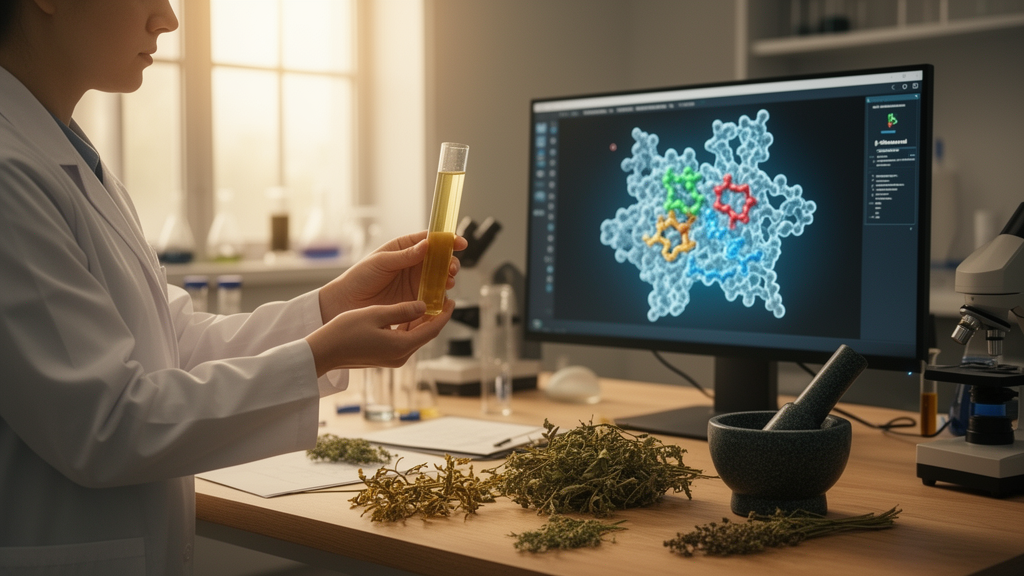
A plant long prized in traditional medicine across Asia and Africa for mending fractures and calming inflammation has now been put through a full laboratory and computational workup. Researchers at the Captain Srinivasa Murthy Central Ayurveda Research Institute in Chennai and collaborating institutions report a comprehensive pharmacognostic evaluation of Cissus quadrangularis L., a succulent vine of the grape family, together with the isolation and structural confirmation of one of its hexane-extractable constituents, β-sitosterol. The study, published open access in Discover Pharmaceutical Sciences on 13 February 2026, then used molecular docking and ADMET prediction software to explore how the isolated sterol might interact with a panel of disease-relevant protein targets. The authors are careful to frame the docking results as computational predictions only, and they state explicitly that experimental validation through in vitro, in vivo, and clinical studies is essential before any therapeutic claim can be made.
The plant material itself was collected from Melamanappakkam in Kancheepuram district, Tamil Nadu, India, at coordinates 12° 45′ 30.8″ N and 79° 52′ 41.7″ E, following institutional, national, and international guidelines. Taxonomic identification was carried out using regional floras, and the currently accepted name was verified against the World Flora Online, the International Plant Names Index, and Plants of the World Online. A flowering twig was preserved as a voucher specimen, deposited in the CSMH-Herbarium in Chennai under accession number CSMH-0558. Known locally as Pirandai in Tamil, Hadjod in Hindi, Nalleru in Telugu, and Changalamparanda in Malayalam, the species carries a long ethnobotanical pedigree that the authors situate within a broader literature on bone health, antioxidant, antibacterial, and other pharmacological activities attributed to its extracts.
The pharmacognostic half of the study followed the Ayurvedic Pharmacopoeia of India. Macroscopic examination of dried stem pieces revealed quadrangular, shrivelled, longitudinally striated, succulent segments with long internodes, nodes bearing leaf scars and tendrils, dichotomous branching in some pieces, a glabrous and woody surface with short fibrous fractures, four-winged projections at the stem corners, a pale greenish colour, a characteristic odour, and a bitter taste.
Microscopy added a second layer of diagnostic detail. In transverse section, the stem showed a ridged outline with a thick cuticle over a single-layered, thick-walled epidermis with straight anticlinal walls, and uniformly distributed actinocytic stomata in surface view. The ground tissue contained thin-walled parenchyma, a central pith traversed by numerous secretory cavities, idioblasts holding starch grains and bundles of acicular calcium oxalate crystals, and a discontinuous ring of conjoint, collateral, open, endarch vascular bundles capped by arcs of sclerenchymatous fibres and collenchyma beneath the winged projections. Powder microscopy of the coarsely ground stem showed actinocytic stomata, cluster, rosette, and acicular calcium oxalate crystals including raphides, simple oval to globular starch grains with rare bicomponent forms, spiral and pitted xylem vessels, and thick-walled phloem fibres with both pointed and blunt tips. Documentation was performed with an Olympus BX51 fluorescence microscope fitted with a Canon EOS 1500D camera.
Physicochemical standardization completed the quality-control picture. The team measured loss on drying at 105 °C, total ash, acid-insoluble ash, alcohol-soluble and water-soluble extractive values, and the pH of a ten percent aqueous suspension, reporting the full set in tabular form. Such parameters matter because they indicate the purity of a raw drug, including the presence or absence of foreign materials such as metallic salts. Qualitative phytochemical screening identified flavonoids, phenols, and tannins as the major phytoconstituents, and quantitative spectrophotometric estimation followed, using quercetin as the standard for flavonoids at 415 nm, gallic acid for phenols at 760 nm, and tannic acid for tannins at 700 nm, with calibration curves generated for each assay.
The chemical isolation work began with cold maceration. Washed, air-dried plant material was ground to a coarse powder in a mortar and pestle, a deliberate choice made to avoid chromium contamination from stainless steel, and extracted with hexane at a 1:3 plant-to-solvent ratio for 72 hours, with the process repeated three times. Filtrates were evaporated under a stream of laboratory air overnight to yield the crude hexane extract. Ten grams of this extract were then loaded onto a silica gel column of 50 g stationary phase, eluted first with pure hexane and then with a gradient rising to pure ethyl acetate and onward to methanol in one percent increments. A white crystalline compound appeared at a hexane-to-ethyl acetate ratio of 92:8 and, after hexane washing and recrystallization from ethanol, 140 mg of solid material was obtained.
Structural elucidation converged on β-sitosterol. Fourier-transform infrared spectroscopy showed a broad O–H stretching vibration at 3421.35 cm−1, C=C stretching bands at 2917.67 and 2850.87 cm−1, and aliphatic carbon stretching across 1648.50 to 556.83 cm−1, matching reported spectra for the sterol. Proton NMR at 400 MHz in DMSO-d6 displayed an aliphatic OH proton near 5.287 ppm, a C=C–H signal around 3.5 ppm, and the expected aliphatic envelope between roughly 2 and 0.8 ppm. Carbon-13 NMR at 100 MHz showed olefinic carbons at 140.77 and 121.72 ppm, an oxygen-bearing carbon at 77.33 ppm, and the remaining aliphatic carbons between 77.02 and 11.86 ppm. Mass spectrometry on Perkin Elmer Clarus 680 and 600 systems produced a molecular ion peak [M + H]+ at approximately 414.717, consistent with the molecular weight of β-sitosterol and with prior published data.
The in silico phase used AutoDock 4.2 with AutoDock Tools 1.5.6, ligand preparation in ChemDraw and ChemDraw 3D, protein preparation in Molegro Molecular Viewer, and visualization in Biovia Discovery Studio 2021, with ten genetic algorithm runs per protein. Docking returned its strongest binding energy for human dihydrofolate reductase at −10.95 kcal/mol with a reported IC50 of 9.51 µM, followed by human endothelial nitric oxide synthase at −10.11 kcal/mol (IC50 39.15 µM), pancreatic cancer targets at −9.11 kcal/mol (IC50 208.41 µM), prostate cancer at −8.48 kcal/mol (IC50 611.39 µM), tuberculosis-related targets at −8.29 kcal/mol (IC50 839.4 µM), carbonic anhydrase at −8.13 kcal/mol (IC50 1.09 µM), and tumor necrosis factor-alpha at −7.64 kcal/mol (IC50 2.51 µM). These are model-estimated binding values for a single ligand against isolated protein structures, not measurements of biological activity in cells or patients, and the authors themselves note that further in vitro and in vivo studies are needed to authenticate any pharmacological properties.
The ADMET predictions, run through SwissADME with toxicity screening in ProTox-II and Osiris, painted a favourable but entirely computational picture. β-sitosterol was predicted to have high gastrointestinal absorption but poor blood-brain barrier permeability, to be negative in the AMES mutagenicity test, non-hepatotoxic, and non-carcinogenic, not to inhibit the major cytochrome P450 enzymes CYP3A4 and CYP2D6, and to comply with Lipinski’s Rule of Five, a proxy for oral drug-likeness. The authors conclude that β-sitosterol behaves as a promising lead compound candidate whose evidence base rests uniquely on computational predictions, and that critical experimental validation is essential to confirm efficacy, safety, and mechanism of action. In the wider context of the paper, the value lies in the integration: authenticated plant material, pharmacopoeial standardization, a structurally confirmed isolate, and a transparent pipeline for early-stage natural product drug discovery, with the clinical chapter still entirely unwritten.
Subject of Research: Pharmacognostic evaluation and in silico analysis of β-sitosterol isolated from Cissus quadrangularis L.
Article Title: Comprehensive pharmacognostic evaluation, bioactive compound isolation, structural elucidation, and in silico analysis of Cissus quadrangularis L.
Article References: Ghosh, K., Gopal, K., Narayanan, L., Krishna, V. K., Pandey, A., Soumya, M. C., Durga, K. S., Priya, S., Suseem, S. R., Chitra, S., Meena, A. K., Srikanth, N., & Acharya, R. (2026). Comprehensive pharmacognostic evaluation, bioactive compound isolation, structural elucidation, and in silico analysis of Cissus quadrangularis L.. Discover Pharmaceutical Sciences, 2(1), Article 6. https://doi.org/10.1007/s44395-025-00035-z
Image Credits: AI Generated
DOI: 10.1007/s44395-025-00035-z
Keywords: Cissus quadrangularis, β-sitosterol, pharmacognosy, phytochemistry, molecular docking, ADMET, Ayurvedic Pharmacopoeia, natural products, structural elucidation, drug discovery, plant authentication, computational predictions
News Source: Ophelia Keating. (October 30, 2026). Bone-Healing Plant Yields β-Sitosterol in Study Pairing Classic Pharmacognosy with Computer Docking. Scienmag.



