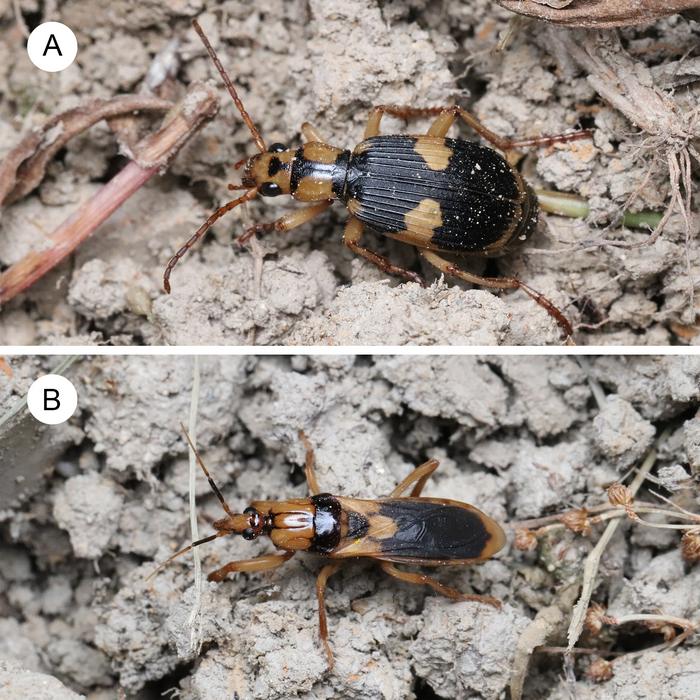
Animals can defend themselves against their natural enemies in various ways. Well-defended species often share conspicuous body colors with other well-defended or undefended species, forming mimetic interactions. Bombardier beetles eject toxic chemicals at a temperature of 100°C to repel enemies such as frogs, and many have warning body colors that function to deter enemies. An assassin bug, Sirthenea flavipes, exhibits a conspicuous body color similar to the bombardier beetle Pheropsophus occipitalis jessoensis which coexist with the assassin bug in the same habitat in Japan (Fig. 1). The assassin bug can stab with its proboscis, causing severe pain in humans. Although both insects are well defended, the mimetic interaction between the bombardier beetle and the assassin bug remains unclear.
Credit: Shinji Sugiura
Animals can defend themselves against their natural enemies in various ways. Well-defended species often share conspicuous body colors with other well-defended or undefended species, forming mimetic interactions. Bombardier beetles eject toxic chemicals at a temperature of 100°C to repel enemies such as frogs, and many have warning body colors that function to deter enemies. An assassin bug, Sirthenea flavipes, exhibits a conspicuous body color similar to the bombardier beetle Pheropsophus occipitalis jessoensis which coexist with the assassin bug in the same habitat in Japan (Fig. 1). The assassin bug can stab with its proboscis, causing severe pain in humans. Although both insects are well defended, the mimetic interaction between the bombardier beetle and the assassin bug remains unclear.
Japanese entomologists Shinji Sugiura (Kobe University) and Masakazu Hayashi (Hoshizaki Green Foundation) found that the bombardier beetle P. occipitalis jessoensis has a stronger defense against a shared predator compared to the assassin bug S. flavipes. They also showed that both the bombardier beetle and the assassin bug benefit from the mimetic interaction via the shared predator. Their research appears in the 6 June 2023 issue of PeerJ.
In central Japan, the pond frog Pelophylax nigromaculatus coexists with the bombardier beetle and the assassin bug in the same habitat. The pond frog, which is well known as a predator of various insects, could potentially attack the bombardier beetle and the assassin bug under field conditions. The researchers observed the behavioral response of pond frogs to bombardier beetles and assassin bugs under laboratory conditions (see video). Among the frogs, 100% rejected bombardier beetles and 75% rejected assassin bugs (Fig. 2), suggesting that the bombardier beetle is better defended against frogs than the assassin bug. The researchers also provided a bombardier beetle or an assassin bug to a frog that had encountered the other insect. Frogs that had previously encountered one insect species were less likely to attack the other species (Fig. 3). Specifically, a history of encounter with assassin bugs reduced the rate of attack on bombardier beetles by frogs from 75.0% to 21.7% (Fig. 3). A history of encounter with bombardier beetles reduced the rate of attack on assassin bugs by frogs from 91.3% to 40.0% (Fig. 3). Therefore, the mimetic interaction between the bombardier beetle and the assassin bug may be mutualistic.
Video:
https://youtu.be/BZ75K6rfvdE
Credit: Shinji Sugiura
Journal article:
Sugiura, S. & Hayashi, M. (2023) Bombardiers and assassins: mimetic interactions between unequally defended insects. PeerJ (https://doi.org/10.7717/peerj.15380)
Journal
PeerJ
DOI
10.7717/peerj.15380
Method of Research
Experimental study
Subject of Research
Animals
Article Title
Bombardiers and assassins: mimetic interactions between unequally defended insects.
Article Publication Date
6-Jun-2023