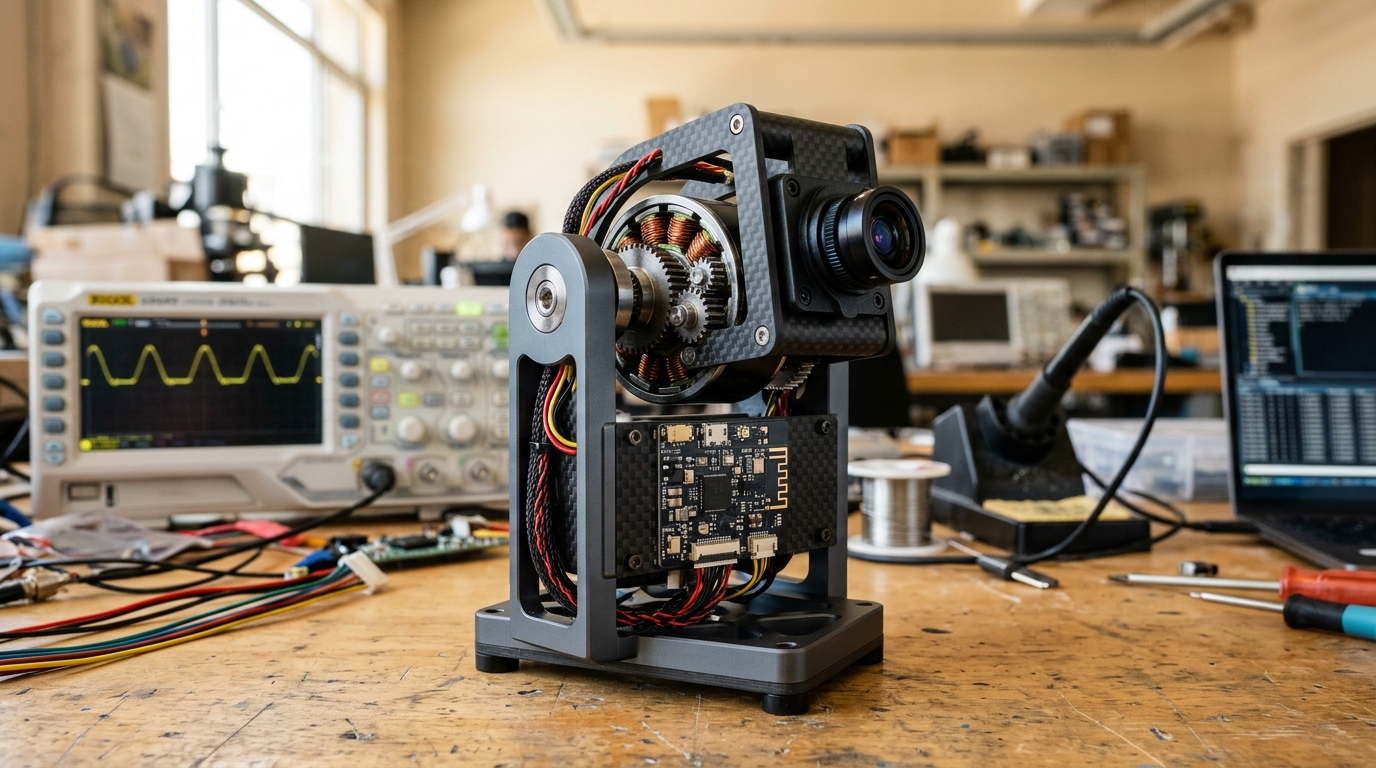
A newly published study introduces a two-way Bluetooth communication framework for embedded robotics that successfully tackles the technical challenges of executing motor control and video streaming at the same time. Conducted by researchers Sandeep Gupta, Udit Mamodiya, and Rekha Jain, the open-access research was published in the International Journal of Networked and Distributed Computing. The investigation focuses on enabling responsive bidirectional transmission over short-range wireless links, demonstrating that compact robotic hardware can handle both movement commands and continuous visual feedback simultaneously.
The communication system is built around the ESP32-CAM platform and utilizes a specialized marker-based framing protocol to manage data exchange. To structure and tune the interaction between disparate communication channels, the authors applied an analytical design methodology grounded in information theory, finite state machine modeling, and control theory. This unified protocol integrates heterogeneous data streams into a single coordinated flow, delivering a measured 23 percent reduction in latency when evaluated against baseline communication implementations.
In operational benchmarks, the framework achieved command transmission latencies ranging between 100 and 150 milliseconds, with an observed variability of plus or minus 15 milliseconds. Concurrently, the wireless link sustained video transmission rates between 5 and 8 frames per second at QVGA resolution. The experimental evaluation confirmed that these performance levels remained stable across operating distances extending up to 10 meters, meeting the speed and responsiveness demands required for real-time robotic maneuvering.
The finite state machine architecture demonstrated an automatic error recovery rate of 98.7 percent, allowing the communication link to restore normal operation autonomously following state disruptions. Under standard working conditions, overall system error rates remained below 2 percent, showing consistent data handling across the dual-channel stream.
When subjected to challenging test conditions with 15 percent packet loss, the framing method retained a 99.2 percent accuracy rate in detecting frame boundaries. According to the research team, these combined experimental findings establish the practical viability of the unified Bluetooth framework for real-time embedded robotics tasks that require simultaneous control inputs and live visual monitoring.
Subject of Research: Bluetooth communication framework for concurrent motor control and video streaming in embedded robotics
Article Title: Low-Latency Bluetooth Communication Framework for Simultaneous Motor Control and Video Streaming in Embedded Robotics
Article References: Gupta, S., Mamodiya, U., & Jain, R. (2026). Low-Latency Bluetooth Communication Framework for Simultaneous Motor Control and Video Streaming in Embedded Robotics. International Journal of Networked and Distributed Computing. https://doi.org/10.1007/s44227-026-00136-w
Image Credits: AI Generated
DOI: 10.1007/s44227-026-00136-w
Keywords: embedded robotics, Bluetooth communication, motor control, video streaming, ESP32-CAM, low-latency communication, marker-based protocol, finite state machine, information theory, control theory, command latency, QVGA resolution, frame boundary detection, packet loss, error recovery, heterogeneous data streams, two-way communication
News Source: Denise Maddox. (November 16, 2026). Bluetooth Framework Enables Concurrent Motor Control and Video Streaming in Robotics. Scienmag.