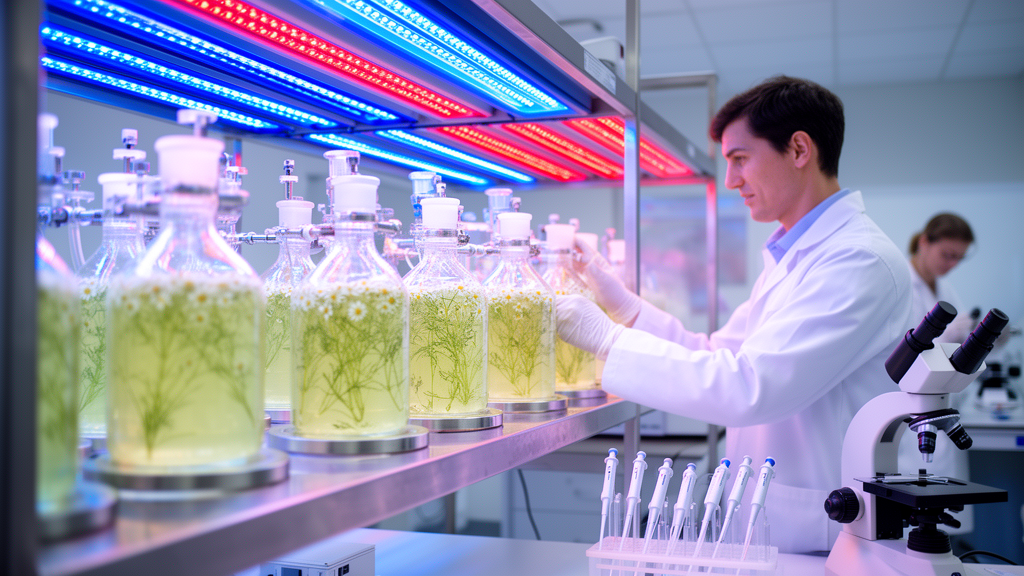
Chamomile (Matricaria chamomilla L.) is valued for the phenolic and flavonoid compounds its cells can produce, and a new open-access study in BMC Plant Biology reports that the color of LED light shining on those cells shifts the balance between growth and secondary chemistry. In cell cultures derived from chamomile hypocotyl explants, the red-blue light combination produced the highest biomass accumulation of any treatment tested, while blue light delivered the greatest phenolic and flavonoid biosynthesis and the highest phenylalanine ammonia lyase (PAL) activity over the three-week culture period.
The research team first transferred calli to Murashige and Skoog (MS) liquid medium and then grew the resulting cell suspensions on MS solid medium. After one week of culture, the cells were exposed to four LED spectra—white, blue, red, and a red-blue combination—with darkness serving as the control. Samples were collected after one, two, and three weeks of exposure, allowing the researchers to track how physiological and biochemical responses evolved across the culture window.
The clearest divergence appeared in biomass accumulation. The red-blue treatment produced the highest biomass of any light condition, followed by blue light, while the other spectra and darkness lagged behind. Within this experimental system, the combined wavelengths supported cell proliferation more effectively than either red or blue alone.
Light quality also reshaped the cells’ antioxidant machinery. The greatest activities of peroxidase (POX) and superoxide dismutase (SOD) were observed under blue light after three weeks of treatment, while the highest catalase (CAT) activity was recorded under red, white, and blue lights, respectively. These enzymes respond to reactive oxygen species, and their differential induction indicates that each spectrum imposed a distinct oxidative environment on the cultures.
Consistent with that pattern, the lowest hydrogen peroxide (H2O2) content across the various growth stages was measured under red-blue light, whereas the highest malondialdehyde (MDA) content—a marker of lipid peroxidation—was measured under blue light. Microscopic observations further confirmed that blue light imposed enhanced oxidative stress on the cells.
Despite that stress, blue light proved the strongest trigger for secondary metabolism. All light treatments induced the biosynthesis of phenolic and flavonoid metabolites as well as PAL activity, a key enzyme of the phenylpropanoid pathway, during the three-week culture period. The highest levels of these metabolites and of PAL activity were recorded under blue light, meaning the greatest metabolite output coincided with the strongest oxidative stress markers in the same treatment. Red-blue light, by contrast, paired lower H2O2 accumulation with strong growth but did not match blue light’s metabolite levels.
The study concludes that blue light holds greater potential for enhancing the production of bioactive secondary metabolites in chamomile cell cultures, whereas red-blue light is more favorable for biomass accumulation. LEDs are widely used in greenhouses, in vitro culture, and plant tissue and cell culture facilities because of their cost-effectiveness and spectral specificity, which makes spectral selection a practical variable in controlled cultivation systems.
Because the work was conducted in cell culture over a three-week window, the findings apply to this in vitro system rather than to field-grown plants, and the measurements capture associations between light spectra and biochemical responses within the tested conditions. Even so, the results offer a spectral framework for chamomile cell culture: red-blue LEDs favored cell mass in this system, while blue light favored phenolic and flavonoid output alongside a measurable oxidative burden.
Subject of Research: Effects of LED light spectra on growth and secondary metabolite production in chamomile cell cultures
Article Title: Study of different LED light impacts on growth mechanisms and secondary metabolites production in cell cultures of Matricaria chamomilla L. through analysis of H2O2 level, antioxidative responses, and cell ultrastructure
Article References: Nasiri, M. H., Hassanpour, H., Rezayian, M., & Niknam, V. (2026). Study of different LED light impacts on growth mechanisms and secondary metabolites production in cell cultures of Matricaria chamomilla L. through analysis of H2O2 level, antioxidative responses, and cell ultrastructure. BMC Plant Biology. https://doi.org/10.1186/s12870-026-10283-5
Image Credits: AI Generated
DOI: 10.1186/s12870-026-10283-5
Keywords: chamomile, LED light, cell culture, secondary metabolites, blue light, red-blue light, antioxidant enzymes, hydrogen peroxide, phenolics, flavonoids, PAL activity, plant biotechnology
News Source: Alan Morgan. (October 26, 2026). Blue LED Light Boosts Chamomile Cell Metabolites While Red-Blue Mix Drives Growth. Scienmag.