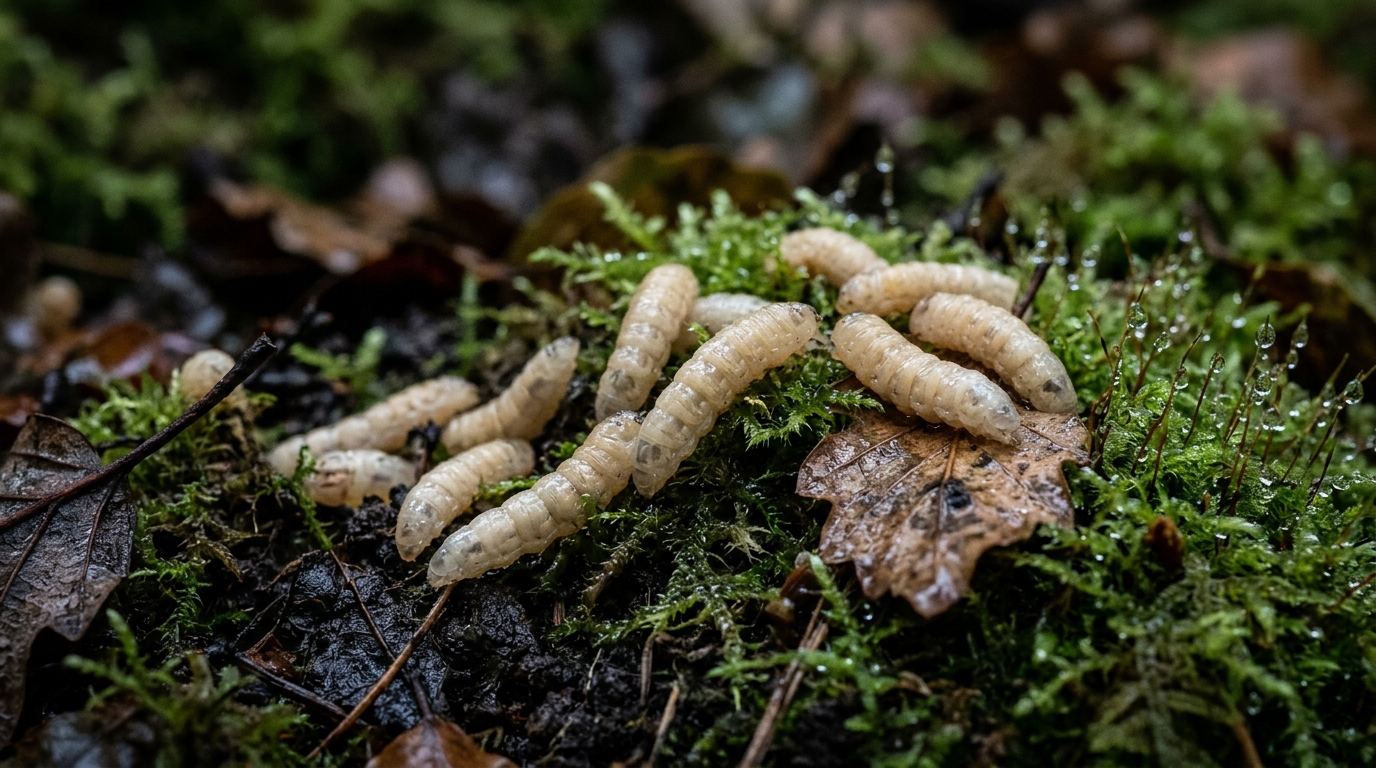
Forensic entomologists can read the age of blowfly larvae on a corpse to estimate the minimum time since death, and a new study suggests that the chemical signature they rely on holds up even when the insects develop outdoors rather than in a controlled laboratory. Researchers reared larvae of the blowfly Lucilia sericata at two European field sites, Swindon in the United Kingdom and Frankfurt in Germany, and showed that cuticular hydrocarbon profiles measured by gas chromatography–mass spectrometry could place larvae into daily age classes with accuracies of 98.9 percent for the UK outdoor group, 95.0 percent for a UK indoor group held at 25 ± 1 °C, and 90.0 percent for the German outdoor group.
The work, published in the International Journal of Legal Medicine, was led by Canan Kula, with Jens Amendt and Hannah Moore as co-authors. Accurate larval age estimation is fundamental to determining the minimum post-mortem interval in forensic casework, and cuticular hydrocarbon analysis had already shown promise under controlled laboratory conditions. What remained poorly understood was whether the method stays reliable under natural temperature fluctuations and with geographically distinct populations, which is the situation investigators actually face at a crime scene.
To test this, the team extracted cuticular hydrocarbons daily throughout the entire larval development period of eight to ten days and analysed them by GC-MS. The resulting chemical data were then fed through a machine-learning pipeline that combined principal component analysis with linear discriminant analysis, validated by leave-one-out cross-validation, to classify each larva by age and by population. Across all three rearing groups, the area under the receiver operating characteristic curve ranged from 0.97 to 1.00 for every larval stage, indicating that the chemical clock remained informative from the earliest to the latest stages measured.
Crucially for forensic use, the method was not just accurate on average but precise in its errors. All misclassifications occurred between adjacent age classes, meaning that no single larva was ever placed more than one day away from its true age. For an investigator converting a larval age into a minimum post-mortem interval, that boundary matters: the worst-case error in this study was a single day of development, not a shift between distant developmental stages.
The German population did show one striking deviation. During the post-feeding stage, the Frankfurt-reared larvae underwent what the authors describe as a marked ontogenetic reversal, a temporary increase in branched methyl alkanes accompanied by a reduction in n-alkanes in the cuticle. This reversal coincided with a sustained period of large diurnal temperature amplitude, suggesting that repeated swings between warm days and cool nights can reshape the larval chemical profile at a specific developmental window.
That finding cuts both ways for forensic application. On one hand, it demonstrates that environmental stress leaves a readable trace in the hydrocarbon profile, which could eventually help investigators recognise the conditions under which immature insects developed. On the other hand, it means the chemical clock is not perfectly uniform across environments: the post-feeding stage under strong thermal stress behaved differently from the same stage elsewhere, and the authors explicitly flag sustained thermal stress and the post-feeding stage as requiring further calibration before the method can be used in routine casework.
The same chemical data also separated the populations from each other. Leave-one-out cross-validated classification of larvae by population reached 95.2 percent accuracy with a macro-averaged AUC of 0.995, meaning the hydrocarbon profile carried information not only about how old a larva was but also about which of the geographically distinct rearing populations it came from. Such population-level discrimination could matter in cases involving body transfer, where knowing the regional origin of colonising insects may become an additional investigative clue.
Lucilia sericata, described by Meigen in 1826, is one of the blowfly species whose larvae are routinely recovered from human remains, and its developmental timing under fixed temperatures is well documented. The present study extends that foundation by asking whether the hydrocarbon-based alternative to traditional morphological aging survives contact with real weather. The comparison between the UK indoor group at a constant 25 ± 1 °C and the UK outdoor group, which experienced a mean temperature of 20.3 °C, is particularly informative, because the outdoor larvae were actually classified slightly more accurately than their laboratory counterparts.
The authors position CHC analysis combined with PCA-LDA as a promising forensic analytical approach for daily-resolution age estimation under field conditions. The caveats they attach are specific: the post-feeding reversal seen in the German cohort and the influence of sustained thermal stress both need further calibration work before the pipeline can be trusted unreservedly in casework. For now, the study establishes that the chemical clock inside a blowfly larva keeps time accurately outdoors, errs by at most a single day, and even carries a chemical memory of where the insect grew up.
Subject of Research: Cuticular hydrocarbon profiles for forensic age estimation of Lucilia sericata larvae under natural outdoor temperatures
Article Title: Cuticular hydrocarbon profiles of Lucilia sericata larvae for age estimation: temperature effect and intraspecific variation
Article References: Kula, C., Amendt, J., & Moore, H. (2026). Cuticular hydrocarbon profiles of Lucilia sericata larvae for age estimation: temperature effect and intraspecific variation. International Journal of Legal Medicine. https://doi.org/10.1007/s00414-026-04058-8
Image Credits: AI Generated
DOI: 10.1007/s00414-026-04058-8
Keywords: forensic entomology, Lucilia sericata, cuticular hydrocarbons, larval age estimation, post-mortem interval, GC-MS, PCA-LDA, temperature effects, population discrimination, blowfly development, Cuticular, hydrocarbon
News Source: Ophelia Keating. (November 5, 2026). Blowfly Larvae Carry a Chemical Clock That Survives the British and German Weather. Scienmag.