


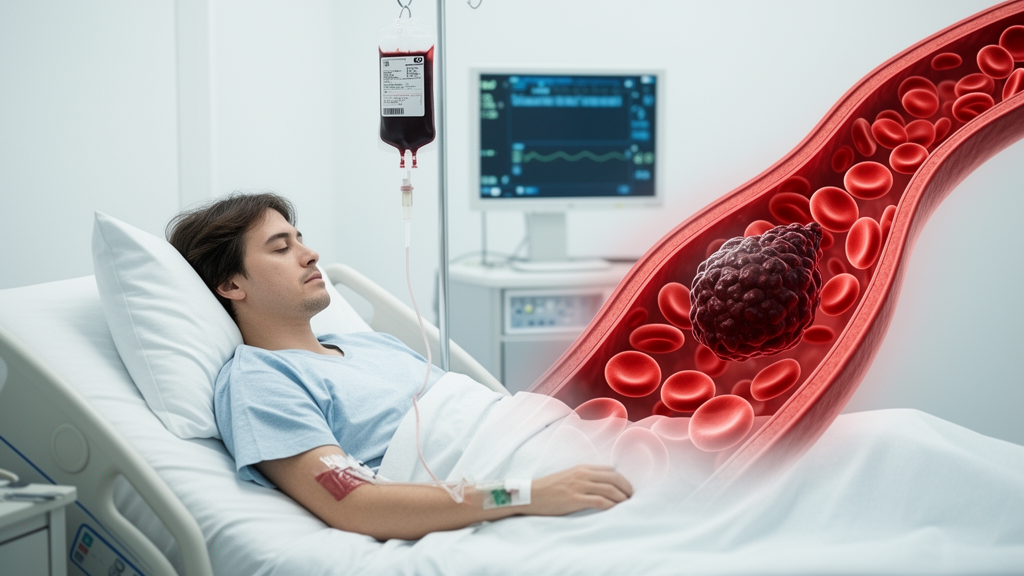
Patients undergoing radical cystectomy for muscle-invasive bladder cancer who receive a perioperative blood transfusion face a significantly higher risk of developing a venous thromboembolism within 90 days of surgery, according to a new study published in BMC Urology. The open-access research, made available early as a peer-reviewed, accepted manuscript carrying a permanent DOI, reports that transfusion remained an independent predictor of postoperative clots even after accounting for other risk factors.
The study, led by Kays Chaker and colleagues, set out to evaluate the impact of perioperative blood transfusion on the occurrence of postoperative venous thromboembolism, defined as either deep venous thrombosis or pulmonary embolism, in patients undergoing radical cystectomy for muscle-invasive bladder cancer.
The researchers reviewed all patients who underwent open radical cystectomy between 2015 and 2023. Patients who developed a venous thromboembolism within 90 days after surgery were compared with those who did not. The team then used logistic regression to assess the association between candidate covariates and the probability of a thromboembolic event within that 90-day window.
In total, 520 cases were enrolled in the study. Of these, 175 patients, or 33.65 percent, developed a venous thromboembolism within 90 days of surgery, a strikingly high incidence that underscores the thrombotic burden associated with this major oncological operation.
The comparison between the two groups revealed a consistent pattern. Compared with patients who did not develop a thromboembolism, those who did were significantly older, more likely to be active smokers, and had a higher body mass index, with each of these differences reaching a p value below 0.001. They also had larger tumors, were more likely to have undergone complete transurethral resection of bladder tumor, and were more frequently treated with neoadjuvant chemotherapy, the latter with a p value of 0.024.
Perioperative characteristics further separated the groups. Patients who developed clots underwent longer surgical procedures, experienced greater intraoperative blood loss exceeding 450 milliliters, and required perioperative blood transfusions more often, all with p values below 0.001. They also received intraoperative tranexamic acid, an agent used to reduce bleeding, more frequently, with a p value of 0.001, and vasoactive agents more often, with a p value of 0.01.
When the investigators moved from simple comparison to multivariable logistic regression, four factors emerged as independent predictors of postoperative venous thromboembolism: older age, with a p value of 0.002; higher body mass index, with a p value of 0.008; greater intraoperative blood loss, with a p value of 0.001; and perioperative blood transfusion itself, with a p value of 0.007. The persistence of transfusion as an independent predictor is the study’s central finding, suggesting that the association is not fully explained by the fact that transfused patients simply bled more or underwent longer operations.
The authors conclude that the incidence of perioperative blood transfusion is significant at the time of radical cystectomy and that the study demonstrates blood transfusion was associated with an increased risk of developing venous thromboembolism.
Subject of Research: The association between perioperative blood transfusion and postoperative venous thromboembolism after radical cystectomy for muscle-invasive bladder cancer.
Article Title: Impact of perioperative blood transfusion on thromboembolic events after radical cystectomy for muscle-invasive bladder cancer
Article References: Chaker, K., Chaabouni, A., Elleuch, W., Hmouda, S., Ouertani, K., Limem, A., Khemakhem, Y., Ouanes, Y., Bibi, M., Chedly, W. B., Slimene, M. H., & Nouira, Y. (2026). Impact of perioperative blood transfusion on thromboembolic events after radical cystectomy for muscle-invasive bladder cancer. BMC Urology. https://doi.org/10.1186/s12894-026-02453-2
Image Credits: AI Generated
DOI: 10.1186/s12894-026-02453-2
Keywords: radical cystectomy, bladder cancer, blood transfusion, venous thromboembolism, deep venous thrombosis, pulmonary embolism, logistic regression, perioperative blood loss, neoadjuvant chemotherapy, BMC Urology, Impact, perioperative
News Source: Ophelia Keating. (October 29, 2026). Blood transfusion linked to higher clot risk after bladder cancer surgery. Scienmag.



