Routine blood biochemical and hematological parameters measured during physical examinations can serve as statistical indicators of feed efficiency and daily performance in commercial growing pigs, according to an extensive evaluation published in Frontiers in Veterinary Science. Investigating physiological profiles across multiple commercial crossbred groups, researchers demonstrated that integrating conventional blood metrics related to protein metabolism, general nutritional state, and hepatic function explained meaningful portions of animal performance phenotypes. Specifically, regularized regression models using blood measures predicted up to a fourth of the observed variability in feed conversion ratio and one-fifth of the variation in average daily feed intake and daily weight gain. These findings indicate that circulating metabolites and blood cell indexes, which reflect underlying physiological pathways and nutrient utilization dynamics, offer a measurable biological signature capable of forecasting production outcomes in healthy animals without relying solely on direct feed intake records.
The study addresses a persistent challenge in modern livestock production, where elevated feed expenses and mounting sustainability concerns demand greater efficiency in converting feed into animal protein. Although improving feed efficiency is a primary economic and environmental goal for commercial swine operations, tracking individual nutrient consumption in group-housing environments remains technically demanding and cost-prohibitive for the vast majority of commercial production barns. To overcome these practical monitoring barriers, researchers have increasingly investigated intermediate biological phenotypes that mirror internal metabolic utilization. In growing pigs, feed intake, lean muscle growth, and backfat accumulation represent interconnected processes dictated by an animal’s metabolic and genetic background. Circulating physiological indicators provide intermediate windows into post-digestive nutrient handling, protein degradation, and immune expenditure, establishing a practical biological framework to assess individual nutrient processing efficiency under standard commercial conditions.
To rigorously evaluate the predictive value of conventional blood tests, investigators conducted a coordinated series of five successive trials involving 762 commercial crossbred pigs at the Institut de Recerca i Tecnologia Agroalimentàries Experimental Pig Farm located in Monells, Spain. The research protocol received full approval from the institutional ethical committee and strictly complied with relevant European Union directives and Spanish animal protection regulations. Across the five experimental batches reared between April 2022 and August 2024, pigs were sourced from five commercial breeding companies and represented multiple commercial terminal crosses sired by Duroc, Pietrain, or Large White boars paired with maternal lines. Experimental groups were organized by batch, breeding origin, crossbreed, sex, and diet, yielding thirteen distinct experimental groups. Animals entered the controlled evaluation facilities around 60 days of age, followed by a three-week habituation period prior to starting the official ninety-day experimental observation period at 80 days of age.
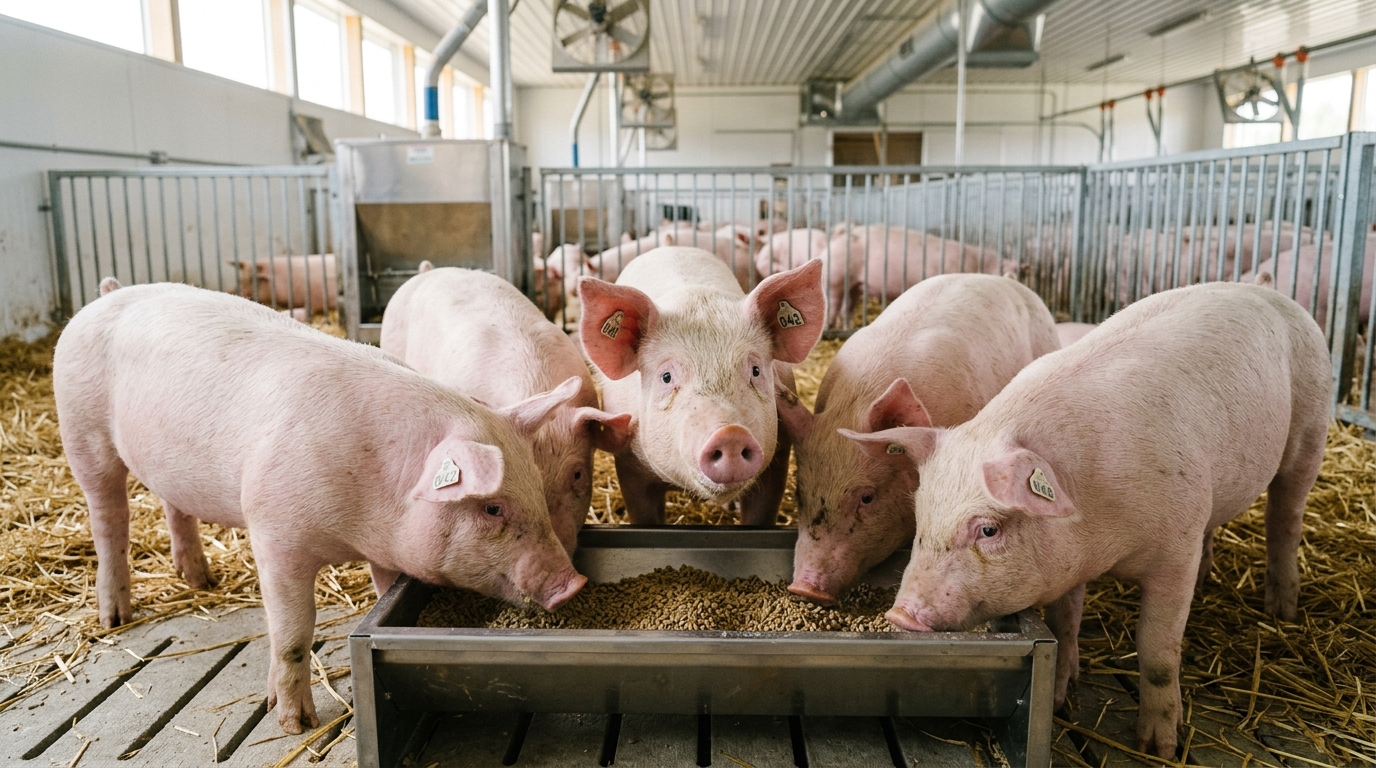
During the entire trial, the animals were housed in uniform study rooms containing four pens each, with single-sex groups of twelve to fourteen pigs per pen measuring five by 2.8 meters. Each pen was equipped with an automated electronic feeding station and an ad libitum cup drinker, ensuring continuous individual traceability and ad libitum access to water and feed. Study rooms maintained controlled thermal conditions between 22 and 25 degrees Celsius via automated ventilation systems with variable-speed exhaust fans and supplementary heating. Nutritional programs followed standard commercial three-phase regimens tailored to crossbreed nutritional needs across the growing and finishing phases, covering 80 to 100 days of age, 100 to 145 days of age, and 145 to 165 days of age. Two trials incorporated dietary interventions, including a high-protein formulation compared to a standard diet, and an organic acid treatment evaluating dietary supplementation with benzoic acid.
Individual production performance and growth metrics were tracked continuously throughout rearing using electronic feeder records and scheduled physical assessments. All pigs were weighed individually at arrival, every three weeks during rearing, and at market weight, allowing daily growth rates to be determined across time using linear models. Backfat thickness was monitored every three weeks via ultrasound measurements recorded with specialized scanning equipment. Electronic feeding stations recorded cumulative feed intake data, allowing average daily feed intake and individual feed conversion ratios—defined as the ratio of average daily feed consumption to average daily body weight gain—to be computed for each animal. Because exact weighing intervals varied slightly among groups, body weight, cumulative intake, and backfat thickness were interpolated at fixed timepoints of 90, 125, and 156 days of age, establishing standardized growth records across two rearing intervals spanning 90 to 125 days and 125 to 156 days.
For biochemical and hematological profiling, two to three pigs per pen were randomly selected at the start of the study, resulting in a representative subset of 176 pigs that underwent repeated blood sampling. Blood draws were conducted at two distinct developmental milestones: approximately 125 days of age, corresponding to the end of the growing period, and approximately 165 days of age, marking the end of the fattening period. In all instances, unfasted pigs were sampled between 08:30 and 10:00 in their home pens under minimal restraint using double-ended vacutainer needles. Whole blood was collected into EDTA tubes for comprehensive hemograms and into serum-separator tubes containing clot activators for biochemical panels. Laboratory analyses evaluated thirty-two conventional parameters, quantifying serum concentrations of urea, albumin, total proteins, creatinine, cholesterol, triglycerides, total bilirubin, glucose, and key liver enzymes, alongside red and white blood cell indices, hemoglobin, and platelet counts.
To resolve information redundancy and multicollinearity prior to multivariate modeling, researchers applied an absolute correlation threshold of 0.60 to eliminate highly correlated parameters while retaining those with superior biological relevance. This data reduction step condensed the dataset from thirty-two to twenty core physiological variables. For instance, albumin and globulin concentrations were retained whereas total protein and the albumin-to-globulin ratio were omitted, and neutrophil and lymphocyte percentages were combined into a single neutrophil-to-lymphocyte ratio. Statistical evaluations employed four distinct linear fixed and mixed models to examine how adding blood parameters altered explanatory power when accounting for systematic effects of sex, batch, crossbreed, diet, and rearing period. Likelihood ratio tests confirmed that incorporating blood variables as multiple regression covariates significantly improved model fit across all investigated productive traits, with substantial increases in explained variance observed for growth rate, daily feed consumption, and overall feed efficiency.
The predictive capacity of the metabolic and hematological profiles was subsequently evaluated on standardized residual datasets using machine learning with an Elastic Net regularized regression algorithm. Observations were randomly split into training sets of 280 records and independent testing sets of 70 records, ensuring that observations from any single animal remained exclusively within one partition. The Elastic Net penalized regression coefficients through a mixture of lasso and ridge penalties controlled by hyperparameters optimized via tenfold cross-validation repeated ten times across four hundred parameter combinations. To guarantee robustness against dataset partitioning variability, the complete modeling sequence—spanning initial data splitting, cross-validation, hyperparameter selection, and testing-set validation—was repeated through seven independent iterations, calculating average correlation coefficients, determination coefficients, and root mean squared errors between observed and predicted values.
Validation testing demonstrated that the best regularized regression models achieved moderate predictive accuracy for key productive phenotypes, led by feed conversion ratio with an average correlation coefficient of 0.45 and an average determination coefficient of 0.20, with iteration ranges reaching 0.50 and 0.25, respectively. Average daily feed intake achieved an average correlation of 0.44 and an explained variance of 0.19, while average daily gain yielded an average correlation of 0.41 and a determination coefficient of 0.17. Backfat thickness showed a comparable prediction profile, recording an average correlation of 0.42 and an explained variance of 0.18. In contrast, circulating blood parameters predicted absolute body weight poorly, accounting for only ten percent of the variance on average and displaying the highest residual error, indicating that general blood chemistry correlates far more strongly with dynamic metabolic utilization rates than with total cumulative physical body mass.
Biological interpretation of the regularized coefficients identified specific physiological pathways underlying swine feed efficiency and growth performance. Serum urea, alkaline phosphatase, albumin, cholesterol, and erythrocyte mean corpuscular volume emerged as prominent biomarkers across multiple models. Urea exhibited positive associations with daily intake, fat deposition, and feed conversion ratio, indicating that higher urea levels reflect excess protein intake relative to accretion needs, inefficient nitrogen utilization, and elevated muscle protein turnover. Conversely, serum alkaline phosphatase displayed a strong negative association with feed conversion ratio, highlighting its potential role as a novel physiological marker of enhanced feed efficiency. Creatinine concentration loaded negatively with daily gain and intake, reflecting muscle breakdown dynamics, while total bilirubin displayed negative associations with growth and intake, aligning with the premise that optimal liver functioning underpins efficient livestock performance.
While hematological measures showed generally weaker predictive contributions than biochemical metabolites, erythrocyte mean corpuscular volume and leukocyte counts contributed partial predictive value in regularized models. The authors noted several inherent biological constraints, including the natural physiological variability of blood parameters across healthy individuals and the exclusion of early nursery phases when piglets adjust to post-weaning diets. Furthermore, combining diverse crossbred lines introduced potential heteroskedasticity, though establishing a unified predictive framework across diverse genetic backgrounds represents a practical strength for commercial applications. Ultimately, the investigation confirms that routinely accessible blood panels provide a cost-effective physiological signature capable of explaining up to a fourth of the variation in swine feed efficiency, establishing valuable biological foundations for future multidimensional phenotypic prediction models.
Subject of Research: Predictive value of conventional blood biochemical and hematological parameters for feed efficiency in growing pigs
Article Title: Physiological proxies of feed efficiency in pigs: exploring the predictive value of blood biochemical and hematological profiles
Article References: Arrazola, A., Piñero, M., Sánchez, J. P., & Quintanilla, R. (2026). Physiological proxies of feed efficiency in pigs: exploring the predictive value of blood biochemical and hematological profiles. Frontiers in Veterinary Science, 13, Article 1734232. https://doi.org/10.3389/fvets.2026.1734232
Image Credits: AI Generated
DOI: 10.3389/fvets.2026.1734232
Keywords: swine nutrition, feed efficiency, blood biomarkers, animal physiology, machine learning, elastic net, feed conversion ratio, veterinary science, Physiological, proxies, feed, efficiency
News Source: Drew Townsend. (November 13, 2026). Blood Panels Predict Feed Efficiency and Growth Patterns in Growing Pigs. Scienmag.