Applying blood flow restriction during submaximal cycling acutely increases systemic oxygen uptake while altering skeletal muscle tissue oxygenation depending on exercise intensity relative to the gas exchange threshold, according to experimental findings published in Frontiers in Physiology by exercise physiologists from the University of Central Florida, Utah State University, and the University of North Texas. Blood flow restriction has gained growing scientific attention as an adjunct to endurance training and interval protocols, yet its acute physiological consequences when prescribed at precise metabolic boundaries remained incompletely understood. By examining exercise performed specifically at the gas exchange threshold as well as at intensities fifteen percent and thirty percent below that boundary, the researchers demonstrated that restricting arterial inflow and venous outflow systematically elevates the metabolic cost of maintaining a fixed mechanical work rate while selectively reducing tissue oxygenation only below the threshold boundary.
To investigate these physiological interactions, the investigative team selected seventeen aerobically trained women who met standardized participation criteria, including an age range between eighteen and thirty-five years, an absence of cardiovascular, pulmonary, metabolic, or muscular diseases, and regular engagement in at least one hundred fifty minutes of moderate-to-vigorous aerobic exercise weekly for the preceding six months. On average, the enrolled participants reported exercising 5.8 days per week and accumulating 345.6 weekly minutes of conditioning. At the start of testing, the cohort presented a mean age of 20 ± 1 years, a mean height of 160.9 ± 6.4 centimeters, an average body mass of 59.1 ± 7.4 kilograms, and a baseline total arterial occlusion pressure averaging 152.7 ± 25.6 millimeters of mercury. Baseline maximal oxygen uptake averaged 2,010.6 ± 296.7 milliliters per minute during initial cycle ergometry, exceeding the age- and sex-specific normative fitness threshold established by the American College of Sports Medicine. Enrolling an exclusively female cohort addressed a recognized gap in the scientific literature regarding vascular occlusive stimuli, while mitigating potential sex-specific variability in vascular responsive profiles previously highlighted in applied physiology research.
The study protocol comprised five separate laboratory visits spaced by a minimum of forty-eight hours and conducted within approximately two hours of the same time of day to control for diurnal variation. The initial two sessions established baseline parameters, individual total arterial occlusion pressure, and graded exercise test performance to verify test-retest reliability and quantify measurement error. Graded exercise testing was conducted on an electronically braked cycle ergometer starting with a five-minute warm-up at fifty watts pedaling at seventy revolutions per minute, followed by thirty-watt resistance increments every two minutes until exhaustion. Following a ten-minute recovery interval, participants completed a supramaximal verification bout pedaling at one hundred ten percent of their peak achieved power output to exhaustion, confirming the attainment of true maximal oxygen uptake via regression modeling criteria. The gas exchange threshold was identified using the simplified V-slope method plotting carbon dioxide output against oxygen consumption, verified against ventilatory equivalent profiles by independent assessors, yielding stable power output values of 108.2 ± 16.7 watts in visit one and 102.9 ± 16.9 watts in visit two.
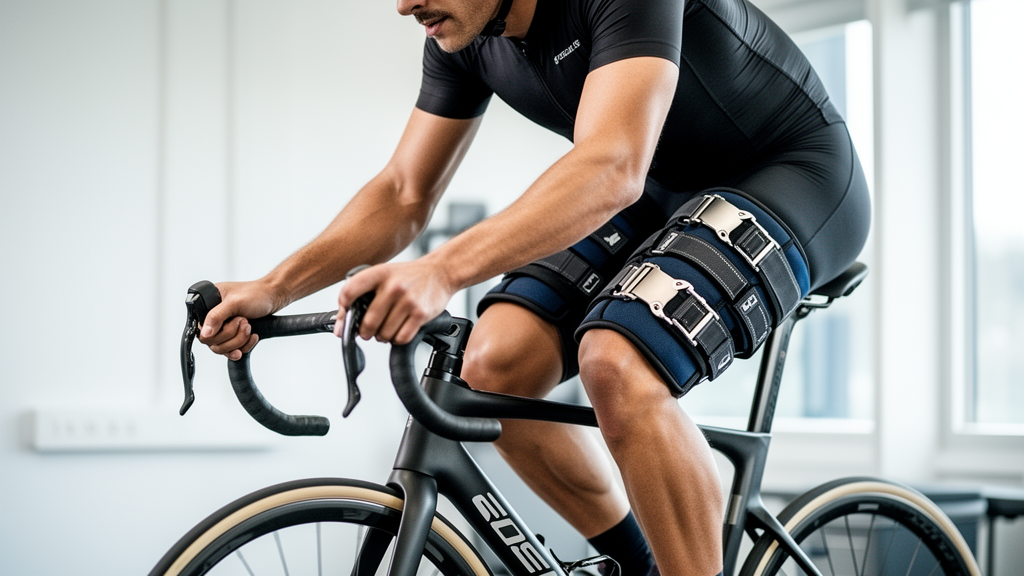
Vascular occlusion was applied using single-chambered, ten-centimeter-wide pneumatic cuffs positioned on the most proximal portion of the thighs. Individual total arterial occlusion pressure was quantified while participants rested in a supine posture using a rapid cuff inflation system coupled with real-time vascular ultrasound imaging of the posterior tibial artery in color Doppler mode. Acoustic coupling gel was applied, and cuff pressure was incrementally elevated until both arterial inflow and venous outflow were visually abolished on the ultrasound display. Pressure was released and re-inflated to confirm complete flow cessation, establishing total arterial occlusion pressure with exceptional reliability, evidenced by an intraclass correlation coefficient of 0.963, a standard error of measurement of 4.8 millimeters of mercury, and a minimal difference threshold of 13.3 millimeters of mercury. For experimental exercise bouts under restriction, cuffs were inflated bilaterally to sixty percent of each individual’s resting total arterial occlusion pressure, providing a standardized occlusive stimulus across all submaximal cycling trials.
During visits three, four, and five, participants completed matched eight-minute submaximal cycling bouts with and without blood flow restriction across three distinct target intensities: at the individual gas exchange threshold, fifteen percent below the threshold, and thirty percent below the threshold. The sequence of testing intensities across visits was randomly allocated using computerized randomization, and the order of completing the restricted versus unrestricted cycling conditions within each laboratory visit was similarly randomized. Prior to each eight-minute trial, participants performed a standardized five-minute warm-up pedaling at fifty watts and seventy revolutions per minute. Following the initial eight-minute cycling bout, participants rested passively in a seated posture on the cycle ergometer for ten minutes without cuff pressure before executing the reciprocal experimental condition. Analysis of variance confirmed that pre-exercise baseline metabolic and oxygenation parameters did not differ prior to the second trial, demonstrating that the ten-minute passive recovery interval provided sufficient physiological clearance between consecutive exercise bouts.
Systemic respiratory gas exchange was recorded continuously using an open-circuit respirometry metabolic cart calibrated with certified gases and a three-liter volume syringe prior to every testing session, with breath-by-breath measurements aggregated into rolling averages and analyzed across sixty-second epochs during the final five minutes of each eight-minute exercise bout. Concurrently, localized muscle oxygenation was tracked at one hundred hertz using a multi-channel continuous-wave near-infrared spectroscopy sensor secured over the right vastus lateralis muscle at seventy percent of the distance between the anterior superior iliac spine and the lateral patellar midline. The optical probe was wrapped in protective barrier film and secured with opaque athletic tape to eliminate ambient light interference and movement artifacts. Skeletal muscle tissue oxygenation was derived via spatially resolved spectroscopy by calculating the percentage ratio of oxygenated hemoglobin relative to total hemoglobin across three optical channels, adjusting for photonic tissue scattering with a differential pathlength factor of four.
Statistical evaluation utilized two-way Bayesian multilevel regression models executed with Markov Chain Monte Carlo sampling in Stan, incorporating fixed effects of intensity and condition alongside random intercepts and slopes to model repeated measures across participants. The Bayesian models confirmed a credible interaction between exercise intensity and blood flow restriction for systemic oxygen uptake, displaying a 95% high-density interval from −0.5 to −0.2. At all three examined workloads, the application of blood flow restriction elicited higher oxygen uptake compared to unrestricted cycling. Specifically, restriction augmented oxygen consumption by a mean difference of 1.0 milliliter per kilogram per minute at the gas exchange threshold, 1.2 milliliters per kilogram per minute at fifteen percent below the threshold, and 1.3 milliliters per kilogram per minute at thirty percent below the threshold, with the posterior distribution indicating a one hundred percent probability of a positive non-zero difference across all three comparisons.
Systemic oxygen consumption closely tracked mechanical work rate across both experimental conditions, increasing progressively from thirty percent below the threshold to fifteen percent below, and reaching highest values at the gas exchange threshold itself. In unrestricted cycling, oxygen consumption rose by 3.0 milliliters per kilogram per minute from the lowest to intermediate intensity, and by an additional 2.9 milliliters per kilogram per minute from the intermediate workload to the gas exchange threshold. Under blood flow restriction, parallel increases of 2.9 and 2.6 milliliters per kilogram per minute were observed across the corresponding intensity steps. These systematic elevations indicate that while external vascular occlusion maintains the linear relationship between work rate and oxygen consumption, it imposes an acute systemic metabolic penalty, requiring exercising individuals to consume modestly greater amounts of oxygen to sustain identical external power outputs on the cycle ergometer.
In contrast to the uniform systemic elevations, skeletal muscle tissue oxygenation exhibited an intensity-dependent interaction with blood flow restriction, reflected by a Bayesian interaction high-density interval spanning 0.3 to 1.2. Applying restriction caused credible reductions in vastus lateralis tissue oxygenation during submaximal cycling below the gas exchange threshold, producing a mean reduction of 1.8 percent at fifteen percent below the threshold and a 1.9 percent reduction at thirty percent below the threshold, with each posterior probability exceeding 99.9 percent. However, at the gas exchange threshold, blood flow restriction did not produce a statistically credible non-zero reduction in muscle oxygenation, yielding a mean difference of −0.9 percent and a 95% high-density interval from −2.0 to 0.1 percent. Within the restricted condition, tissue oxygenation decreased progressively across workloads, whereas in unrestricted cycling, tissue oxygenation did not differ credibly between fifteen percent and thirty percent below the threshold.
The authors discussed that the systemic oxygen augmentations likely stem from localized disturbances in perfusion that impair oxygen delivery, accelerate metabolite accumulation, and promote the recruitment of higher-order type II motor units that possess lower oxidative efficiency, alongside potential hyperventilatory or sympathetic drive. Below the gas exchange threshold, mechanical occlusion constrains arterial inflow and venous drainage, driving greater fractional oxygen extraction and reducing local tissue saturation. At the gas exchange threshold, heavy metabolic demand under unrestricted cycling already elicits substantial deoxygenation, leading to an apparent convergence where restriction induces negligible further optical desaturation.
Subject of Research: Systemic and skeletal muscle oxygenation responses to blood flow restricted cycling relative to the gas exchange threshold in trained women
Article Title: Systemic and local oxygen characteristics during blood flow restricted cycling relative to the gas exchange threshold
Article References: Lubiak, S. M., Howard, M. A., Schmidt, J. T., Fukuda, D. H., Stout, J. R., Keller, J. L., & Hill, E. C. (2026). Systemic and local oxygen characteristics during blood flow restricted cycling relative to the gas exchange threshold. Frontiers in Physiology, 17, Article 1986668. https://doi.org/10.3389/fphys.2026.1986668
Image Credits: AI Generated
DOI: 10.3389/fphys.2026.1986668
Keywords: blood flow restriction, gas exchange threshold, oxygen uptake, muscle oxygenation, cycling ergometry, exercise physiology, near-infrared spectroscopy, vastus lateralis, arterial occlusion pressure, aerobic exercise, ventilatory threshold, Bayesian multilevel models, submaximal exercise, exercise efficiency, metabolic demand, trained females
News Source: Drew Townsend. (November 26, 2026). Blood Flow Restriction Increases Cycling Oxygen Demand While Modifying Muscle Oxygenation. Scienmag.