In a 12-week feeding study in healthy male Swiss mice, adding 10% black soldier fly larval meal to a standard diet reduced the area occupied by lipid droplets in liver tissue and lowered expression of the inflammatory messenger TNF-α. The animals nevertheless gained more weight and had more lean and fat mass than controls, while food intake, glucose regulation, blood lipids and circulating liver enzymes did not differ significantly between the groups. The experiment indicates that the insect ingredient can alter selected aspects of hepatic lipid storage and inflammatory signalling under ordinary physiological conditions, but it does not establish a benefit for human health.
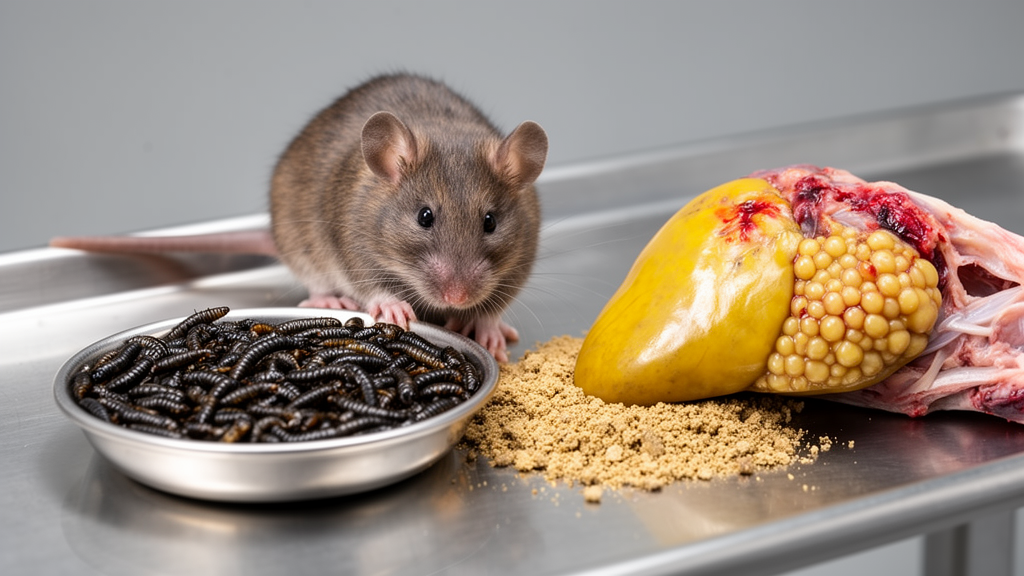
The research, reported in Molecular Biology Reports, used 20 six-week-old male Swiss mice randomly assigned to two groups of 10. One group received the AIN-93 M maintenance diet, while the other received the same diet supplemented with 10% by weight of meal made from late-stage Hermetia illucens larvae. The larvae had been supplied dehydrated, ground into flour and incorporated into the experimental feed. The trial ran for 12 weeks, from December 2024 to March 2025, with researchers measuring weight, food intake, body composition, glucose and insulin responses, blood biochemistry, liver morphology and gene expression.
Analysis of the larval meal found that it was energy dense, containing 34.2 ± 0.62% lipids, 31.8 ± 0.75% protein and 19.9 ± 0.08% available carbohydrate. Its estimated energy value was 514.37 kcal per 100 g, with ash and moisture accounting for 8.2 ± 0.03% and 5.9 ± 0.48%, respectively. The ingredient is also described in the paper as a source of amino acids, fatty acids, minerals, chitin-derived material and bioactive peptides, including lauric acid, which together could influence nutrition, metabolism or immune responses. Those constituents provide possible mechanisms for the observations, although the experiment did not isolate the effect of any individual component.
Animals receiving larval meal gained 17.1% of their baseline body weight, reaching a final mean weight of 46.36 g. Control mice instead lost 3.5%, finishing at a mean of 39.87 g. The area under the body-weight curve differed strongly between groups, with p < 0.0001. Time-domain nuclear magnetic resonance also detected higher fat mass in the supplemented group at p = 0.05 and higher lean mass at p = 0.04. Total body water did not differ significantly, and the investigators found no significant difference in food intake. Because the diets were formulated to provide similar energy levels, the researchers considered the ingredient’s protein and lipid composition plausible contributors to the changes in tissue accretion, but the experiment did not establish which dietary components caused them.
The metabolic tests did not reveal a corresponding deterioration in glucose handling. During an intraperitoneal glucose tolerance test, the area under the glucose curve was similar in the two groups, with p = 0.76. The insulin tolerance test produced the same pattern: no significant difference in the area under the curve, for which p = 0.69. Serum total cholesterol and triglycerides also did not differ significantly, with respective p values of 0.14 and 0.07. Neither aspartate aminotransferase nor alanine aminotransferase activity changed significantly, with p values of 0.39 and 0.09. These null results mean the study did not demonstrate impaired systemic metabolism or blood-based evidence of liver injury over the 12-week period, rather than proving that the supplement has no metabolic effects in other populations or over longer periods.
Most of the liver-specific findings emerged from tissue examination rather than circulating biomarkers. Histological analysis showed that lipid droplets occupied a significantly smaller area in livers from mice fed the supplemented diet, with p = 0.009, even though relative liver weight did not differ significantly. Quantitative reverse-transcription PCR likewise detected lower hepatic TNF-α mRNA expression in the supplemented group, with p = 0.01. The paper interprets this reduction as evidence of attenuated inflammatory signalling. By contrast, expression of fatty acid synthase, or FASN, showed only a downward trend and was not significantly different between groups, with p = 0.16. The molecular results therefore do not support attributing the smaller lipid-droplet area solely to reduced expression of that enzyme.
These findings are notable because earlier work on black soldier fly ingredients had tended to concentrate on animals with obesity-associated liver fat or on immune and antioxidant outcomes in other species. The present study instead examined healthy mice receiving a complete maintenance diet, without inducing obesity, diabetes or another pathological condition. The results suggest that a functional response can appear even in animals maintained under basal physiological conditions. At the same time, the design compared two complete diets and did not include an isocaloric, protein-matched control diet or isolate larval protein, larval fat, chitin, peptides or specific fatty acids. Consequently, the findings cannot determine whether the hepatic changes arose from nutritional substitution, bioactive constituents or the combined effect of the whole larval meal.
The apparent reduction in liver fat also has to be interpreted alongside the increase in total body fat. Hepatic lipid-droplet area is a tissue-level morphological measurement, whereas body fat was estimated by whole-body nuclear magnetic resonance, and the experiment did not report the destination or metabolic fate of lipids. The authors note that related studies have linked black soldier fly-derived lipids with lower hepatic lipid accumulation and have highlighted medium-chain fatty acids, particularly lauric acid, as candidate mediators. The current experiment, however, did not measure lauric acid exposure, fatty-acid oxidation, lipid flux or pathways that could directly connect the supplemented diet to the histological change. Its supported conclusion is therefore limited to a measured association between the diet and selected liver outcomes.
Only male mice were used, each group contained 10 animals, and the experiment covered a single supplementation level for one 12-week period. There was no long-term follow-up, clinical outcome, dose-response comparison or assessment of effects across sexes, ages or disease states. The larval source, processing method and analysed nutritional profile were specific to the material used, which means results may not transfer directly to other meals or commercial products. A separate limitation is the breadth of the mechanisms inferred from the tissue data: reduced TNF-α mRNA is consistent with lower expression of an inflammatory signal, but it is not direct evidence of improved liver function, absence of inflammation or protection from human disease. Random assignment strengthens the comparison, while the small sample limits precision and generalisability.
Overall, the mouse experiment provides a measured proof of concept for black soldier fly larval meal as an ingredient that can influence liver lipid storage and inflammatory-marker expression even when animals are not in a disease-associated model. It also shows that greater weight gain and tissue accretion can occur without detectable changes in glucose tolerance, insulin sensitivity, serum lipids or liver-enzyme activity over the study period. The authors call for further mechanistic and long-term studies to clarify the metabolic effects and possible applications. Until that evidence is available, the results are best understood as an animal finding rather than a clinical recommendation or evidence that black soldier fly meal improves human liver health.
Subject of Research: Effects of black soldier fly larval meal on body composition, hepatic lipid storage and inflammatory-marker expression in mice
Article Title: Dietary supplementation with black soldier fly (Hermetia illucens) larval meal modulates hepatic lipid homeostasis and reduces TNF-α expression in mice
Article References: de Oliveira Ferreira, L., Filho, M. S. S., Simões, K. C. M., Farias, L. C., Guimaraes, A. L. S., de Paula, A. M. B., Barcala-Jorge, A. S., Cota, J., Andrade, J. M. O., & Santos, S. H. S. (2026). Dietary supplementation with black soldier fly (Hermetia illucens) larval meal modulates hepatic lipid homeostasis and reduces TNF-α expression in mice. Molecular Biology Reports, 53(1), Article 1478. https://doi.org/10.1007/s11033-026-12657-2
Image Credits: AI Generated
DOI: 10.1007/s11033-026-12657-2
Keywords: black soldier fly, insect meal, mouse nutrition, liver lipids, TNF-alpha, body composition, insulin sensitivity, glucose tolerance, sustainable food, animal study, Dietary, supplementation
News Source: Daisy Hatcher. (October 25, 2026). Black soldier fly meal alters liver fat and inflammation in mice. Scienmag.