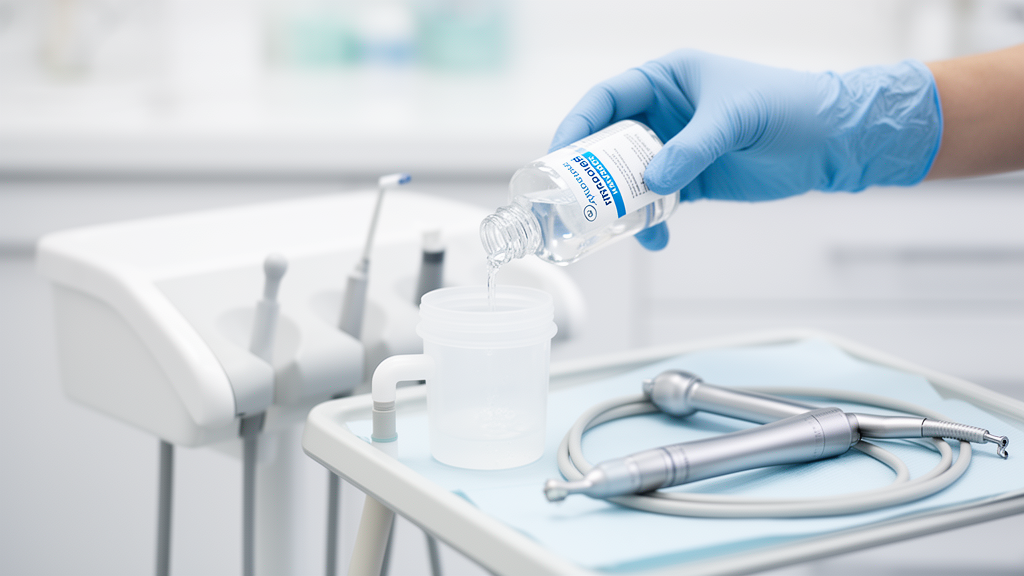
Every time a dentist activates a high-speed handpiece, the water spraying through the mouth of a patient has traveled through meters of narrow plastic tubing hidden inside the dental chair. Those lines are warm, damp, and nearly stagnant between appointments, which makes them ideal incubators for bacteria. In a new randomized pilot study conducted at a dental teaching hospital in Beijing, researchers report that simply tightening the schedule of periodic high-concentration hydrogen peroxide disinfection from every three weeks to every two weeks kept dental unit waterlines within a strict microbial limit for the entire monitoring period, while the three-week schedule repeatedly failed. The findings, published in Frontiers in Oral Health, offer a practical clue for clinics struggling with one of dentistry’s most stubborn infection-control problems.
Dental unit waterlines, or DUWLs, are the narrow-bore tubes that supply water to handpieces and air-water syringes. Their small diameter and convoluted geometry favor nutrient deposition, microbial adhesion, and ultimately biofilm formation, a slimy matrix in which bacteria become far more resistant to disinfectants. Patients and dental staff are exposed to the microbes in this water through direct contact and through aerosols and splatter generated during treatment. Guidelines from the United States Centers for Disease Control and Prevention recommend that dental treatment water contain no more than 500 colony-forming units per milliliter, but surveys around the world repeatedly find contamination far above that threshold, sometimes including opportunistic pathogens such as Pseudomonas aeruginosa and Legionella species. In China, the national dental association has gone further, setting a stricter limit of 100 CFU/mL for treatment water.
Physical measures such as anti-retraction valves, routine flushing, and improved tubing materials can slow microbial proliferation, but they cannot reliably strip away biofilms once they are established inside narrow lines. Chemical disinfectants, including sodium hypochlorite, hypochlorous acid, and hydrogen peroxide, are therefore widely used. Hydrogen peroxide has particular appeal: it kills a broad range of microbes, acts quickly, breaks down into water and oxygen, and is relatively low in toxicity. Its weakness is instability, meaning its antimicrobial effect fades over time. Professional guidelines consequently recommend pairing continuous low-level dosing with periodic high-concentration shock disinfection, and manufacturers typically suggest a four-week shock interval.
That recommendation has not always held up in real clinics. A clinical study in China using the standard four-week regimen achieved only 89.9 percent compliance after 25 weeks, with bacterial counts regularly climbing during the third week of each cycle. An earlier pilot by the same research team found that weekly and biweekly hydrogen peroxide shocks both achieved perfect water-quality compliance, while a triweekly schedule reached only 68.42 percent. Weekly shocks, however, are difficult to fit into busy dental practices. The team therefore designed a randomized comparison of the two most feasible candidates: shock treatment every two weeks versus every three weeks, both layered on top of continuous low-concentration disinfection.
The study ran from May to August 2024 and involved eight dental chair units, four from prosthodontics and four from general dentistry, all equipped with automated flushing and disinfection systems. The units were assigned by department-stratified randomization to Group A, receiving triweekly shocks, or Group B, receiving biweekly shocks. Before any disinfection protocol began, all eight units underwent a standardized biofilm removal procedure using a commercial Biofilm-Removing-Set, following an ISO standard test method, to restore the waterlines to a near-original state. This baseline reset is critical, because residual biofilm from years of use could otherwise confound comparisons between maintenance schedules. After the procedure, the highest bacterial count in any unit was just 58 CFU/mL.
Throughout the six-week disinfection phase, the automated systems continuously mixed municipal water with a 1.41 percent hydrogen peroxide concentrate at a ratio of 100:1, delivering a constant 0.0141 percent concentration in the treatment water. Shock treatments involved filling the lines with undiluted 1.41 percent solution for a 24-hour dwell over the weekend, followed by flushing and drying. The researchers collected 424 water samples in total, drawn from high-speed handpiece and air-water syringe outlets three times per week, with each sample neutralized immediately to eliminate residual peroxide before culturing. Sample collectors and laboratory assessors were blinded to group assignment, and colony counting was cross-checked by two independent assessors.
The results were striking. Group B, with biweekly shocks, achieved a 100 percent compliance rate, with all 144 samples staying below 100 CFU/mL. Group A, on the triweekly schedule, managed only 78.47 percent compliance, and its bacterial counts followed a telltale rhythm: low for the first two weeks after each shock, then rebounding sharply during the third week of every cycle. Using a statistical model that accounted for repeated measurements within each chair unit, the researchers calculated that biweekly shocking increased the probability of compliance by 21.53 percentage points, a difference that was highly significant. Measurable divergence between the groups appeared as early as day 17 of the study.
An exploratory extension followed one randomly selected chair from each group for an additional six weeks, stretching the observation to twelve weeks. The biweekly unit remained compliant throughout, although counts showed a gradual upward drift in the final sampling period. The triweekly unit repeatedly crossed the compliance threshold during the third week of several cycles, though the peak counts appeared to decline in later cycles, a pattern the authors attribute to unit-specific variation or stochastic fluctuation rather than a genuine trend. Scanning electron microscopy of excised handpiece tubing added visual weight to the numbers: after six weeks, the triweekly unit’s tubing showed renewed dense accumulations of rod-shaped structures embedded in matrix-like material, morphologically consistent with biofilm, while the biweekly unit’s tubing showed no obvious mature biofilm-like structure, only scattered particles whose biological nature could not be confirmed by microscopy alone.
The authors are careful to frame these findings as preliminary. The study was small, single-center, and conducted over a single summer in Beijing, and waterline contamination can vary with source water quality, temperature, patient volume, and local maintenance practices. Total viable counts quantify only culturable bacteria and cannot identify specific pathogens or detect viable-but-nonculturable organisms, so the results say nothing definitive about whether dangerous microbes were present or absent. The SEM observations were qualitative and limited to small tubing segments. The researchers emphasize that the biweekly regimen should be considered a candidate strategy requiring validation in larger, multicenter, year-round studies with microbial identification, quantitative biofilm assays, and molecular analyses, not an immediate replacement for existing protocols.
Even so, the study carries practical weight for infection-control teams. It demonstrates that the timing of shock disinfection, not just the choice of chemical, can determine whether water quality holds or slips, and it pinpoints the third week after a shock as the vulnerable window when compliance is most likely to fail. It also highlights the value of a standardized baseline biofilm removal before comparing maintenance regimens, a step many clinics skip. For dental practices operating under stringent water-quality standards, the message is that a modest increase in disinfection frequency, from every three weeks to every two, may be the difference between consistently safe water and a system that quietly drifts out of spec between treatments, an outcome worth the added workload while larger trials catch up.
Subject of Research: Hydrogen peroxide shock disinfection schedules for controlling microbial contamination and biofilm in dental unit waterlines
Article Title: Biweekly versus triweekly hydrogen peroxide shock treatment for controlling dental unit waterline contamination: a single-center pilot randomized clinical study
Article References: Biweekly versus triweekly hydrogen peroxide shock treatment for controlling dental unit waterline contamination: a single-center pilot randomized clinical study. (n.d.). https://doi.org/10.3389/froh.2026.1842649
Image Credits: AI Generated
DOI: 10.3389/froh.2026.1842649
Keywords: dental unit waterlines, hydrogen peroxide, biofilm, disinfection, infection control, water quality, dental clinics, randomized clinical trial, total viable counts, scanning electron microscopy, shock treatment, oral health
News Source: Ophelia Keating. (October 16, 2026). Biweekly Hydrogen Peroxide Shocks Keep Dental Waterlines Cleaner Than Three-Week Intervals. Scienmag.