Credit: Photo Sjouke Anne Kingma
Birds will sometimes care for the offspring of other birds of their own species if they anticipate future benefits. Being tolerated in another bird's territory and the chance to inherit that territory later are considered rewards for which some birds are willing to postpone their own chance of reproduction. On 23 October 2017 veni researcher Sjouke Kingma from the University of Groningen has published an article on this subject in Nature Communications.
In almost ten percent of bird species around the world, certain individuals postpone their own chance of reproduction to help birds of the same species to care for their offspring. This behaviour has also been observed in certain mammals, fish and insects. Since the days of Charles Darwin, biologists have assumed that all creatures are selfish, and do everything they can to maximize the chance of passing their genes to their offspring. So why do some birds sacrifice themselves for the sake of others? What do they gain by not producing their own brood and wasting energy to help others?
Relations
One hypothesis is that they only help their relations, i.e. younger brothers and sisters with whom they share their genes. This is thought to be a way for the helpers to pass on their genes, without reproducing themselves. In a recent study, evolutionary biologist Sjouke Kingma refutes this widely accepted vision by showing that these individuals are also trying to improve their own future prospects. Kingma compared 44 species of birds, some of which help other birds while denying themselves their own brood. Although some birds only help family members, his research showed that a lot of birds are even more keen to help non-family members if they stand to inherit their territory in the future.
Territory
Kingma concludes: 'Birds see their territory in the same way as we see our house. Some species of "home-owners" allow other birds to live in their territory and help them to care for their offspring. This may seem logical if the birds living in the same territory and helping each other are related. But this isn't always the case.
My research reveals that the home-owners get much more help if the helpers stand to inherit their territory in the future. After all, you'd be much more inclined to help someone maintain their home if you thought you'd inherit it one day. This is precisely what a lot of birds do: they help the current owner so that the territory will be worth more when they inherit it.'
Future helpers
Kingma sees two benefits in this principle. 'Showing that you're prepared to help increases the chance that the nesting pair will tolerate you in their territory, which may ensure that you inherit the territory later on. In addition, if you help with the current owners' kids, you'll create your own future little helpers. By the time the territory is handed over, the helpful bird will have its own army of little helpers ready and willing to assist.'
Planning
The concept of helping each other is not strange to humans, but biologists have been puzzling about why wild animals would do this. This research shows that animals are capable of planning and modifying their behaviour to achieve future goals.
###
Note to the editors
– Direct benefits explain interspecific variation in helping behaviour among cooperatively breeding birds, Nature Communications, 23 October 2017. DOI 10.1038/s41467-017-01299-5.
– Contact: Dr Sjouke Kingma, GELIFES — Groningen Institute for Evolutionary Life Sciences of the University of Groningen, http://www.rug.nl/staff/s.a.kingma
– Kingma's research was funded by a Veni grant from the Netherlands Organisation for Scientific Research (NWO).
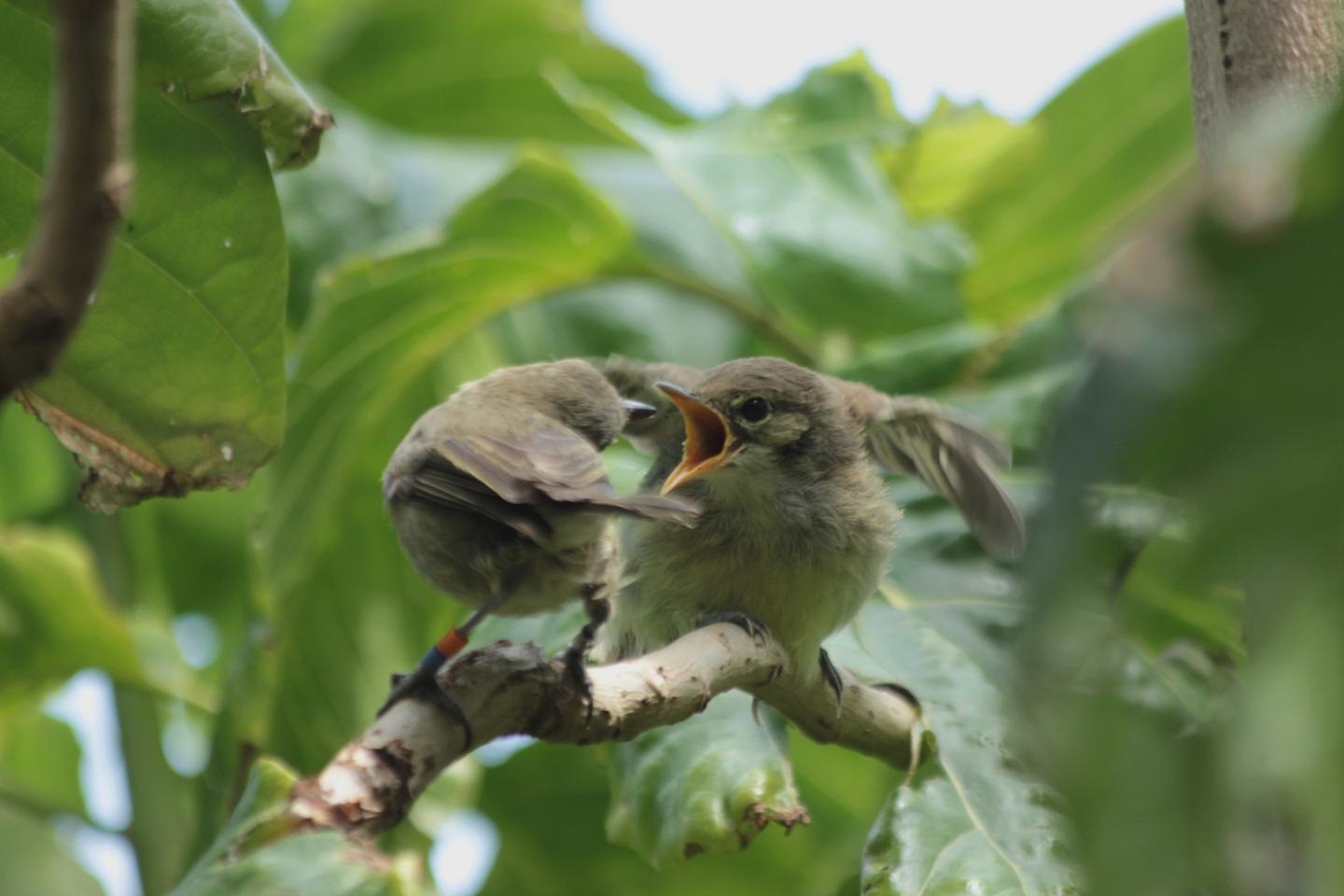
Illustration: Babysitting for the Seychelles warbler, a species that has been monitored for over thirty years. Photo Sjouke Kingma
Media Contact
Sjouke Kingma
[email protected]
31-068-359-6786
@univgroningen
http://www.rug.nl/corporate/index
Related Journal Article
http://dx.doi.org/10.1038/s41467-017-01299-5